2007
Keith Herber discusses how in his "Haunted House" scenario for Call of Cthulhu, characters are driven insane by their attempt to unravel the game's mysteries. Herber's explanation distinguishes his work from many other role-playing games in which the goal is to develop characters and acquire power and/or wealth. In contrast, characters in Herber's scenario are rewarded with mental instability.
Lori Emerson introduces a gathering of nineteen electro-poetic essays. This gathering brings together both critics and creators of electronic poetry; as is usually the case in ebr, the 'electronic' does not exclude, but helps us to reconfigure and revalue poetic works in print as well as define what works in digital environments.
Eugene Thacker resituates the work of Eduardo Kac, not as art applied to the life sciences, but as a form of bio-poetics, consistent with the electro-poetics that has been a longtime focus of critical writing in ebr. Rather than reduce the work to its material (in life-forms, or in text, or in code), Thacker identifies ways that language, form, and life intersect in works of bio-art.
Rowan Wilken sets himself the challenge of theorizing the unrepresentable in relation to the architectural model of the diagram.

As I thread my way through ebr, I touch base with the artificial intelligentsia that my work circulates in. The artificial intelligentsia is an internetworked intelligence that consists of all the linked data being distributed in cyberspace at any given time, one that is powered by artistic- intellectual agents remixing the flow of contemporary thought.
Jerome McGann addresses the so-called "Crisis in the Humanities" in the context of two of its most apparent symptoms: the digital transformation of our museums and archives, and the explicitly parallel "Crisis in Tenure and Publishing" that has more recently come to attention.
2006
Entering the 'cyberdebates' initiated by Nick Montfort, John Cayley, and Rita Raley, new media scholar Mark Marino proposes that we should analyze and explicate code as a text like any other, 'a sign system with its own rhetoric' and cultural embeddedness.
Joseph Tabbi introduces the thread and gathers prior essays by fiction writers on fiction writing.
Rob Swigart asks why we keep hearing about a technological fix (dubious) and rarely about adaptation as a viable response to global warming.
This review of Ralph Berry's novel Frank and the subsequent exchange between the authors, appeared in the March/April 2006 and July/August 2006 issues of The American Book Review.
2005
Jokes play a fundamental role in Slavoj Žižek's philosophizing. Is Žižek joking when he extols the virtues of Christianity to the Left? Eric Dean Rasmussen analyzes Žižek's pro-Christian proselytizing as attacks on modes of PC-ness - political correctness and perverse Christianity - that sustain an undesirable neoliberalism.
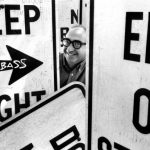
1999 e-literature award winner John Cayley writes about Saul Bass of classic film title fame. A precursor to language arts innovators Jenny Holzer, Richard Kostelanetz, and Cayley himself, Bass may now be recognized as a poet in his own 'write,' important for a new generation of designwriters creating "graphic bodies of language," moving words and signifying images, in digital environments.
Scott Rettberg, responding to "The Pixel/The Line" (section 4 of First Person) wonders whether electronic writing isn't evolving into a subspecies of electronic art, one that uses words as material, 'just as sculptors use clay.'
Now that the First Person essay collection is complete and the case has been made for computer games as a form of narrative, Brian Kim Stefans asks the fundamental questions - concerning what can be read as literature, and what really cannot.
Jill Walker's encounter with a participatory, and vaguely sinister, online narrative.
Warren Sack uses The Conversation Map, a "graphical interface" that analyzes newsgroups and listservs, to analyze the possibilities of discourse analysis itself.
The subtitle - "Using Voice Chips and Speech Recognition Chips to Explore Structures of Participation in Sociotechnical Scripts" - tells the story, partly. But there's more in store.

Carolyn Guertin surveys the politics of Hacktivist women.
Is there such a thing as womens' writng? Or, for that matter, womens' media? Elisabeth Joyce moves through the work of Annie Abrahams and writes against restrictive domestications of electronic media.