2004
John Cayley dadas up the digital, revealing similarities of type across two normally separate, unequal categories: image and text. "Neither lines nor pixels but letters," finally, unite.

Camille Utterback exposits "embodied interaction with symbolic spaces" – the body and language of digital art.
The parallels (and oppositions) between hypertext and AI are brought out in section five.
J. Yellowlees Douglas and Andrew Hargadon on the affective side of hypertexts via "schemas, scripts, and the fifth business."

Dave Ciccoricco returns to Stuart Moulthrop, considers Operation Enduring Freedom (2003) in light of Operation Desert Storm (1991), and consults the annals of World War II for a likely source of "Victory Garden," the title of Moulthrop's 1991 network fiction on the Gulf War.
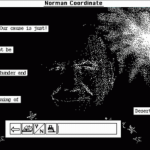
Matthew Kirschenbaum rethinks the final section of First Person in light of "five basic strategies for furthering the history of reading."
Henry Jenkins uses narrative space to distinguish between different tale-ends.
Jesper Juul maps the "flow" state of gameplay onto innerspace and elsewhere.
Applying games to games, Celia Pearce uses The Sims to showcase six keywords.
Eric Zimmerman whips "four naughty concepts" into disciplinary shape.
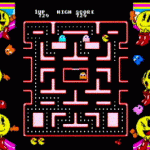
Slavoj Žižek addresses the situation of post-9/11 global politics - and his own, controversial, theories of the political - in this interview with Eric Dean Rasmussen.
Jane McGonigal goes mobile with a "transformational agenda" shift for Cyberdrama.
Do violent games train us for violence? Drawing on social psychology and cognitive science, Simon Penny examines the "ethics of simulation."
Gonzalo Frasca's proposal for videogames that address "critical thinking, education, tolerance, and other trivial issues."
Phoebe Sengers discusses the Expressivator and socially situated AI.
Bill Seaman hyphenates the "hybrid-languages" of Lexia to Perplexia.
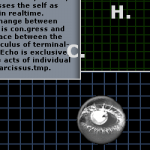
Eric Zimmerman modifies Gonzalo Frasca's game strategy with a strategic patch.
2003
Reiichi Miura considers the worldwide reception of Japanese writer Haruki Murakami and charts a course for a fiction where nationalism loses relevance.

Katie King on the challenges and rewards, in her own life and the lives of her students, that emerge when writing about personal encounters with technology.
Pattern, absence, routine, return - Dave Ciccoricco mulls the shape(s) in Michael Joyce's new paper novel, Liam's Going