2026
Steve Tomasula's Ascension refuses to let the novel sit still, weaving a plethora of multimodal practices into a form that insists reading is a physical, perceptual act. Saidi argues that identity and reality in the novel are never found but perpetually assembled by a reader who cannot remain passive.

A poem that encrypts itself after one reading, a videogame-poem that exists only in the contingency of play, an augmented-reality sequence that vanished with its platform: Foscolo argues that disappearance is not a problem digital literature faces but a formal principle it has learned to inhabit.
The word "prompt" carries three histories at once: the teacher's assignment, the command line's blinking caret, and the natural-language input to a large language model. This essay reads all three together to argue that prompting is not purely programming but something that sits uneasily in the contact zone between code and natural linguistic expression.

When you read code, you can interpret it, or you can trace it, and these are not the same thing. Arakawa proposes verificational reading as a distinct epistemic practice, one whose validity rests not on critical persuasion but on what the code actually does when it runs.
Providing insight into posthuman narrative strategies, Laura Shackleford analyses Steve Tomasula's novel Ascension (2022) for relational points of interest. Who or what is ascending who or what, and to what end?

This essay by Cristina Luli analyzes and compares Steve Tomasula's short story "A Farewell to Kilimanjaro" (1993) to Ernest Hemingway's "The Snows of Kilimanjaro" (1936), bringing to light the embeddedness of media ecology and the materiality of storytelling.
In literature, as in science, how humans emerge remains a continuous matter of engagement. In this article, Claudia Desblaches looks at the emerging scales of human representation in Tomasulas' The Atlas of Man.
Being a reader of Steve Tomasula for the past 30 years means following formally and materially innovative works of art and literature that contribute to a technological reshaping of the posthuman condition. Mary K. Holland, reminded in a waiting room in 2015 of Tomasula's impact on her own critical thinking, reflects on the eerie connections in 'fi about sci, not sci-fi'.
In this provocation, Maud Bougerol analyzes the teetering of boundaries in Steve Tomasula's "The Color of Flesh" (2015) where the reading experience lingers between linearity and non-linearity, and words and images transgress their usual thresholds.
In challenging the tools and materials that make up a narrative, Hanna Hadjadj interrogates the representational aspects of cultures and communities in Tomasula's short story "The Risk-Taking Gene as Expressed by Some Asian Subjects" (2013).
Different mediums explore our contemporary experience in alternative ways. The novel, through its many different perceptions and iterations, has a rich history in which David Banash places Tomasula's work as both timely and needed
With a first-hand experience of observing and participating in the inception of the internet and early machine writing, Steve Tomasula reflects on his and Joseph Tabbi's interconnected history within a new form of the sublime. Using Tabbi's collected works as a framework, Tomasula explores the posthuman experience of narrative architecture.

Stuart Moulthrop's meditation on AI artistic production explores the pareidolia at play in human interactions with generative models while arguing, via Wim Wenders' Until the End of the World (1991) and Greta Gerwig's Barbie (2023), for a loving approach to humanity's newest tools.
2025
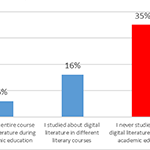
Eman Younis and Hisham Jubran's study investigates Arab university students' exposure to digital literature and their attitudes toward it. In doing so, they discover students feel the inclusion of digital literature in university-level literature courses should be a scientific necessity and that its absence in the curriculum compromises their professional development.
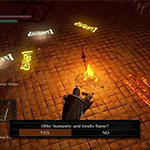
Austin Anderson applies a videogame formalism methodology to Dark Souls and argues that the game's various ludic-textual structures challenge player expectations, encouraging them to engage with the game's multiplayer systems and explore fan-made paratextual materials. By defining the player's movement between these structures as an act of hyperlinking which creates a networked community, Anderson identifies these as key characteristics of what he calls the 'networked hyperlinked videogame'.
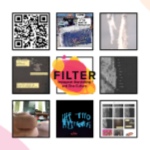
Sarah Whitcomb Laiola and Richard Snyder share their experience of cataloguing Instagram 'zine Filter for a travelling exhibition with The NEXT, the Electronic Literature Organisation's museum, library, and preservation space. Arguing that platforms are not merely tools for distribution but shape the very literariness of a work, Laiola and Snyder suggest that e-lit archival practices must evolve to recognize and account for the integral role contemporary social media platforms can play.
Tuuli Hongisto explores the problems of cyborg authorship through the presentation of ChatGPT as a co-author of literary works on Amazon. Rather than shying away from admitting that an AI took part in the writing process, these authors position ChatGPT and other LLM's as authors with their own rights, rather than tools.

Experimental storyteller and digital artist Mez Breeze explores the liminal spaces of The Backrooms, a found footage web series which is based on a popular creepypasta of the same name. In doing so, Breeze confronts the feelings of alienation and predation inherent to late-stage capitalist society.

Part 2 of Philippe Bootz's exploration of the procedural mode in digital literature, continued from part 1.
2024
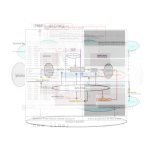
Phillipe Bootz defines and situates a set of artifacts, devices, material components and human groups that are in contact with earlier procedural "dispositifs." The procedural model, in Bootz's 30 year long research, analyses, theoretical frameworks and observations, expressly distinguishes human beings from material components. In opposition to artificial/human proposals such as the trans-human or the cyborg. The dispositif, in Bootz's presentation, only concerns the physical world. It does not contain signs, is not concerned with literature or art. And neither are individuals, within the procedural model, considered for themselves. They are actors at a given moment. Their positions are characterized by their power to directly act on the artifacts and objects of the dispositif.