Materially Representing a Minority: styles of representation in Steve Tomasula’s “The Risk-Taking Gene as Expressed by Some Asian Subjects”

In challenging the tools and materials that make up a narrative, Hanna Hadjadj interrogates the representational aspects of cultures and communities in Tomasula's short story "The Risk-Taking Gene as Expressed by Some Asian Subjects" (2013).
Steve Tomasula’s short story “The Risk-Taking Gene as Expressed by Some Asian Subjects” (published in Once Human, 2013) humorously subverts the Latin phrase “in medias res.” Both intertwined narrative voices do indeed start “in the middle of things,” but instead of those “things” being solely their respective plots, the design of the story also places readers in the middle of multimodal styles of representation and therefore interrogates the material means of the short story. One of the voices, which I shall henceforth refer to as “the scientist’s,” guides readers’ attention to materiality in the sense that the story diegetically refers to concrete objects with the opening line, “Their shirts had the uniform neatness of suburbia: chemically fortified green, polo” (173). The lack of antecedent for the possessive adjective guides our attention to palpable material artifacts instead of the identification of characters. This focus on material artifacts expands extradiegetically towards a focus on the medium of the short story with the introduction of the second narrative voice, which I shall henceforth refer to as “Tommy’s.” His first line, “Shit! — have you ever been kung-powed by a piece of paper? —wham! — fist-of-the-dragon worthy of Bruce Lee” (180) signals not only a linguistic shift in tone, but also a visual one. The scientist’s ubiquitous Times New Roman font (although already somewhat offset by a blue grid and blue highlights as a background) gives way to Courier and storyboard-like drawings, as well as timestamps between brackets (see figure 1). The “graphic surface” (White) of the short story is therefore defamiliarized and brings readers “in the middle of” the materiality of storytelling pointing to the main tension of the short story, which this article will explore: conflicting styles of representation. Those styles are embodied by two narrative and stylistic voices (the scientist’s and Tommy’s) which I consider expand beyond the purely linguistic aesthetic to also include typographic and visual materials on the page, as well as the diegetic attention to different material qualities of the subject of representation by each character. I shall argue that the opposition of those voices creates a critical interrogation of representational modes, in particular when they are applied to the representation of social minorities.
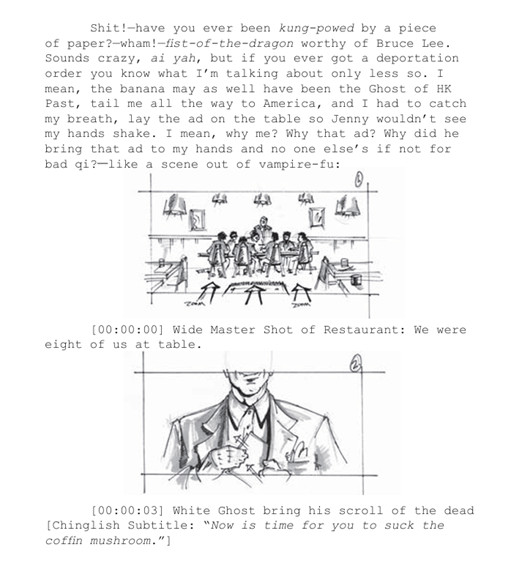
The story opens with the point of view of an unnamed young geneticist who, as per the title, is trying to identify the gene for risk-taking, specifically in the Asian community of Chicago’s Chinatown. Through his eyes, the story creates a pointillistic portrait of this community through their sole genetic material. He tries to recruit different subjects for his study so that he can obtain DNA samples that he will use to attempt to determine whether they possess “variations in the DNA coding sequence of the D4 receptor, a forty-eight base-pair sequence that controls clozapine and spiperone binding, especially when it appears as an eightfold repeat” (187). His recruitment methods have so far failed. He attempted to publish an article in the journal “The Chinatown Lantern” to attract potential participants, but few came forward. Ultimately, he realizes that the approach cannot be productive, as those willing to take risks are unlikely to read the publication or volunteer for such a project. As he is eating in a Chinese restaurant, Three Happiness, he encounters a group of eight individuals whom he interprets as dangerous men who look at him in murderous ways and who must be part of a tong, that is to say members of “a secret society or fraternal organization especially of Chinese in the U.S. formerly notorious for gang warfare” (“Tong”). For that reason, he gathers the courage to hand his newspaper advert to the person he identifies as a leader.
A shift of point of view and in the graphic manifestation on the page introduces this leader’s (henceforth referred to as Tommy) internal focalization. He is a self-declared “filmmaker,” born in Hong Kong, schooled in England as a child, then in Hong Kong for his higher studies. He has found a way to make money by bootlegging kung fu films, either by reshooting entire movies or by going into cinemas and filming the screens, already prefiguring diegetically the multimodal way his character is portrayed on the page through storyboard images. His “Risk-Taking” behavior has led him to work for one of his university professors as a thief for rare Chinese calligraphy in specialized libraries. The story makes no mention of how he came to live in the United States, or what he does there beyond the projections of the scientist. Tommy is highly interested in movies, and he sees his interactions as movie scenes, hence the association of his voice with specific typeset and the specific types of images on the page. The cinematic world and modality are indeed established as a specific materiality of the page, opposed to the means of representations that the scientist sets forth. The conflict between Tommy and the scientist exceeds their styles of representation of the Asian community and appears to be interpersonal as well, which I would claim reiterates the problems of representation. Tommy indeed expresses his contempt for the scientist (of Japanese descent) by calling him the racist slur “banana”: “an ethnic slur referring to an individual of Asian ethnicity now living in the West. Denoting someone perceived as ‘yellow on the outside and white on the inside’” (Fee and Webb 74). Tommy does agree to take part in the scientific study, although indirectly, as instead of offering his own blood sample, he hands the scientist different samples of bloodied gauze, trying to, in his terms, find the one “without balls” (188) and the one “who always thought he could piss with the big dogs” (188).
This article argues that materiality is questioned at different levels in this short story. Each character’s point of view appears on the page in a distinct way through different textimage (Mitchell 89) means and therefore multimodal material means: a kung fu script, a pseudo-scientific experiment with a very specific graphic surface, graph paper, or bubble answer sheets. Diegetically, the characters focus on different materials as well, in this instance, meaning the elements they are trying to identify as markers of identities, one of them is trying to identify the minute bodily material markers that is DNA, whereas the other aims for a more cultural identifier through his references to the specific cinematic culture of kung fu. Hence my focus on the extent to which materialism effectively represents “Asian subjects.” This article will explore the diverse nature of those materials (from language to visual presentation; from art to DNA) to wonder whether there can be any truth to either of those representations.
Parodying the Scientific Style of Representation
The collection Once Human has already set up an economy in which certain discourses are entirely parodied. The first short story, “The Color of Flesh,” has already made a parodic or an ironic use of the judicial narrative, with the final page claiming that the main character Yumi’s artificial leg has been used “in ways wholly consistent with kicking.” The story that comes before “The Risk-Taking Gene” is titled “The Atlas of Man”: a story in which Dr. Johnson is trying to identify personality types as linked to soma type, with very limited results. The collection has therefore already initiated a critical and humorous examination of the language of scientific discourse.
Imitation of the Language and Codes of Medical Sciences: a Parodic Signal?
In “The Risk-Taking Gene,” the scientific discourse is entirely ridiculed, leading to a failure of fictional science, despite (or perhaps precisely because of) a meticulous imitation of the language and codes of medical science. The title “The Risk-Taking Gene as Expressed by Some Asian Subjects” might be reminiscent of geneticist publications about the genomics of personality traits, a subgenre of the “Gene Wide Association Study” of the late 1990s and early 2000. The restriction to “Some Asian Subjects” is justifiable by geneticists’ need to find a group of people with minimal genetic diversity. This justification is relayed by the fictional scientist in the story, who serendipitously identifies the group of people sitting next to him as a “homogenous population”:
I watched my table neighbors for these signs, taking comfort in the fact that they were the very sort of homogeneous population needed for my study. Like the Amish. Though the relatively low percentage of Risk-Takers believed to live among the Amish precluded my use of this group.
Not so the Chinese (175-176).
This identification proves to be both prejudiced, imprecise, and as limited as the fragment sentence simile “Like the Amish,” which recreates at the sentence level the monolithic observations the scientist offers, and continues to offer about the second population included in a fragment sentence, “Not so the Chinese.” However, as limiting as it is, the impulse to find a restricted group of people is supported by peer-reviewed sources that can often be fact-checked, meaning the narrative voice integrates codes of scientific discourse that go beyond the mere scientific vocabulary of those few lines (“homogenous population,” “relatively low percentage”), even when integrating references narratively and not in an overtly scientific typography. Those references are indeed not footnotes or integrated in a separate biography or following any kind of predetermined style guide but are merged in the explanations. For instance, the fictional scientist defines the “Risk-Taking gene” as
the genetic propensity discovered by Cloninger, Adolfsson and Svrakic for some people to put themselves at risk in order to feel the level of arousal most of us get from the petty concerns of our day—a disagreement with a co-worker, for example, or walking into a restaurant and discovering that it wasn’t as nice as we had expected (174).
This seems to be a reference to the article “Mapping Genes for Human Personality,” published in Nature Genetics, in January 1996 by Robert Cloninger, Rolf Adolfsson and Nenad Svrakic (Cloninger et al.). The fictional scientist later “explained the Zuckerman Personality scale for Sensation Seeking that Ebstein, et al. developed into the Tri-Dimensional Risk-Taking Index (RTI)” (186) which corresponds to an article published in the Journal of Consulting and Clinical Psychology, titled, “What is the sensation seeker? Personality trait and experience correlates of the Sensation-Seeking Scales” (Zuckerman et al.). All in all, then, although these elements are incorporated into a fictional story, the “fictional science” does seem to hold its weight.
Nevertheless, scientific discourse is rendered inoperative and even humorous because of its incongruous development in a literary context, and the scientist’s lack of awareness of the literary effects of his use of the discourse. Counting members of a family, he comes to the conclusion that there is “a Family Unit with n members where FUn=╧Ç (the mother was pregnant)” (173), seemingly unaware of the homophone “fun pie,” and of the absurdity of counting a group of people with an irrational number. More generally, it is incongruity and displacement that make this case of fictional science absurd. That discourse is failing before it even begins because its cultural codes occasionally get in the way of obtaining visual elements from the story. In other words, the graph paper background or the bubble answer sheet creates visual constraints that are akin to the logic of displacement. This includes the fact that the line spacing of the printed text does not correspond to the graph paper background, creating a literal misalignment. The background materials cause the need for extra effort to get to the text, on top of the hyper attention needed to decipher specialized scientific vocabulary. The double scientific decorum (linguistic and visual, see figure 2) therefore contrasts with the “practical stuff” (187) that the counterpoint narrative voice of Tommy craves.
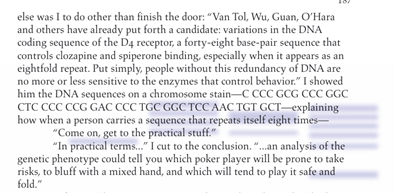
In this passage, Tommy expresses his frustration at the abundance of scientific words in the scientist’s explanations, by ordering, “Come on, get to the practical stuff” (187). However, instead of creating another mode of presentation of scientific endeavor, the scientist’s praxis is also the subject of parody.
Pattern Recognition ad absurdum, Displacing Scientific Methods for Humoristic Purposes
If the scientific presentation is becoming comical because of its incongruity, so is the scientific reading grid. The pattern recognition that the scientist claims to derive from his scientific method seems questionable and potentially exaggerated. Throughout the story, at multiple points, the scientist misreads situations, sometimes leading him to absurd conclusions. From beginning to end, his understanding of the world is biased by his pattern recognition methodology.
We can see this thought process in action when he tries to identify the group of people sitting opposite him.
At one point they paused to listen to him recite a poem. _At least I thought_ it was a poem, given the regular cadence his Chinese fell into:
Lu acai yu huang feihong.
Gui ma zhi duo xing.
Yige zitou de danshen.
But then he began to end each line with what seemed to be an English translation: “All the Wrong Clues for the Right Solution” and “Too Many Ways to be Number One,” one of which I thought I recognized as a title, and I realized he could be reciting a list, an inventory, maybe of book titles: both his English and the words themselves had just that sort of catchy snap. I couldn’t imagine the group as an office party for book importers, though, or the Association of Chinese-American Librarians, given his flashy yellow shirt, the spaghetti straps of her dress, the laughter one of his titles caused. Maybe they were just happy (177, emphasis mine, except Cantonese transliteration).
In this passage, language operates as a touchstone of the methodology. Pattern recognition is inoperative because of the character’s inability to identify language and to decipher between poetry and titles (the switch to Tommy’s narrative offers the key to decipher those titles as classic Hong Kong movies). The epanorthosis and modal auxiliary verbs linguistically contain doubt. However, the continuation of pattern recognition in the story seems to indicate that this questioning attitude is transferred to readers as opposed to the primary reader of the situation that the scientist is. The misuse of his reading pattern therefore introduces a subtle metaliterary comment on how to read.
The pattern identification is further associated with meta-artistic commentary when it leads the scientist to believe he is, in fact, in a dangerous situation. He looks at the group of people and decides that they have “murderous expressions” (179), which leads him to the conclusion:
I now saw; the men all sitting with their backs to the wall, facing the door… I was in the midst of a tong, clearly, or more exactly, the underbelly of one of the tongs that still engaged in gambling, prostitution, dockworker control, and other illegal activities. In other words, a roomful of Risk-Takers (179).
The use of the verb “saw” as an intransitive verb in the first sentence signals the type of absolute thoughts that the scientist engages in, as confirmed by the epanorthosis in the adverbs “clearly, or more exactly.” If the scientist sees, there seems to be a lack of critical organization of his observations, leading to the detection of patterns that faulty and racist pattern sets established about American Chinatowns in popular films. A cinematographic imagination about Chinatowns, meaning another imagination based primarily on sight, overlaps the pattern identification issue and supports the identification of the scene as a criminal entanglement. Philippa Gates explains in Criminalization/assimilation: Chinese/Americans and Chinatowns in classical Hollywood film, that:
America’s Chinatowns became associated with crime for several reasons: first, because newspapers tended to publish only stories about crime when writing about Chinatowns; second, because newspapers connected every Chinatown murder to a tong war or crime racket; third, because novels and films set in Chinatown capitalized on such stories to attract readers and viewers; and last—and most important—because being Chinese in America was, in many ways, regarded as being criminal in and of itself (Gates 4).
The scientist’s flawed pattern recognition is therefore not just humorous; it allegorizes how racialized communities have been historically misread and mislabeled by “objective” disciplines and artistic representations that both seem to reduce a community to a fixed object. We thus lean into reification and the main limit of this fictional scientific study: a problematic way of labeling, and therefore of solidifying the use of language and losing its flexibility.
Linguistic Reification: Making Language a Static Material that Solidifies One Type of Representation
“The Risk-Taking Gene as Expressed by Some Asian Subjects” exposes the precariousness of seeing language as anything other than fluid and, on the contrary, praises the ambiguity and the multiplicity of interpretations each work might have. Regarding the dangers of using frozen language, Steve Tomasula responds to David Banash’s question, “The way you think about science fiction here is really interesting, since you emphasize how you can see science fiction as really about defamiliarizing our everyday existence and our languages of the mundane,” by pointing to an example of a limiting use of the word “anger.”
While writing “The Risk-Taking Gene” I kept coming across studies that were trying to identify the gene that controls anger— as if anger was one thing (and as if there was one gene). And I kept thinking how any literary critic, poet, or just reader who’d had a real education (and not just the job training that often passes for education) could probably come up with a list of fifty different definitions of “anger” and so, immediately we see why the study failed before it even started. So the inability to identify a gene wasn’t for lack of funding, equipment, or science, but rather a naiveté about language; and how the things we think are real are enmeshed with our use of language, no matter what else there might be (Tomasula 288).
In the case of “The Risk-Taking Gene” short story, this “naiveté” about language is apparent as well. No clear definition of “risk” is ever given. It appears vaguely in the definition of “Risk-Takers” quoted from Cloninger, Adolfsson and Svrakic’s scientific article, but is limited to a definition by the negative, indicating the type of situations that are not enough to be considered arousing by those individuals, instead of clearly including the types of behaviors that are considered risky.
This therefore creates some incoherence when the scientist uses the adjective “risky” to talk about stargazing, seemingly another “petty concern”:
That a certain kind of risky imagination has been supplanted by a more pragmatic one can be seen in the way we Westerners read our stars, […] Whereas the ancient Chinese saw dragons in their sky—those guardians of hidden mysteries—whereas the Hindus looked up to the same stars and saw Agni the fire god in gymnastic couplings with the wives of the Seven Sages, we here in the pragmatic West are taught to see a big dipper. And as if to confirm our paucity of vision, when we look to the stars nearest this dipper we see another dipper, smaller (173).
The comparison of astrological metaphors aims to oppose two types of imagination but overemphasizes the difference between the adjectives (“risky” v. “pragmatic”) and misses the common factor in the act of perception itself. Three cultures are compared in a binary opposition, separating “the Ancient Chinese” and “the Hindus” from the indeterminate “West,” which actualizes an Orientalist reading. However, the only perception verbs in the paragraph, “to see” and “to look” are applied regardless of the images perceived by each group, and regardless of the “pragmatic” or “risky” imagination mentioned. If we can understand how “dragons” or “fire gods” seem more impressive than “dipper” and “another dipper,” they are also figments of imagination in that they are all equally purely mental images. The word “risk” and its derivative “risky” therefore lose their substance and become linguistic manifestations of the shift in the story, towards an essentialization in language that oversimplifies and binarizes communities.
Both narrators in the story use insensitive language, with more or less self-awareness, therefore already engaging in essentializing discourse, which devitalizes words, leading to linguistic representations that lose the potential for rich interpretations. Tommy uses the term “banana,” but also the tamer term “gweilo” to exclude the scientist, which projects a monolithic image onto the character. The scientist’s discourse does show signs of awareness of the fact that he uses culturally inappropriate language but is still haunted by language’s memory of racism. Late in the story, as he has been invited to a gambling area and indoor racetrack, the place is chaotically evacuated, and he thinks to himself: “The racist ‘Chinese Fire Drill’ popped into my mind, not so much to describe the people running about as the tumult of details that came rushing into my head” (198). The scientist narrator’s use of quotation marks, which could be interpreted as scare quotes in this case, is distancing, but nevertheless reactivates the racist image, hence locking a community inside a set representation. Racist language is thus a signal of the way the scientist’s language fossilizes a minority by turning their representation into a fixed material. Using the sentence ironically or giving a warning about the fact that it is racist does not grant the words their full flexibility because on the contrary, it bears with it the confinement of an identity into a fixed image, hence turning language into a hard material instead of developing its fluidity.
Therefore, the linguistic work in the story leads to the heart of the problem of thinking in essences or thinking that a community defines itself by a specific gene, or that a slur can create someone’s portrait. Roland Barthes summarizes this in Mythologies, where he mentions in his entry about “the Blue Guide,” a popular French travel guide, that, “For the Blue Guide, men exist only as ‘types’. In Spain, for instance, the Basque is an adventurous sailor, the Levantine a light-hearted gardener, the Catalan a clever tradesman and the Cantabrian a sentimental highlander. We find again here this disease of thinking in essences, which is at the bottom of every bourgeois mythology of man” (Barthes 74-75). Barthes, with his derogatory use of “bourgeois” deplores this limited mythologic view, pointing, I would argue, to what is at stake in terms of the representation of a minority in a short story: a “mythology,” that is to say a narrative that can construct an identity. Focusing on the scientist’s narrative exposes the pitfalls of “mythology” in that it shows the way scientific materiality, in its specific expressive linguistic material as well as its search for representative genetic material, is essentializing the Asian community. The integration of this type of discourse in the short story displaces this style outside of the usual place for this discourse, instead integrating it into fiction, revealing the limits in terms of representation, but also offering an immediate contrasted alternative.
Cinematographic Composition of Fluid Portraits
Taking “mythology” as a positive and generative concept, offering not essentialization but a multiplication of aspects of a minority’s identity, a possible interpretation of the way Tommy’s character uses kung fu is that it offers him a specific style of narrative that grants him the opportunity of self-determination, in that it allows him to recognize himself in one of the “types” that “thinking in essences” creates.
Commodification of Perceived “Asian” Identity: a Counter-mythology
Tommy, by referring to kung fu, creates a striking self-portrait as “Kung Fu Guy” (an expression used by the main character of Interior Chinatown by Charles Yu, published in 2020), which is an identity he claims for his own benefit: instead of being a limiting label in the scientist’s narration, it becomes an empowering mediator of his own identity. He is commodifying a Chinese identity, just as the industry has done with kung fu movies on a larger scale almost since their conception. Heng Chao, founder of the Hong Kong Culture Festival, explains that, “Hong Kong was a British colony and for them, filmmaking was not merely an exercise in entertainment, but it was also a way of postulating the Chinese identity” (Iron Fists and Kung Fu Kicks). In morphing himself into a kung fu character, Tommy enters a complex logic: he simultaneously asserts his identity as Chinese, as well as turns himself into an always already mediated character. This can be seen when he commodifies his identity by morphing into the mediated identity that is the image of the tong boss projected onto him by the scientist. Tommy’s embrace of kung fu tropes, while at the same time bootlegging, remixing, and performing them, becomes a site of counter-mythology. He ironically conforms to the expectations projected onto him but weaponizes those stereotypes through exaggeration and self-aware performance. This cinematic presentation is not necessarily his authentic self, but he is who he needs to be in the eyes of the scientist, turning himself into a canvas that the scientist can project his ideas upon. This mediated identity materializes a portrait that is convenient for Tommy, as it conforms in his own style to the scientist’s projections.
Conversely, Tommy’s performance could also be read as not only subversive, but potentially complicit in commodifying a particular form of Chineseness. I believe this tendency is avoided because of the logic of hypermediacy and metafictionnality that always creates a counter narrative, sometimes only for himself, but also for Tommy’s larger family. The narrativization of always-already mediated images of characters creates a broad family tree of “Risk-Takers” who all risked their lives to emigrate. One of the astounding stories he relays is that of an uncle.
He talked about an uncle who hung onto the undercarriage of a train despite blowing snow and a cold so deep that when guards discovered him, he couldn’t let go. “They amputated two fingers just to arrest him,” he said, holding up a hand with his fingers folded at the knuckles to illustrate. “But the next year he tied himself to the undercarriage and tried again…” (188-189).
The text withholds further clues as to whether this story is true, and it might fortuitously be realistic. However, as a narrative, it draws on the projections of the scientist and gives him exactly what he is looking for. The micro-narration leans into the gruesome in a grotesque way through pantomime doubling of the horrific amputation. This narrative tableau thus satisfies the desired scenario while simultaneously mocking it by exaggerating the very elements the scientist looks for. As a matter of fact, one of the comical aspects of this story comes from the repetition of the method by Tommy’s uncle, who “tried again…” The ellipses themselves are multiplied using four dots instead of the conventional three, making repetition the heart of the humoristic logic. This multiplication of images lets Tommy overdeliver the “Risk-Taker” identity. The potentially farcical double-entendre on the word “undercarriage” brings the imagined family mythology into the general mockery of the scientist and echoes the vulgar vocabulary Tommy uses to describe the gauze samples. Tommy therefore not only creates images that could satisfy the scientist, but he does so ironically and manipulates the cinematographic representational style to diminish the other character.
Exploiting Cinematographic Mediation to Create Partisan Portraits
This mocking dynamic is explored with a distancing effect facilitated by cinematic codes and references. Firstly, the mediation of movies creates another methodology through which to see the world and reiterates the metaliterary. Tommy allows himself to engage with or separate from the world by the mediation of his imagined camera. For example, during the initial restaurant scene, we can read “[00:00:21] Reverse-Angle Shot to Me for My Reaction” (181). The internal narration becomes almost impossible if the storyboard images are interpreted as the realization of the prompt. The cinematographic imagination indeed seems to demand new materiality on the page, and to expand Tommy’s narrative voice beyond words only. In other words, storyboard images are not illustrations of Tommy’s narration, but what he perceives. Following this logic, if the image is seen through Tommy’s camera-eye, then he is both the person looking and the person being looked at (see figure 3).
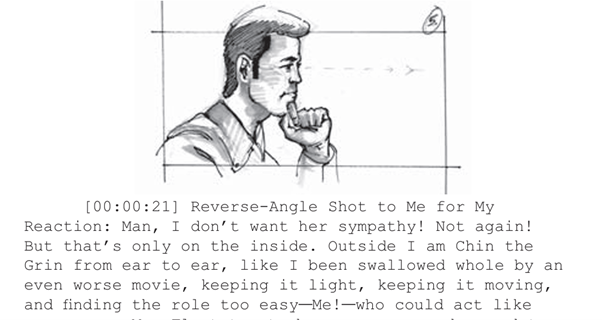
The character embodies a double role: actor and director (or in narratological terms both internal and external focalizer) which leads him to an inside/outside logic after that “reaction shot”: “But that’s only on the inside. Outside I am Chin the Grin from ear to ear, like I been swallowed whole by an even worse movie, keeping it light, keeping it moving, and finding the role too easy” (181). The movement between inside and outside, concentrated around the juxtaposition at the end of one sentence and the beginning of the next of the antithetical “inside” and “outside,” is subverted by the expression “swallowed whole,” which implies an integration into a new closed system. Tommy’s role therefore becomes ambiguously multifaceted, leading to a blurring of the question of identity, which cannot be fixed in a singular movie or role.
The cinematographic imagination hence becomes a duplicitous tactic in that it creates representations that are materialized and yet remain fluid and unstable. When movie titles function as passwords for the scientist to enter the gambling and racetrack area, for instance, I argue that they create an integration of the scientist’s character into the cinematic imagination that dispossess him of his stable identity.
I knocked softly and a voice from inside answered in Chinese.
“Gui ma zhi duo xing… Yige zitou de danshen,” I replied, and there was muffled laughter. Why? What was I saying? (195).
The scientist, repeating the titles he doesn’t understand, is an unwilling ventriloquist for titles that translate into “All the wrong clues for the right solution,” and “Too Many Ways to be Number One”. He’s made to take on the ethos of an actor, but without any of the agency. The cinematographic imagination is therefore duplicitous: it facilitates the representation of Tommy and yet when the scientist is thrown into that modality of representation, it creates an image he is not in control of, and that is built at his expense. The three recurring Honk Kongese movie titles indeed evoke images of absurd characters from these films. All the Wrong Clues for the Right Solutio is a comedy that has been described as “a comedy of the crass and commercial school” (Teo); Too Many Ways to be Number One is described by one Reddit user as “one of the craziest, funniest, most stylish Hong Kong gangster movies of the 90s” (geekteam6), thus multiplying the representations of the scientist onto different mediums.
Remediation as Instable Material Representation
The reference to movies creates a fragmentation of the characters’ identity. The cinematographic imagination layers the representation of the characters (willingly for Tommy, at his expense for the scientist) and allows for a modulated mediation of each facet of their identity. This cinematographic mediation becomes a way to reappropriate subjectivity amid representation because of the transfer of the layering from that of identities themselves to the materiality of the representative modes, through the movement of hypermediation. Tommy is a bootlegger, and I argue that this turns the story into a perpetual bootleg. He is bootlegging a movie. Readers are being told about it through a short story that takes the form of a script. The story is caught in an almost endless logic of quoting a movie and therefore quoting narratives. It never ends, and it also never starts. This is the heart of the logic of hypermediacy, defined by Bolter and Grusin┬áas one “that acknowledges multiple acts of representation and makes them visible” (Bolter and Grusin 33-34). Hypermediacy therefore self-consciously creates material representation, meaning that it both represents its subjects and acknowledges the materials it uses to do so. Acts of representation are visible not only because material styles of representation are being highlighted in a metarepresentational manner, but also because the indefiniteness of representation is exposed by the layering of representative modes.
When the character Tommy enters the scientist’s office for the first time, their confrontation leads to the creation of an imagined narrative, that is, a doubly fictional movie (fictional because it emerges from the short story, and because it only manifests in the character’s mind).
it all came broiling out: flurry of fists, head-high kicks, manga jump cuts with him answering back, us two shaolin fighting on speedboats, on flaming ladders, off trampolines and soaring—him on wire, me no net— […] (192, emphasis mine).
This passage, accompanied by the largest storyboard illustration of the story (see figure 4), exposes the material aspects of the creation of a movie by explicitly naming camera movements—“rack focus,” “camera zigzag-tracking,” and “pan” (on the illustration)—as well as mentions of editing choices—“manga jump cuts,” “slo-mo,” and “pause”—and stunt technicalities: “him on wire, me no net.”
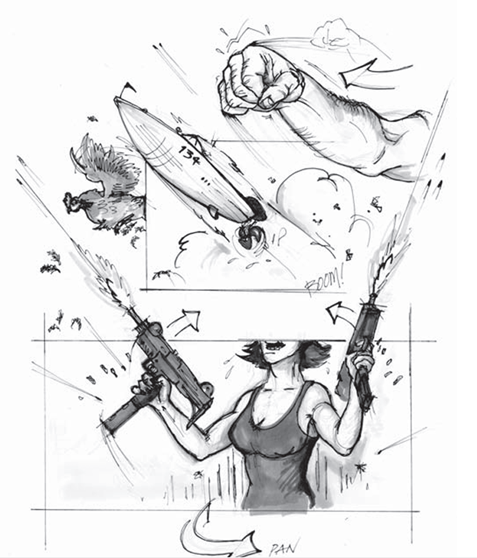
The illustration renders the making of the movie visually as it shows its construction lines, showing penciled frames. The story does not merely reference cinema; it becomes a filmic experience-in-the-making that refuses the logic of realist representation twofold, as the lack of realism of this movie doubles the fact that this is all a daydream. In doing so, the narrative itself becomes a bootleg—a copy of a copy of a myth that no longer pretends to authenticity.
Letting go of authenticity, hypermediacy, on the contrary, leads to a hyperawareness of all representative modalities in the story and of the story itself. This hyperawareness leads to a denaturalization of all acts of representation, including those that stem from sciences hailed as objective. All acts of representation are interrogated in their ability to accurately depict a community, not solely by questioning the elements that are described, but by challenging the tools and materials employed to craft those portraits.
Reading “The Risk-Taking Gene” as an attempt to confront modes of material representation leads me to see that essentialism is overridden by the broad-spectrum metafictionnality at play. The story highlights all its construction materials (language, images, intermediality) and, by doing so, never sets the portraits it produces in stone. Remediation and the fluidity of those manifestations of different discourses on the graphic surface of the collection Once Human lead to a representation that we cannot truly grasp, which therefore defuses reification and essentialism. This hypermediated representation, which loses its anchoring because of the hypermediation process, creates a nuanced representation of people that acknowledges the impossibility of accuracy in representing a community. Thus, what Steve Tomasula’s story does, through parody, remediation, and metafiction, is not simply point out how both science and popular culture can flatten identity—it structurally enacts that critique, and, in so doing, creates an anti-representation of representation, developing more attuned tools to achieve cultural appreciation.
Works Cited
Barthes, Roland. Mythologies. 1957. Translated by Annette Lavers, Hill and Wang, 2006.
Bolter, Jay David, and Richard Grusin. Remediation: Understanding New Media. The MIT Press, 1999.
Cloninger, C. Robert, et al. “Mapping Genes for Human Personality.” Nature Genetics, vol. 12, no. 1, Jan. 1996, pp. 3-4. DOI.org (Crossref), https://doi.org/10.1038/ng0196-3.
Fee, Christopher R., and Jeffrey B. Webb. American Myths, Legends, and Tall Tales: An Encyclopedia of American Folklore. ABC-CLIO, 2016. EBSCOhost.
Gates, Philippa. Criminalization/Assimilation: Chinese/Americans and Chinatowns in Classical Hollywood Film. Rutgers University Press, 2019.
geekteam6. “‘Too Many Ways to Be No. 1’ is one of the craziest, funniest, most stylish Hong Kong gangster movies of the 90s (and a Tarantino favorite). In this scene, rival brothers hire the same guy to kill the other at a party.” Reddit Post. R/Movies, 11 Oct. 2018, https://www.reddit.com/r/movies/comments/9n7qww/too_many_ways_to_be_no_1_is_one_of_the_craziest/.
Iron Fists and Kung Fu Kicks. Directed by Serge Ou, 2019.
Mitchell, W. J. T. Picture Theory: Essays on Verbal and Visual Representation. University of Chicago Press, 1994.
Teo, Stephen. Hong Kong Cinema: The Extra Dimensions. Repr, British Film Institute, 2007.
Tomasula, Steve. Interview by David C. Banash. 2015. Steve Tomasula: the Art and Science of New Media Fiction.
Tong. Merriam-Webster.com Dictionary, 9 June 2025, www.merriam-webster.com/dictionary/tong.
White, Glyn. “Reading the graphic surface.” Reading the Graphic Surface: the Presence of the Book in Prose Fiction, Manchester University Press, 2018.
Zuckerman, Marvin, et al. “What Is the Sensation Seeker? Personality Trait and Experience Correlates of the Sensation-Seeking Scales.” Journal of Consulting and Clinical Psychology, vol. 39, no. 2, 1972, pp. 308-21. DOI.org (Crossref), https://doi.org/10.1037/h0033398.
Cite this article
Hadjadj, Hanna. "Materially Representing a Minority: styles of representation in Steve Tomasula’s “The Risk-Taking Gene as Expressed by Some Asian Subjects”" electronic book review, 24 April 2026, https://doi.org/10.64773/5jz5-vi55