Emergent Manners of Seeing in "The Atlas of Man" from Once Human, stories by Steve Tomasula

In literature, as in science, how humans emerge remains a continuous matter of engagement. In this article, Claudia Desblaches looks at the emerging scales of human representation in Tomasulas' The Atlas of Man.
Introduction: “Emergent Manners of Seeing”1:
Emergence is a concept that appears across many disciplines, describing how complex patterns or behaviours arise from the interactions and redistribution of simpler elements within natural or human made systems (Goldstein 49). Among key emergent processes and components are complexity emerging from lower-level entities and layered planes of discourse and reality that are evolving with novel forms and processes (Briosch). Emergence thus characterizes a process of creation by complexification. It can occur in unpredictable ways and might be a (vivid) lens to explore Tomasula’s books which indeed seem to invite emergent manners of seeing (or reading) by encoding emergent manners of seeing (or writing). In a 2023 interview, Tomasula defined “emergent manners of seeing” as patterns of being over essence, ”[…] interconnectedness, an absence of centers, erosion of privacy, blurring of all kinds of boundaries, an ease of recombination, dependence on the image, interactivity, infinite linkage and therefore indeterminacy […]”(Tomasula Steve; Claudia Desblaches).
This work endeavors to probe this complexity, led by the notion of emergence as the driving force behind “The Atlas of Man,” whose concrete title promises a mapping of the subject(s) and so might reveal identifiable forms of emergence transposed to the literary field. “The Atlas of Man” centers around a scientific project led by three fictional characters, Dr Johnson assisted by Evelyn Smith and Jimmy, the first-person narrator2. Their aim is to map what a human being is, resorting to a categorizing view. Jimmy’s account of the experiment challenges scientific and technological hegemony. Tomasula’s story might provide satirical3, graphic, and poetic emerging manners of seeing the way past and contemporary science dehumanizes human beings. Multiple angles of vision, poetic, textual, graphic, pictorial and satirical techniques show the irreducible nature of human beings. Steve Tomasula argues that “these new kind of stories (…) may be considered emergent narratives, generated by multiple agents and agencies interacting to produce unexpected and surprising effects” (Tomasula Steve, M. Michlin and F. Sammarcelli). What is supposed to emerge in fiction? Our first intuition is that the various intermingled epistemological frames within this story (like text and skin texture) might be formal agencies that contribute to setting up emerging scales of representation4.
In an article to be published in 2026, Steve Tomasula argued that “[the Gutenberg print culture] is incapable of offering the forms necessary for a narrative that incorporates elements of chaos theory, […], big data, social feeds, interactivity, […] and statistical modeling of a truly posthumanist narrative. So, what’s a novelist to do?” One will keep in mind formal features listed here by Tomasula, as well as other “multiple agents of emergent narratives,” like desire, exploratory characters and readers, unconnected pictorial elements.
The first aspect of emergence to discuss is changing scales, which encourages readers to pay close attention to visual details like dots or somatoplots besides the linear plot5. With emerging manners of writing, seeing, and reading, the short story reveals the multidimensional thickness of being and the possibility for the scientific gaze to observe the Real poetically.
Changing Scales
According to the author, indeed, “emergence [offers itself] as a lens through which to read […] by adopting a non-human scale, we enable readers to see in another way” (Tomasula, 2014, 16). Thus, the American writer invites a reflection on interpretation and representation with the final view of subjectivity as the inevitable notion correlated to that of emergence.
“The Atlas of Man” contributes to vary the lenses we apply to the Real as the intimate level (the romantic plot involving Evelyn and Jimmy) interferes with other scientific or pictorial layers of representation. These complex views are in tune with our contemporary world, a mixed reality made of data. Katherine Hayles argued that Gibson created cyberspace by “transforming a data matrix into a landscape”—a place apart from the physical world—“in which narratives can happen” (26). Set in the 1950s, the chart landscape in “The Atlas of man” allows readers to zoom on the way technology poses a threat to the integrity of human beings. One strategy to insert emergent phenomena in prose is to direct focus on ultra-minimalist forms like dots. Facts are changed into new reading modes, dots become new spots of vision6. In the short story, there is this similar interest for graphs and dots, calling for readers to connect all the dots. Focusing on what seems to be only (graphic or typographic) trifles, readers are generally fully aware that data and images can deceive or reproduce partial information. Dots on a graph can make us see density or zoom on singularity. Indeed, in Tomasula’s stories, linear plots are complexified with digital knowledge, figuration and scientific means.
The Emergent Meaning of Dots, Somatoplots, and Footnotes
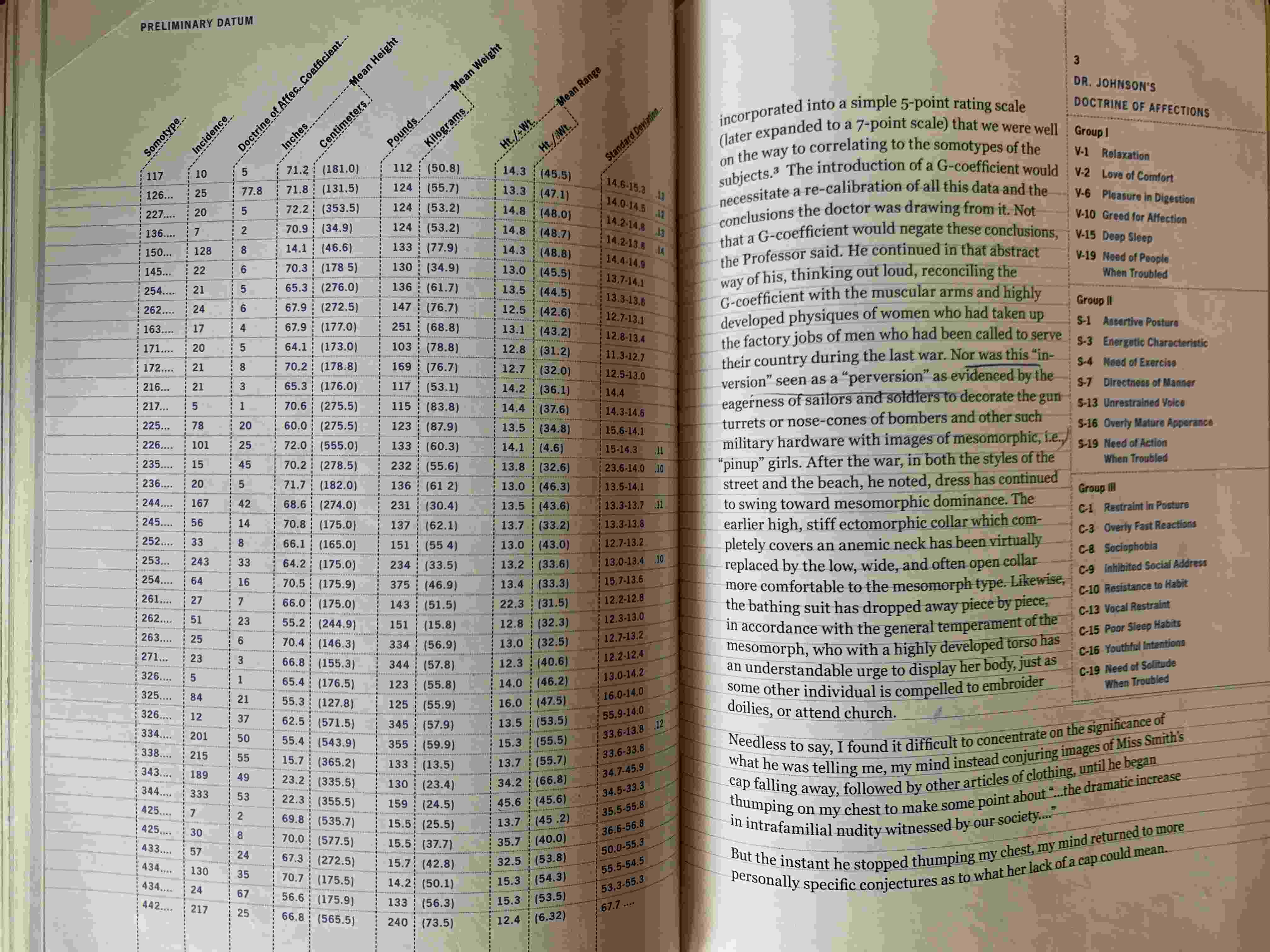
This attention paid to the most acute detail (the embryo represented as a half period in “Self Portrait,” the dotted graph in “The Atlas of Man,” or the blue dot that ends Tomasula’s latest novel, Ascension, 2022) encourages readers and critics to establish new data poetics of the gaze. Within the story’s architecture, dots and graphs correspond to what scholars of emergence and Steve Tomasula himself call “lower-level conditions and interactions that give rise to higher order behaviors, patterns, formations, meanings”(Tomasula 2014, 13). In “The Atlas of Man,” the dots on the graph are a first step towards Dr Johnson’s tentative and objective capture of man in somatoplots (charts showing body types)7. The dotted graph appearing on the second page in “The Atlas of Man” represents the quantity of subjects surveyed in search of a systemic morphotype. The survey is conducted by a certain Dr Johnson who is a firm believer in the rigor and objectivity of science. Like a visual truth that does not need any further proof, the dotted graph represents the gap between the number of men under survey in contrast to the only woman studied (Dr Johnson’s wife). Almost lost in the lower right-hand corner of the page, the dot standing for the number of women studied (one out of 50000 men) acquires a metaphoric color within the story.
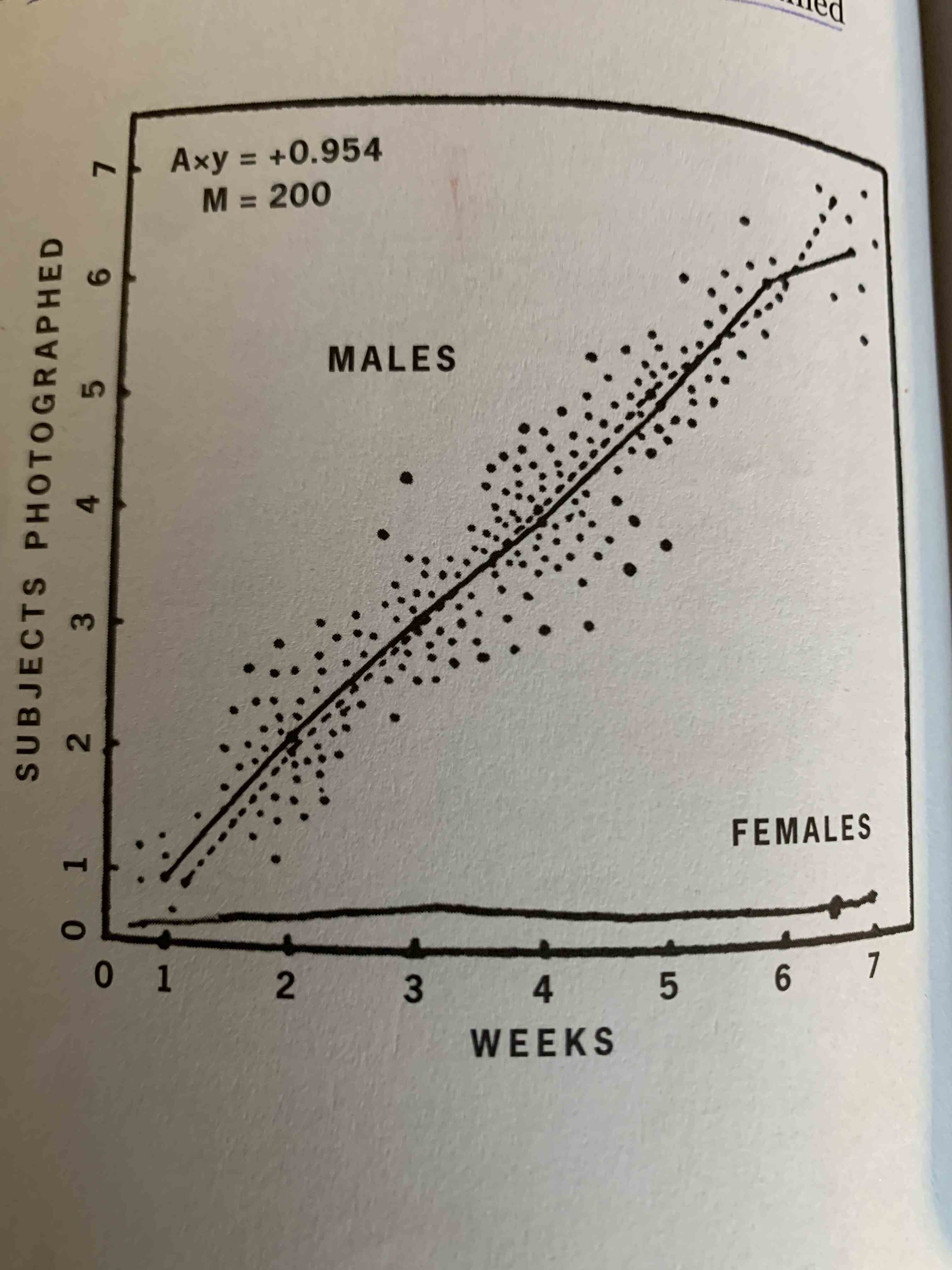
Data and dots within the literary texture might be symptomatic of the author’s anxious concern about new technologies: the author uses emergent means to experiment them within the literary field. The dot also serves as a powerful illustration of how intricate systems and complex views can emerge from simple beginnings. It might also point at the Augustinian idea of “signa data” (or intentional sign)8, the fact that there is always an intention behind conventional signs. Readers should not be content with the materiality of the sign but consider what they point at9. We finally get the picture: the first graph and the only, almost lost she-dot questions the survey’s objectivity from the start. Tomasula’s prose uses here a subtle neutral graphic convention as an emerging oddity. In the same representation of a dot, Tomasula provides different angles and blurs meanings. The dotted graph is a practical demonstration of human reification and the lack of parity10. That’s Tomasula’s point, I think: not only does he insert in his story non-literary objects like graphs, statistical tables, scientific tools but he does so practically and metaphorically.
Another emergent strategy is the odd system of footnotes (138-139) that encourages readers to omit information or choose between the literary or technical elements displayed on the page (the text or the graph). Ironically, the footnotes point at readers’ selective perception that influences interpretation. However, the curious reader is encouraged to maintain a double reading with binocular lenses. Footnotes further appear as oddities that require interpretation instead of providing clarification. When Jimmy has to continue the scientific experiment by collecting data while repressing his “gigantic desires and needs,” he asserts that his private life interferes with the “grander work” (167). In parallel, footnotes are imbricated in the page within a pyramidal form as if the Mount somotype pyramid had contaminated other narrative parts. The page ends with footnote 6 itself referring to a pyramid where footnotes end paragraphs leading to new footnotes.
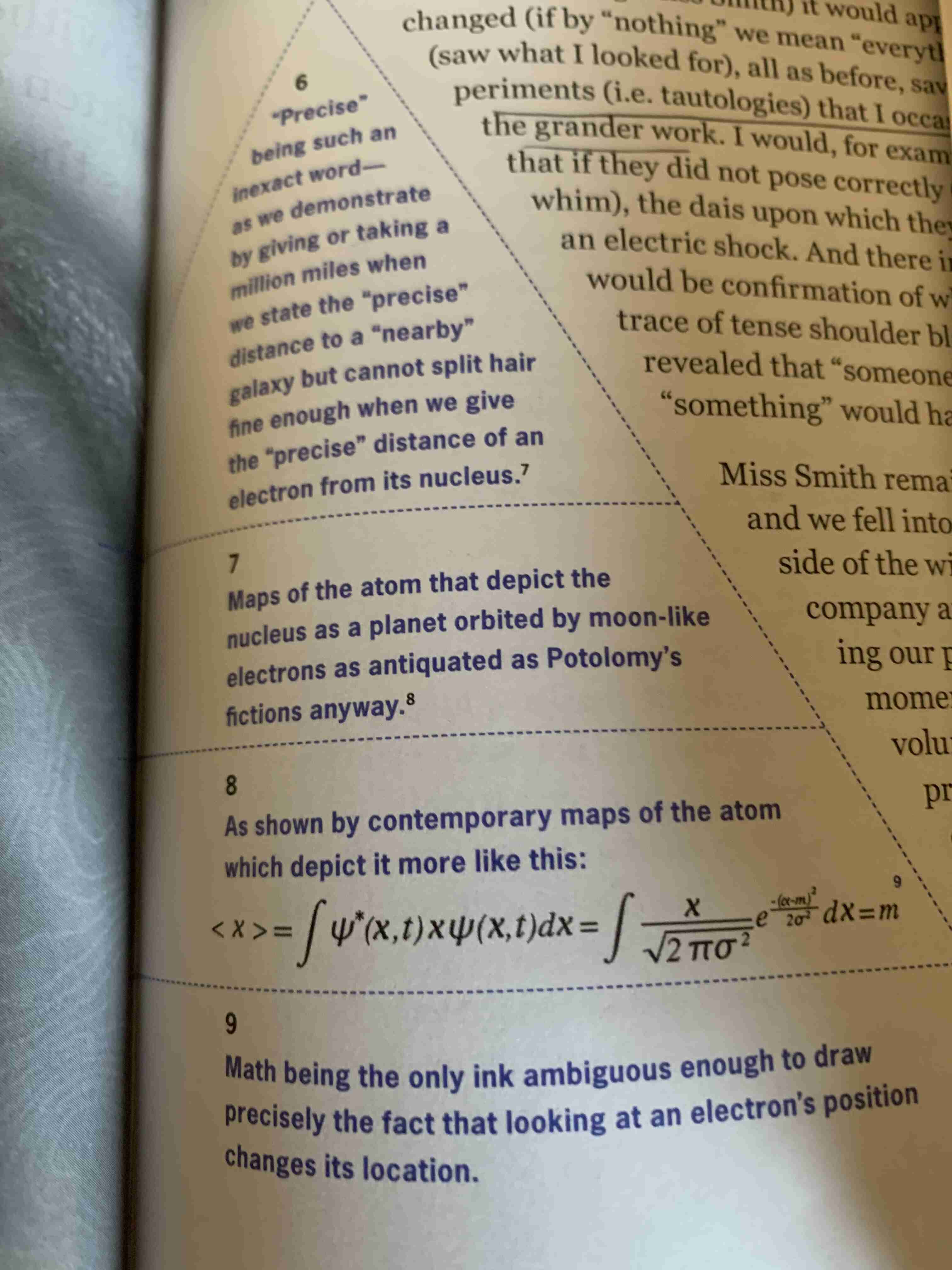
Footnote 5 promises infinite explanations (ad infinitum, 157). With the elements of the picture that propose frames within frames and imbricated footnotes, we thus understand that all levels of existence are interconnected. The infinite mise en abyme strategy is also echoed by the lithograph that represents the former hospital’s grounds and will later reveal the window through which Jimmy and Evelyn will be able to observe each other. The odd footnote framed system absorbs the same emergent logic as the framed narrative and other tentative tautological definitions of man’s morphotype observed by another morphotype (136). The reader’s gaze can never rest on a clearly delineated portrait. These emergent self-reflexive strategies complexify the diverse perspectives we can place on the plot, the text and the images. The footnotes also mock the scholar’s vain attempt at clarifying his thoughts. The quest is endless. The pseudo photographic compositions also upset a clear-cut strategy of representation.
The Pseudo Photographs
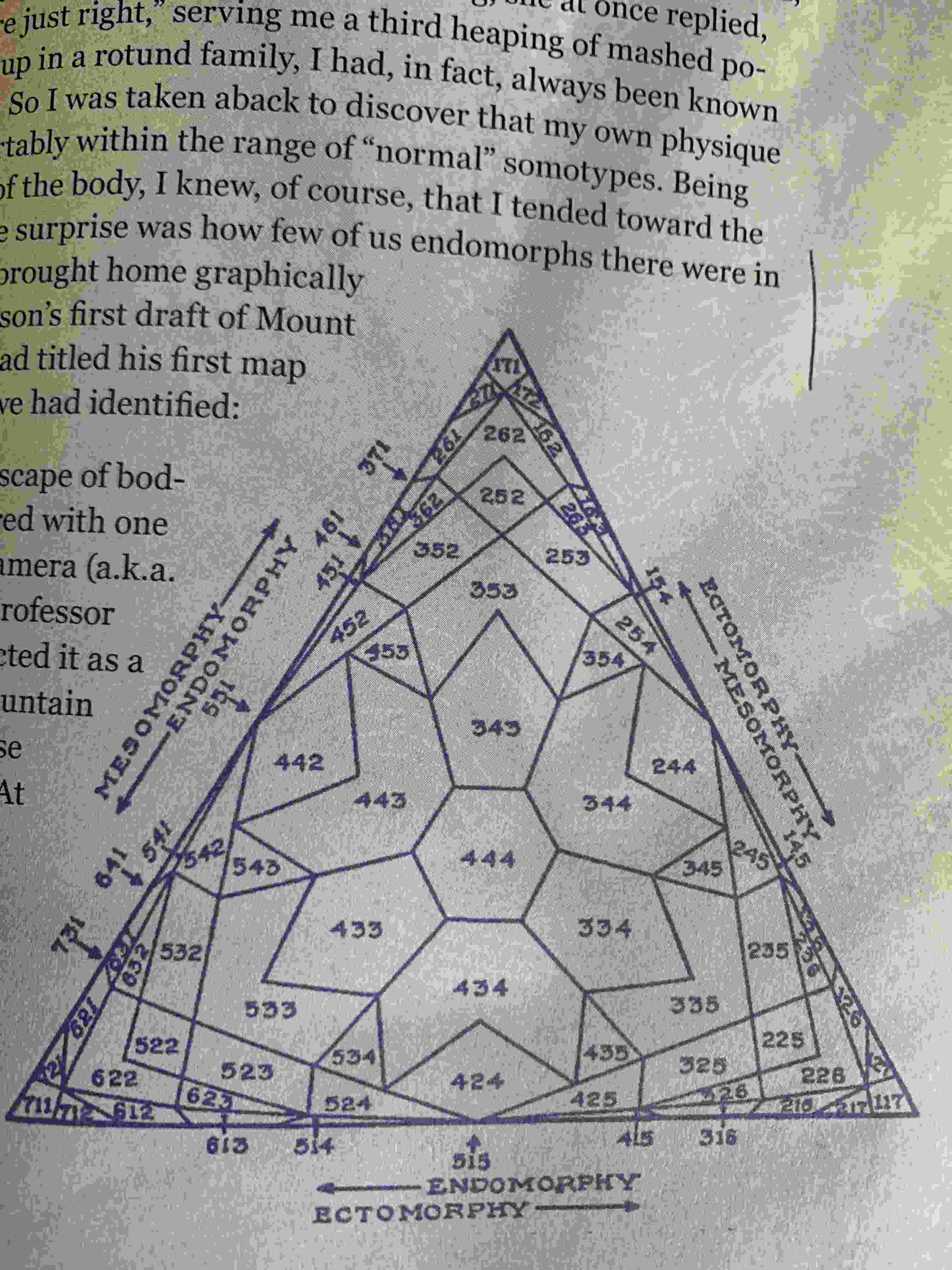
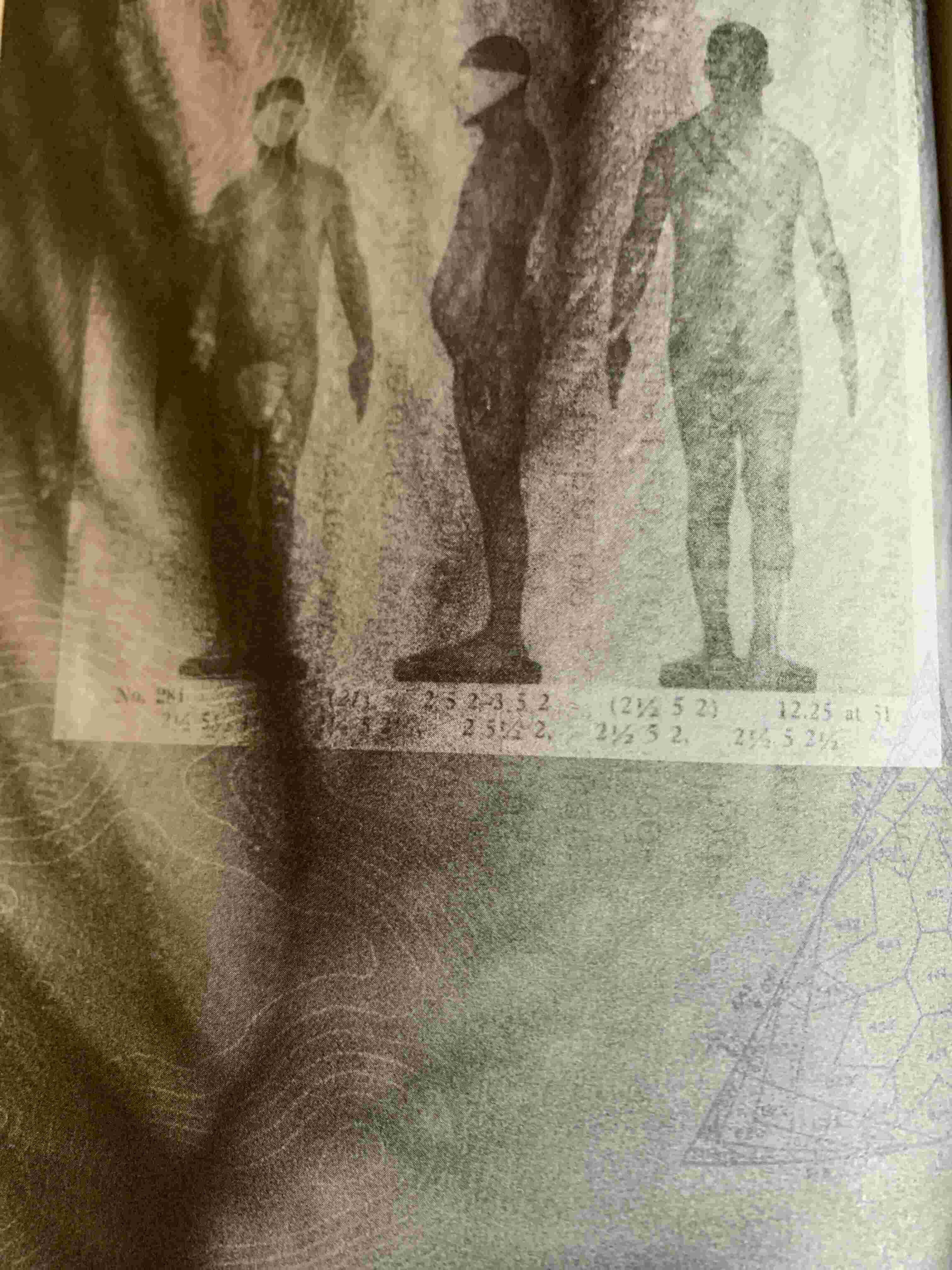
The visual illustrations of the story lead readers to explore two models of understanding human behavior: William Sheldon’s The Atlas of Men (1954) and Abraham Maslow ‘s Hierarchy of Needs (1940-1987). The pseudo photographic composition that appears 7 times as a continuously modified graphic refrain (pages 140, 146, 152, 158, 166, 170, 171) is a “booster shot” questioning the work of Sheldon, an American psychologist and eugenicist. His theory was criticized for its limitations11. With Dr Johnson’s Doctrine of Affections (149) and the different drafts of Mount Somotype (151-152), the story’s visual emergent elements also include a reworking of Maslow’s pyramidal hierarchy of needs. The writer provides historical hindsight on the technology of the past as an allegory of the distance we should take from our technological world. As a case in point, we could compare the original Picture of Sheldon’s somatotypes12 with Tomasula’s pseudo photographic composition that remediates them. The first bodily contour that appears in the story serves first as a shadowy background to the text (139).
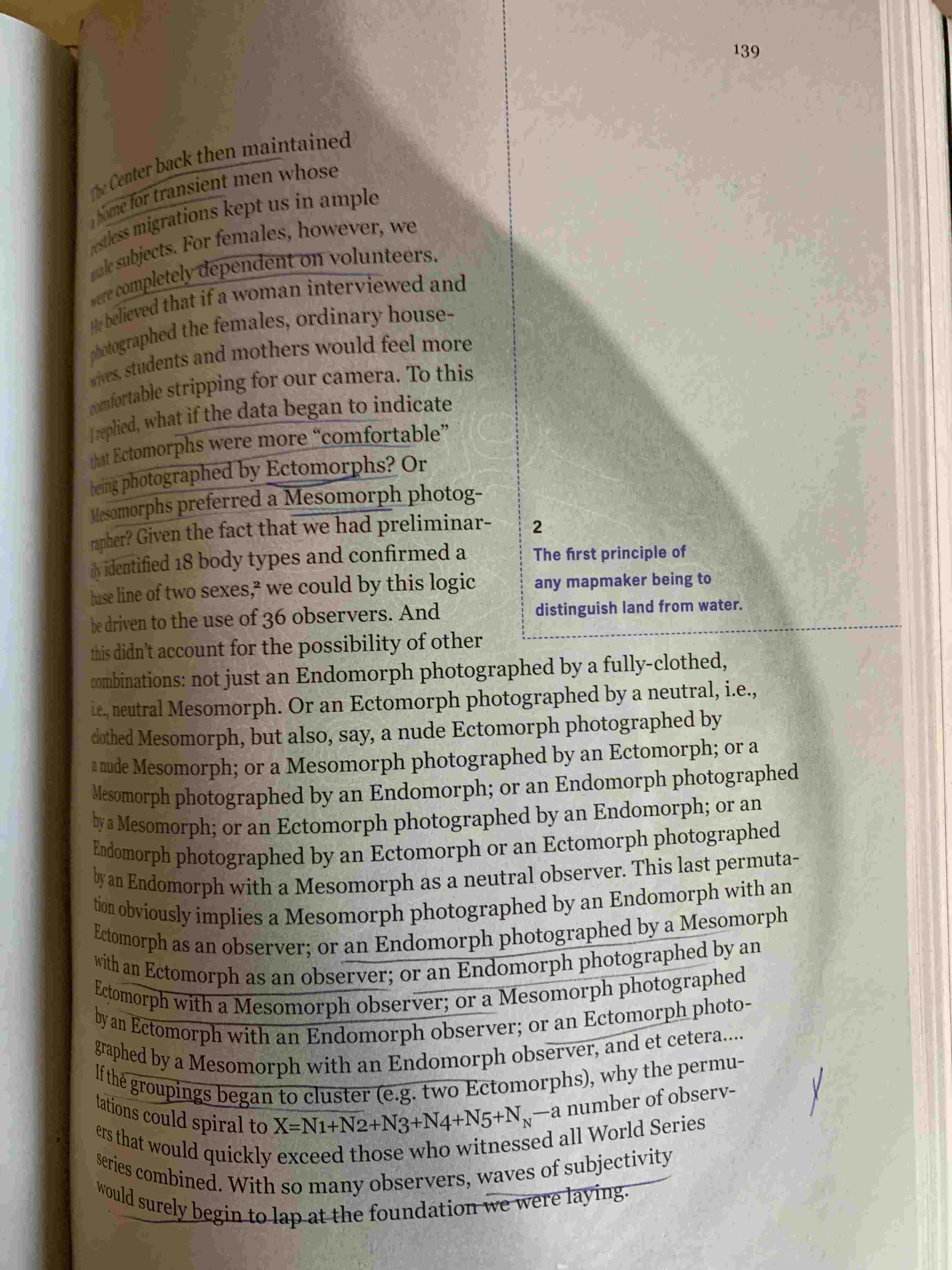
It is a preliminary view of the strange composition that occurs on the next page. The prose passage explains the protocol, the way volunteers are interviewed. The shadow that contains the text makes us see that the way they are questioned depends on the way they are seen13. Indeed, the superposition subtly illustrates the obscure parts of the survey. It might also allude to the original source of Dr Johnson’s study; that is Sheldon’s authentically archived scandalous photographs of nude students available for viewing by scholars in an obscure section of the Smithsonian institution. The belly-like form might represent a “huge wave of subjectivity” (139), overwhelming scientific rectitude. Progressively and intricately, the disturbing varied graphic forms pervade the text as Jimmy questions the relevance of the statistical study. Scientific foundations are set on unstable ground, whether textually or visually demonstrated.
The next image (140) is a frame within which Sheldon-like photographed profiles appear as remediated on the page with a play of light and shadow. The composition relies on different strata and the incorporation of other indeterminate elements acting as reminders of the original Sheldon photographic image:
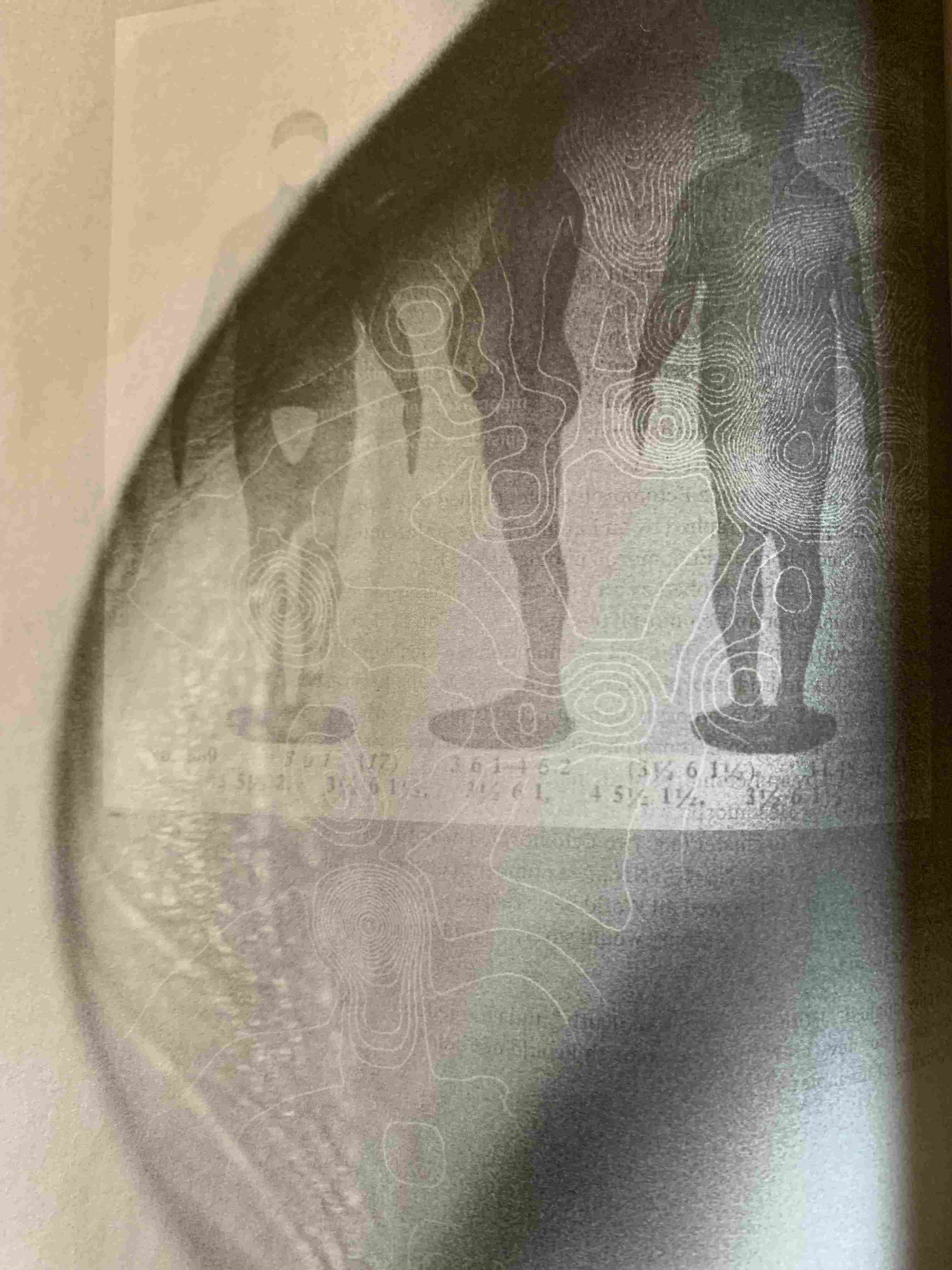
The half-lit forms may be graphic metaphors of Jimmy’s emerging consciousness. The page exhibits the lack of visibility and transparency of the study. The portrait of man remains impossible to delineate in full light. With the graphic editing, you see what you can’t see from the statistics and nude pictures. The composition associates fixity and movement, the reality of past pictures juxtaposed to an imaginary production. These series of pictures are a counterpoint to the preliminary data (148-49) and the pyramidal landscape of man’s body types in Mount Somotype (151). The reworking of Sheldon’s nudes and Maslow’s pyramid that interacts with the plot provides a different perspective than the statistics vainly circumscribing men as categorised forms and psychological traits.
The effect on the reader is that of subjective engagement; a new emergent discourse is created by connecting the different elements of the picture. With this new object under scrutiny, the reader tends to side with the narrator. The shapes superposed to other layers first occur at the moment when the narrator explains the rigid protocol to Miss Smith, the assistant. Ironically and symbolically, the overall procedure is upset by Miss Smith’s body which slips away from control and measurement as her breasts extend and arouse Jimmy’s desire.
Within the rational procedure described textually, something unexpectedly erotic occurs. In parallel, within the image, the rigid representation of standing subjects as the result of a logical protocol is completed with the inappropriate fingerprints/traces on a belly/breast. Here, subjective meaning irrupts by chance with unfamiliar associations of visual and textual layers: the object of the study (the body) and the subject of the study (the observer) are here revealed in their living and unpredictable nature. “The power of the body [that could] mock the most rigorous system” (142), interacts with the unclear forms of the composition standing for what remains unsaid visually in the image and within the intimate plot. Jimmy and Evelyn “continued to work together as if nothing had happened” (142). The private and singular reaction of the narrator assisting Dr Johnson’s scientific task is reasserted against the dogmatic rationalism of the latter. In correlation, the rigidity of the frame is counterbalanced by hazy and hazardous shapes that partly cover it.
Visual Oddities emerge from the cryptic images that combine different layers of meaning. The reader is overwhelmed by different points of attention: are we dealing with a criminal profile? A mesomorphic picture? A woman’s belly or a man’s torso? Fingerprints, land or ocean maps? In the image, readers are not convinced by one vision or another. The graphic construction compensates for the variables that are excluded from the study and Johnson’s “flat earth habits of mind” (155). The enigmatic composition might induce several simultaneous analyses. The reader grasps a clue from the text at the end of the page with the erotic trouble mentioned. Later on (152), another comical example is given with the graphic peak in Mount somotype being no longer represented visually but converted in Jimmy’s mind as a bodily promontory. In other words, his fantasy reaches a peak when he imagines Miss Smith (humorously and erotically) “caressing the west of the location, that is lower down the mountain” (153). The decentred Mount somotype becomes itself a visual oddity when inserted within the photographic nudes (152). All in all, the hazy curves stand for the missing imaginative and sensual parameters in Johnson’s experimental mapping of the human being. These obscure shapes allude to human desire and unpredictable being-in-the-world.
Chaos and Randomness as Conditions of Emergence
The disturbing picture introduces chaos and randomness as emergent events within the statistical study. At the end of the story, Jimmy deviates from the scientific study through his obsession with Miss Smith, and the more he observes her, the more the quest for knowledge becomes “an equally indeterminate blot,” or “a chaos [that] could coalesce into an answer” (160).
Other heterogeneous moments mud the plot still further. Cases in point are the chaotic anecdotes or digressions delivered by Jimmy and Dr Johnson. Here, again, the pseudo photographic pictures prompt the reader to open his eyes for the unexpected (143): the surprises to emerge from the graphic material but also from the plot. Note when the narrator extrapolates from the observation of certain subjects he has interviewed or made up (“the extreme coarse Viscerotonic subject,” “the extreme narcissistic Cerebrotonic case”143). These savoury expressions about extremely singular human types subvert Dr Johnson’s pigeonholing. Scientific tools are not enough to cope with randomness within observable patterns. Katherine Hayles adds that “randomness is a necessary component alongside pattern in the emergence of narrative meaning” (286). “Using a telescoping lens,” “abstract patterns” can emerge and refer to diverse contradictory elements depending on the focal point adopted. In the last pages, the truncated photographs are decentred (170-171):
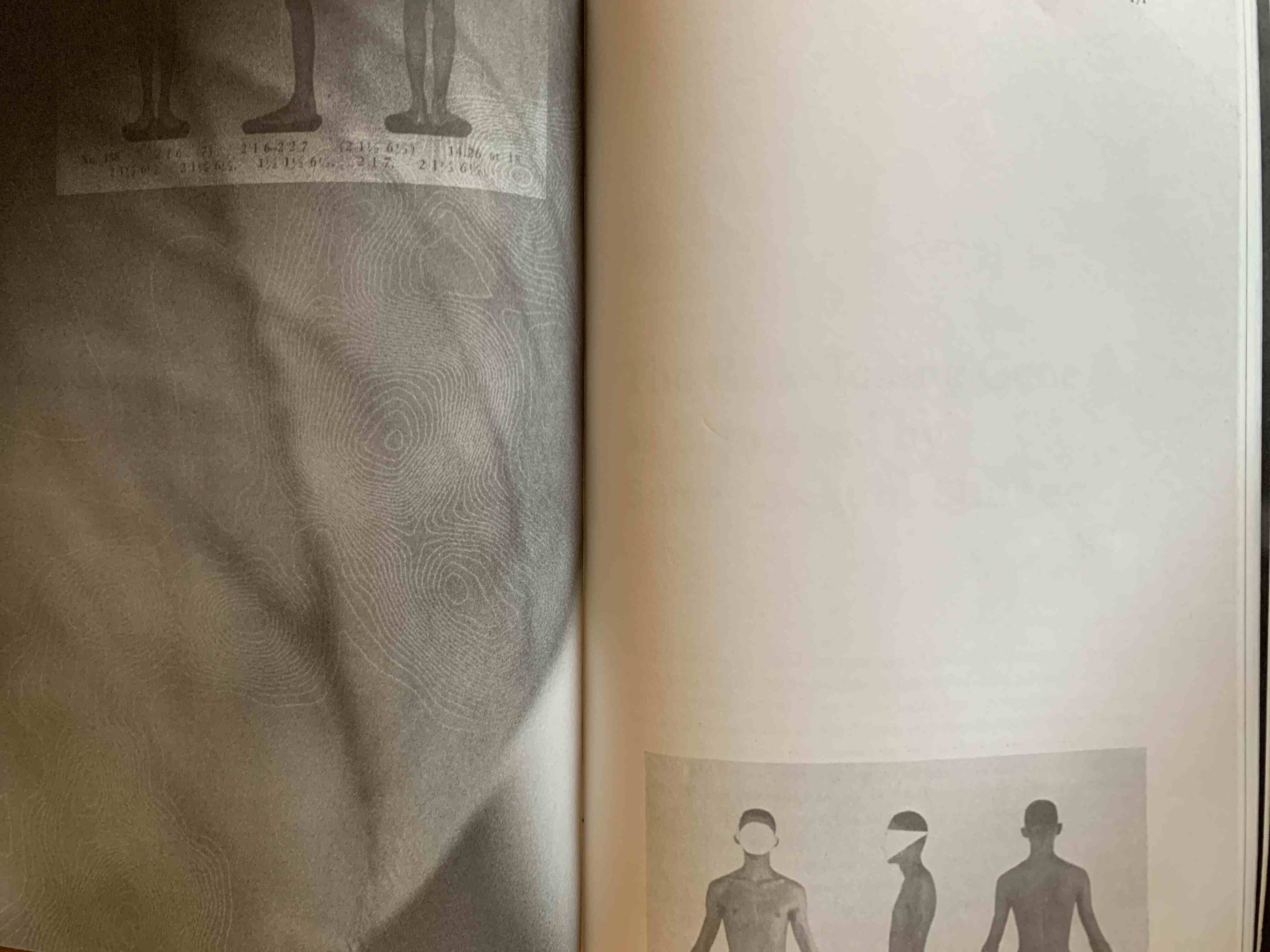
One (with the lower body parts) leaves readers with traces of shadowy forms and skin texture and the other page (with the truncated higher body parts) encourages us to complete the remaining blank spaces on the page and thus explore boundless humanness. The different layers formed by blurry curves, shadows, refracted and hatched light, trigger multiple interpretations.
The Instability of Interpretation
“The [subjects’] statistical significance to emerge” (138) asserted as the final objective of the study rather corresponds to the observer/reader’s subjective interpretation with the need to accept the blind spots, the lost dots, variables, a thriving imagination, “dreams and flights of fancy [that] ascend” (164). The risk of extrapolation ironically might affect all our reading grids. “Faith, good reader, faith” might Dr Johnson have told us if we believed in a “god’s eye view” (151), that here characterizes Johnson’s Mount somotype but not our necessarily limited semiotic interpretation.
The whole story obviously encapsulates a meta poetic reflection on the relativity of interpretation. Interpretation, the way knowledge is shaped, depends on the intentions, cultural background and beliefs of readers. The mockery of Dr Johnson’s dogmatic views can be understood as a subtly allegorical lampooning of hasty readers jumping to conclusions or just clinging to “the interpreter’s cogito” (164), that is a literal interpretation of hard facts. However, inevitable and fruitful “moments of disorientation” (164) are said to animate the work of any researcher or scientist, as stated by the narrator himself.
All semiotic or interpretive systems might neglect unknown factors, variables, singularity or an isolated dot, a missing G coefficient (or an unreachable G spot?) In the story, science is asserted as work in progress, scientific precision being relative and dependent upon the state of the art. The illustrations page 156 shows the deceptive pictures that have inspired the physiognomists and the phrenologists and made them jump to syllogistic psychological conclusions. The obtrusive visual similarity between the heron and the seditious politician is reiterated in the analogy between a turkey and a submissive Turk. Such delusional reasoning is also comically sent up in the romantic subplot through the narrator’s obsessional conjectures about whether he should interpret Miss Smith taking off her cap or smiling oddly as romantic overtures. The reader, in turn, has to assume the risk of misinterpretation or overinterpretation.
The series of elusive illustrations demonstrate the instability of interpretation. The profiles revealed by an interplay of light and shadow (146) are correlated to the narrator’s amorous hope “to lie down in the moonlight” with Miss Smith.
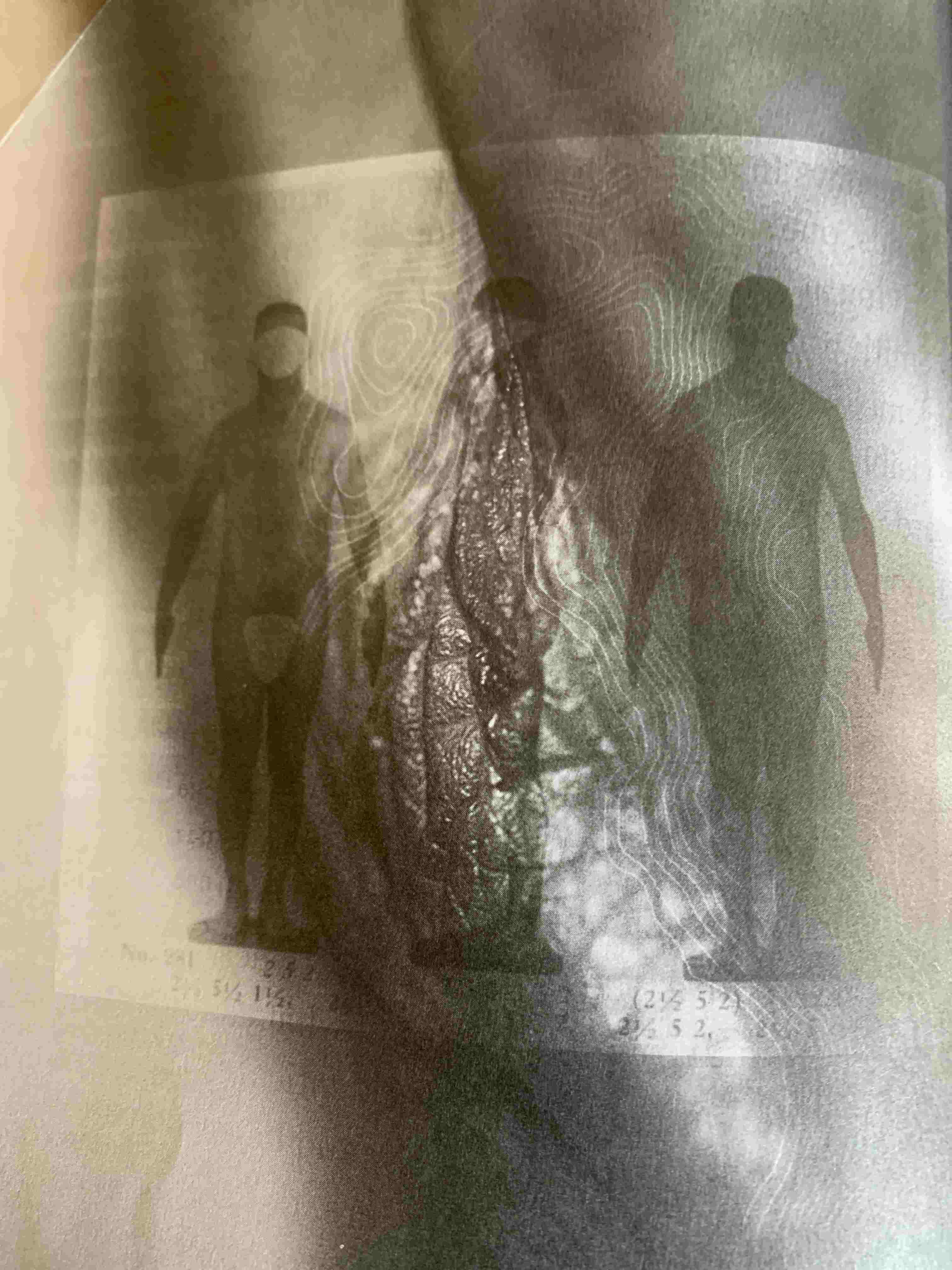
The streaks of light and their adjoining shadowy forms point both to Jimmy’s phantasms projected on the photographed nudes and to the tension between scientific enlightenment and the opacity of humanness fuelling the “Human sciences.” Or later on, more concretely, the pictures appear as nothing more than the reproduction of the previous (Sheldon or insane asylum ) images with a natural play of light that Jimmy looks at when he decides to apply the protocol to himself : “here “moonlight streaming through the Venetian blinds cast bars of shadow across the engraved illustration of the insane asylum that hung on the wall” (155). The half-lit scene of self-exploration within the “monastic walls” of Dr Johnson’s neo-gothic former insane asylum reminds one of Dr Frankenstein’s creature appearing in the moonlight. Indeed, the Gothic style of the story, with its various allusions to medieval or pre-industrial times (the H├⌐loise-and-Abelard-like romantic subplot, the references to the Inquisition), its grotesque imagery and humour, contributes to the metaliterary questioning of scientific interpretive hubris.
The uncertainty of interpretation triggered by this interplay of light and shadow shows how diffuse meaning can become. When Jimmy places the Center (of research) in a negro neighbourhood to extend the sample, the image is also submitted to focalisation changes. The narrative is decentring the views, the photographic images and the plot simultaneously.
Here the study might correspond to “social feed as emergence.” (Tomasula) When Jimmy tries to find subjects of study in the black vicinity, his true identity as a somotyper is mistaken for that of a homosexual. In parallel, he discovers that Miss Smith could see him seeing her through what he first mistook for a one-way mirror. Jimmy then realizes that the observer also depends on the observed. It is “the gaze and the returning gaze, looking and looking at looking” that Shoba Venkatesh Ghosh sees as part of the emergent phenomena analysed in The Book of Portraiture (2013)14. The mise-en-abyme of the observer-observed relationship and the inescapable interaction or mutual influence that precludes objectivity is a process that deconstructs Dr Johnson’s faith. Framed representations and interactions counterbalance his discourse on the possibility of absolute objectivity. The mud of language is a first step towards emergent meanings. In the middle of the story, when an effort is made to “recalibrate data,” the plot lingers on Dr Johnson’s somewhat illogical view of the reasons behind the evolution of the body shapes. Here, the reader steps back, as the narrator conjures up images of his beloved (149). Uncertainty invades the text. We are left with the unstable “mud of language” (160), with Miss Smith saying yes, interpreted as no (150). Soon after, one subject of the study provides systematically contradictory answers (150). Nothing holds except Johnson’s so called “divine truth” represented by the first draft of Mount Somotype (151). Dr Johnson’s faith in achieving an all-engulfing observation and mapping of mankind (Atlas of Man) is questioned. Note that Dr Johnson’s scientific rationalism is implicitly equated to Newtonian physics through the epigraph quoting Isaac Newton’s belief in the possibility of having an omniscient view of the universe — his theories allowing him “to stand on the shoulders of giants” and thus “see further than other men.”
The first appearance of the pyramid is clear cut (151), showing the short-term adherence of Jimmy to the Doctor’s view. Behind his back or on the other side of the page (152), the pyramid reappears within the initial photocomposition, decomposed and decentred as one angle of vision among others:
The lower right corner of the pyramid is even cut by the page frame, hiding one of the somatic extremes (1-1-7). The decentred pyramid brings out the limits of representation. It also reflects the plasticity of images and “the mud of language.” The equality of signs is presented in equation but, still, the Real escapes. Ironically, math as a plastic language is able to assert inaccuracy and the instability of the world with precision. Ptolemy’s fictions are equated to maps of the atom: “Math being the only ink ambiguous enough to draw precisely the fact that looking at an electron’s position changes its location” (167). It can never be depicted with satisfactory accuracy even in the mathematical language (167). One of the footnotes in a pyramidal form (167) specifies that “precise is such an inexact word” (167, footnote 6). Thus, the short story tends to prove in a practical and comical demonstration that a symmetrical representation of Man and the world is impossible.
”It’s odd to reproduce anything.” (159)
Representation kills the subject’s singularity. In the story, Jimmy sees his own somotype as a voodoo doll and a zombie which he desperately tries to summon back to life, producing -“no effect!”(160) In another comical passage, this idea is taken up when the narrator offers his subjects a final cigarette as if they were about to be executed: their somotype number looks like a prisoner’s registration number: ” to dissect one must first kill” (161). The neoromantic narrator even rephrases Wordsworth’s aphorism from “The Tables Turned:” “We murder to dissect. Enough of science and of Art” (Wordsworth). Yet, the narrator does not finally yield to romantic brooding. He describes himself as a subversive joker and proves it by turning Johnson’s pictures into an optical toy, “a flip book” that turns the fixed images into moving pictures to be handled and read quickly. As the kineograph produces an optical illusion of movement and life, the narrator subversively meddles with the deadening experiment to conjure up “the fluidity of the human type” (161).
However, the massive analyses of 50,000 subjects and the focus on too many details renders the study pointless. To use Roland Barthes’s terms from his famous essay on photography (90), in this pseudo photographic composition, there is neither studium (the general apprehension of man is incomplete) nor punctum (there are too many details for the reader’s gaze to focus on)15. Human subjects photographed in a blurry black and white tinge lend a spectral visual quality to the scientific pictures. Spectrum is precisely the word chosen by Roland Barthes for the ghostly subjects photographed. Jimmy’s view runs counter to the statistical survey that strips Human beings of their vital essence. According to the latter, the details that compose the essence of individuals cannot be circumscribed: “always, always, the more detail I added to this map, the more useless it became for navigation” (161). This process is echoed in Jimmy’s subjective reaction to the unsatisfactory survey. Humanness cannot be mapped. Details that constitute the singularity of the individual as well as other factors like facial features are excluded from the study.
Subjectivity and the Emergence of a New Man
“It’s easy to discuss subjectivity in the humanities, but it also infuses science. Witness all the effort that goes into ruling it out. What attracts me to writing about science and technology, or rather incorporating it in the fiction, is that it is much harder to see the cultural or subjective nature in a scientific question” (Tomasula, 2023). Thus, subjectivity is that of a subject experiencing the world, hence Jimmy represents a counter voice different from his dogmatic master. The main narrator is made to experience the scientific project emotionally, imaginatively and bodily. With the amorous subplot that inserts desire within the scientific procedure, Jimmy gets conscious that the overall study lacks many variables and that human beings cannot be reduced to framed categories. Miss Smith pinpoints Jimmy by narrowing him down to the smallest potential as a fixed 5-3-3 morphotype (in the “You are here” localisation on the morphotype map). He then progressively evolves towards the realization of his “own banal uniqueness” (165) in connection with the Family (169) of other scientists, other Human Beings and in correlation with all the elements of the universe, bacteria, or stars.
The short story bears witness to the gradual and final emergence of a new man: instead of letting “the statistical significance emerge” and “sing a chorus of operatic dimensions” (138), Jimmy becomes a subject on a higher level of conscience. He recognises the phenomenological complexity of being in the world: “Given the nexus of body, consciousness and the world otherwise known as the crack in [his] skull” (168), an ungraspable mode of being he defines as “the Eternal Human Heart” (168). He thus comes up with a lay, phenomenological definition of the subject as a nexus or interface between body, mind and world. But the harsh fluorescent light (142) of Dr Johnson’s Center leaves no room for such subjective opacity. Hence, Tomasula disrupts it with a crack of light emerging “all around the frame of the engraved illustration” of the former lunatic asylum’s grounds in Jimmy’s office. By revealing the window opening onto Miss Smith’s office, the crack of light symbolizes the intrusion of irrational, uncontrollable longing. Emotional and sexual suppression lead to fantasizing, self-delusion and hallucinatory visions or perceptions. Jimmy was disoriented after the episode of the one-way mirror, as he “was observing her knowing she was observing [him]” (164). He is also subjected to auditory hallucination: “I couldn’t tell if he said, “Miss Smith requested it all” or “Miss Smith, flower in a crannied wall” (164). The second expression uttered by Dr Johnson and heard by Jimmy accounts for their office swap. The cold injunction, “Miss Smith requested it all” is swapped into a more poetic connotation, “Miss Smith, flower in a crannied wall.” This ambiguous move from strict enunciation to metaphor might represent the whole enterprise of the story: poeticising scientific protocols to reveal the aesthetics of science and technology. The literary view resists the absorption of singularity within norms16.
The Poeticization of Science as Aesthetics of Emergence
The inaccuracy of Sheldon’s survey and Tomasula’s critique of would-be perfect scientific objectivity are represented by the artistic blur or soft focus of the photographic composition and “all that jazz” (159). This artistic blur of superimposed shadows, black and white forms, lines and circumvolutions, rectangles and luminous points conjure up the place, where new meanings, new readings can emerge17.
Irregular shapes or singular expressions require interpretation. As an example, remember when Jimmy projects his male desire onto the female subjects Miss Smith studies, “mentally casting their somotypes, the Rubenesque 5-4-1s, the slender 2-4-4s of Boticelli” (144). His male and artistic perspective challenges fixed categories. In the same way, the illustrations add visual elements as supplementary layers over the original Sheldon somotypes for readers to ‘connect the dots’ about human identity.
Tomasula adds that “every work of art is a translation; every form of representation has an aesthetic, be it an equation, or an autopsy report. […] Technology and science are never neutral. There are aesthetic judgments and power relations, embedded into the tools and techniques that color how we think of the subjects (Tomasula, 2015).18 Scientific objects are thus estheticized and serve literary and political purposes. All the scientific data or pseudo-photographs to be deciphered contribute to Tomasula’s complex forest of signs. At the end (167), in a Baudelairian poetic impulse to establish correspondences, the narrator’s view about identity definitely escapes the reification process. Baudelaire uses forests of cryptic signs, correspondences, synaesthesia and disturbed and expanded senses to clarify readers’ perception. Tomasula uses the telescope as a scientific tool to make other meanings emerge, in unexpected connections with other layers of reality. The viewpoint delivers the vision of the subject’s navels as “abstract patterns” from which emerge many connotations: they are associated to patterns of “an inner ear, watery vortex, or galaxy” (169). The subject is caught in the thick and moving meshes of the real. Scientific knowledge, materials and tools are aestheticized and shown to be part of the skein of the world. The scientific discourse triggers imagination and allows the emergence of new forms of expression.
Typography (dots, footnotes), scientific graphs (statistics, dotted graphs and somatographs) and graphic art (the pseudophotographic compositions) acquire a poetic value. The story thus offers a mise-en-abyme of the representational, aesthetic component of scientific observation: quite tellingly, Evelyn and Jimmy’s free procedure of mutual observation corresponds to the one Jimmy believes should replace Dr Johnson’s artificial procedure imposing a “cookie-cutter pose on each subject (the very essence of any “pose” being artificiality).” By taking down the engraving in his office and revealing what he initially mistakes for a one-way mirror, Jimmy substitutes a freer, aestheticized method of observation for Dr Johnson’s systematic and reifying procedure. It prompts Jimmy to take the engraving down and “find a window with a clear view into Miss Smith’s office, and of Miss Smith herself in high heels and a sequined evening dress of low, i.e., mesomorphic, neckline” (157-159). The passage emphasizes both the inclusion of longing in the procedure and the representational and aesthetic nature of scientific observation. “Perhaps we would be better off letting our subjects adopt whatsoever aspect they fancied” (154). The fluidity of mankind is graphically asserted against the rational rigidity of science, the Center and the objectivist science it embodies, “mocking the very bricks of the Center with the fluidity of the human type — a seamless continuum of MAN” (161).
Conclusion
Tomasula digs a literary flag in our hyper technological world, attempting to convert dots or pixels into meaningful insights (or punctums) within the narrative. Obviously, we can neither rejoice in the reification of human beings in dotted graphs nor accept the total aestheticization of scientific results and processes that could anesthetize our minds.
However, by setting forth the unavoidably aesthetic dimension of science, “The Atlas of Man” entreats readers to experience emergence or put it into practice as a test case to experiment with what humanness can and cannot be, to see with human eyes or see by not seeing. The story starts with the tentative statistical representation of Man and ends with a poeticized version of the scientific project. Dr Johnson’s solely restricted abstract mode of representation dissolves on the page that celebrates creative imagination and plurality. The main narrator (Jimmy) sees the events and the world in an enlarged phenomenological perspective with “the nexus of body, consciousness, and world otherwise known as the crack in [his] skull” (168). His conscience may have gained momentum and strength from the social, amorous, human connections he made during the scientific experiment converted into a subjective experience. This aspect might be confirmed by reading Merleau Ponty, La Phénoménologie de l’Esprit and his conception of conscience as a phenomenological intentionality and movement towards the world with here the image of the nexus as a connecting point that relates to other realities. Human conscience cannot be objectified. Man, as a subject, surges within the texture of the world as an interplay of light and shadow in constant flux, or as a being-in-the-world, a “nexus” between world, body, and consciousness (recalling Merleau-Ponty’s idea). In Phénoménologie de la Perception (1945), perception depends on a preconscious modality of being, that is a spontaneous and pulsating movement towards the world, a kind of diaphragm or mobile interstice which connects us to the world to inhabit it.
According to Merleau-Ponty, visual perception cannot be solely explained by phenomena, but perception is the result of Man’s intention as a being-in-the -world to inhabit his environment. All in all, human beings are taken in a network of relations and emotions. The story’s final image is that of an experiential nexus, of the phenomenological core of being-in-the- world described by Maurice Merleau Ponty, a focal point of contact, multiplicity and networks that connects the dots, initiates relations, events and persons and cannot be objectified. With Tomasula’s prose, “the scene of writing continues to serve as a foundational site for existing and emergent understandings of the human and her appropriate and inappropriate relations to technology” (Shakleford 29). In “The Atlas of Man,” a new man can emerge and with him, new readers. By so doing and reading, we might nonetheless catch a glimpse of the emergent fluid mysteries of the world at work in this story “mainly concerned with representation and how the more we try to narrow it in pursuit of objectivity, the more diffuse ‘meaning’ becomes”19 (Tomasula, 2023). We should be grateful to Steve Tomasula’s story for letting us see by not seeing, discarding purely scientific facts to the benefit of (more poetic) modes of vision.
Works cited
Barthes, Roland, La Chambre Claire. Note sur la Photographie, Paris, Cahiers du cinéma, Gallimard, Seuil, 1980.
Brioschi, Maria Regina, “A Niche for Subjectivity, Emergence and Process According to S. Alexander and A.N. Whitehead”, Nóema, vol. 4, no. 2, 2013, Ricerche http://riviste.unimi.it/index.php/noema. Accessed May 13, 2025.
Ghosh, Shoba Venkatesh, “The Archeology of Representation: Steve Tomasula’s The Book of Portraiture,” Electronic Book Review, December 1, 2013, https://electronicbookreview.com/essay/the-archeology-of-representation-steve-tomasulas-the-book-of-portraiture. Accessed June 3, 2025.
Giraud, Vincent, “Signum et Vestigium dans la pensée de saint Augustin,” Revue des sciences philosophiques et théologiques, 2011/2, tome 95, éditions Vrin, 251-274. https://shs.cairn.info/revue-des-sciences-philosophiques-et-theologiques-2011-2-page-251?lang=fr. Accessed March 20, 2026.
Glavanakova, Alexandra, “Posthuman Modes of Reading Literature Online.” Transhumanism and Posthumanism in Twenty-First Century Narrative in Twenty-First Century Narrative, edited by Sonia Baelo-Allué, Mónica Calvo-Pascual. Routledge, 2021.
Goldstein, Jeffrey, Emergence as a Construct: History and Issues, “Emergence: Complexity and Organization”, Emergence, vol. 1, 1999, pp. 49-72. DOI:<10.1207/s15327000em0101_4>. Accessed June 1, 2025.
Hayles, N. Katherine, How We Became Posthuman: Virtual Bodies in Cybernetics, Literature, and Informatics, University of Chicago Press, 1999.
Marchand, Stéphane, “Saint Augustin et l’éthique de l’interprétation”, in Wotling, Patrick. L’interprétation, Vrin, pp. 11-36, 2010, Thema.https://shs.hal.science/halshs-00915203v1, 3. Accessed March 20, 2026.
Palleau-Papin, Françoise, “Enumeration and the form of the short story in Steve Tomasula’s One Human”, in Steve Tomasula, The Art and Science of New Media Fiction, edited by David Banash, Bloosmbury, 2015, pp. 259-272.
Shakleford, Laura, Tactics of the Human, Experimental Technics in American Fiction, DigitalCultureBooks, University of Michigan Press, 2015.
Tissut, Anne-Laure, “How to Do Things with Books, Steve Tomasula’s VAS, an Opera in Flatland,” published online in 2022. https://www.erudit.org/en/journals/sp/2021-sp07034/1089667ar/ Accessed March, 21, 2025.
Tomasula, Steve, “Beyond the Humanist Novel: the Joint Emergence of Narrative Form and Technology,” L’indiscipline et l’Inattendu comme moteurs de la création entre arts et sciences, Claudia Desblaches, Camus Christophe, Dirani Agathe et Neuwirth Stefan, á paraître en 2026.
—. The Book of Portraiture. Tallahassee, FC2, 2006.
—. “Emergence and Posthuman Narrative”, Flusser Studies 09, 2010, pp. 1-18.
—. “How does One Translate this into Literature: Using Scientific Concepts like Multiple Coincident Realities.” Interview by Claudia Desblaches, on Once Human: Stories (2014), January 4 2023, in Poétiques de l’inattendu dans la littérature Anglophone contemporaine, by Claudia Desblaches, Mondes Anglophones, Editions Universitaires de Lorraine, edited by Stéphane Guy, 2026.
—. “Spotlight on Science: Steve Tomasula,” Interview by Katie Luu in The Blog of the MIT Press, 18 December 2015. Accessed November 21, 2022.
—. “Visualization, Scale, and the Emergence of Posthuman Narrative”, in Exposure/Overexposure, edited by Monica Michlin and Françoise Sammarcelli, special issue, Sillages Critiques, vol. 17, 2014. Accessed November 21, 2022, http://sillagescritiques.revues,org/3318.
Footnotes
-
Tomasula gets further in his explanations about the notion of emergence at work in his art: “And out of step with a world marked by global interconnectedness, an absence of centers, erosion of privacy, blurring of all kinds of boundaries, an ease of recombination, dependence on the image, interactivity, infinite linkage and therefore indeterminacy, the dispersal of Origins, of Author/Authority, its grounding in pattern rather than presence, and material-informational entities— that is, many of these characteristics of our cultural moment, which includes a posthuman, or emergent manner of seeing. […], «“How does one translate this into literature”’: using scientific concepts like multiple coincident realities», Questions to Steve Tomasula on Once Human: Stories (2014), January 4th 2023, Desblaches Claudia, Poétiques de l’inattendu dans la littérature anglophone contemporaine, mondes anglophones, Editions universitaires de Lorraine, coordonné par Stéphane Guy, juin 2026. ↩
-
All the references to Tomasula’s short stories are taken from the following edition: Once Human: Stories, Tuscaloosa, University of Alabama Press, 2013. ↩
-
The short story, “The Atlas of Man,” provides an ironical echo to the third chapter of The Book of Portraiture (Tomasula, 2006) in which a psychoanalyst strives to cure a female patient from ‘sexual nervousness.’ As in the short story, it is subjectivity that is mapped. The reading target is the woman’s body that attracts a saturated network of signs. In both stories, the objective nature of photographs is questioned since they require interpretation beyond representation. Ghosh, Shoba Venkatesh deals with that aspect in “The Archeology of Representation: Steve Tomasula’s The Book of Portraiture,” Electronic Book Review, 1 December 2013. ↩
-
In Tomasula’s new kind of stories, readers might take delight in experimenting formal porosity within the narrative, which facilitates the manifestation of emergence reflecting the complexity of the Real. ↩
-
The linear plot is disturbed by the presence of statistical graphs and pseudo-photographic images to decenter the reader’s gaze and make him include technical elements within his interpretative scope. The (mock(ed))-scientific efforts at photographing the world and objectifying man fail. ↩
-
Indeed, discussing Minard’s statistical graph, Steve Tomasula makes us aware that dots on graphs can represent a far more brutal rendering of the Berezina Napoleonian defeat (via the equation of soldiers as dots) than a classical oil-painting with Napoleon as the central figure This is Tomasula’s example to illustrate the concept of emergence in “Emergence and Posthuman Narrative” (Flusser Studies, no. 9, 2010, pp. 1-18) and also in “Visualization, Scale, and the Emergence and Posthuman Narrative,” (Sillages Critiques, no. 17, 2014). Thus, the paradox of Tomasula’s prose is that it is in tune with the technological emerging forms while providing a (humorous) distance. ↩
-
The “Atlas of Man” seeks to find a rational measurement of man, linking body contours, morphotypes to psychological traits. This endeavour is made notably with the help of charts, statistics and pseudo photographs. The intention of mapping and delineating man necessarily induces the creation of perception with selective presentation and representation. Maps can influence the way you see. ↩
-
This notion is mentioned in Stéphane Marchand, “Saint Augustin et l’éthique de l’interprétation,” in Wotling, Patrick. L’interprétation, (Vrin, 2010) pp. 11-36, Thema. Another key article about the concept of ‘Signa Data’, is “Signum et vestigium dans la pensée de saint Augustin”, Vincent Giraud, Revue des sciences philosophiques et théologiques, 2011/2, tome 95, éditions Vrin, pp. 251-274. ↩
-
Dr Johnson’s survey tries to delimitate in mathematical language the formal structures of being, notably measure, number weight, form, order and unity. ↩
-
The different simultaneous focal points initiate readers to a metaphoric reading by the change of scale, which is one of the features of emergent and enlarging narratives: the universal neutral minimalist typographical sign can appear as metaphorically charged, a textual oddity. This might be the textual equivalence of punctum in photography, according to Roland Barthes. The period or dot in its strict minimalism takes us back to science (data, calculation and pixels), painting (with the dots as protowriting during the Stone Age or even the pointillists), astronomy (dots as stars), anatomy (the human skeleton traced by dots or stippling). ↩
-
He categorized individuals into ectomorphs, mesomorphs, and endomorphs. All possible body types are graded in a scale from 1 (low) to 7 (high), based on the degree to which they matched these types; with 4 as average. Each type is represented by a series of photos and is given a comical or descriptive name, like “saber tooth tiger” for extreme mesomorph. (source: http://malankazlev.com/kheper/topics/typology/somatotypes.html) ↩
-
Sheldon’s work, The Varieties of Human Physique, (W. H. Sheldon, Harper and Brothers, 1940) is an example of early visual body type classification combining photography with Cartesian grid structure. More recently, one can even find a book correlating Jung’s theory and Shedlon’s, entitled Tracking the Elusive Human, A Practical Guide to C.G. Jung’s Psychological Types, W.H. Sheldon’s Body and Temperament Types and Their Integration, by Tyra and James Arraj, Inner Growth books, 1988. To visualize these pictures, go to https://www.researchgate.net/figure/Sheldons-somatotypes-1940-Adapted-from-The-Varieties-of-Human-Physique-by-W-H_fig7_330566394 and https://malankazlev.com/kheper/topics/typology/somatotypes.html. Tomasula’s visual remediation invites to a new emergent discourse that is created by connecting the different elements of the picture and questioning the absence of a female atlas. ↩
-
Ironically, with endless enumerations and permutations, the plot explains that if you apply the categorizations of the study to the observers, the results change and the parameters have to be adjusted. ↩
-
Shoba Venkatesh Ghosh https://electronicbookreview.com/essay/the-archeology-of-representation- steve-tomasulas-the-book-of-portraiture/ “The Archeology of Representation: Steve Tomasula’s The Book of Portraiture”, Electronic Book Review, December 1, 2013. ↩
-
Anne-Laure Tissut provides a further discussion on punctum in Tomasula’s work in the following article: “How to Do Things with Books, Steve Tomasula’s VAS, an Opera in Flatland”, published online in 2022, pp. 15-16. ↩
-
For a discussion on form in Tomasula’s short stories, see Françoise Palleau-Papin, “Enumeration and the Form of the Short Story in Steve Tomasula’s One Human”, in Steve Tomasula, The Art and Science of New Media Fiction, edited by David Banash, Bloomsbury, 2015, pp. 259-272. ↩
-
Alexandra Glavanakova explains that the posthumanist perspective implies changes in the way we read, highlighting emerging posthuman modes of reading. See Alexandra Glavanakova, “Posthuman Modes of Reading Literature Online.” Transhumanism and Posthumanism in Twenty-First Century Narrative in Twenty-First Century Narrative. (eds.) Sonia Baelo-Allué, Mónica Calvo-Pascual. Routledge, 2021. ↩
-
“Spotlight on Science: Steve Tomasula,” Interview by Katie Luu in The Blog of the MIT Press, 18 December 2015. ↩
-
“The Atlas of Man” (which ends with the qualifier, “If by man we also mean ‘woman’), is mainly concerned with (again) representation and how the more we try to narrow it in pursuit of objectivity, the more diffuse meaning becomes because there’s really no escape from our dependence on language, and all the biases and assumptions our use of it contains. […]. When this story was included in a Best of the Year Science Fiction stories, I was really surprised because for me none of this is really science fiction; more like fiction about science, or fiction that uses science to think about ontological or epistemological questions, but also all the other cultural components that make up our reality, e.g. facial recognition, data mining to define us as consumers, privacy laws, the very idea of privacy and how it’s the foundation for individuality, and the role of things like these in the shape literature takes in different centuries” (Tomasula, Poétiques de l’Inattendu dans la literature anglophone contemporaine, juin 2026). ↩
Cite this article
Desblaches, Claudia. "Emergent Manners of Seeing in "The Atlas of Man" from Once Human, stories by Steve Tomasula" electronic book review, 24 April 2026, https://doi.org/10.64773/8ju7-vi96