2024

Like so many generic literary reconstructions, comics are now being transformed into information -- a process that, for postdoctoral scholar Ilan Manouach, is concomitant with the expansion of tools and services in the field of generative AI. Like so many AI emergences (and emergencies), this one poses important challenges to the comics industry and the careers of comics professionals.
Can ChatGPT or other Chatbot interfaces really write anything better than a feeble imitation of postmodern cut-up techniques? Polina and James Mackay think so, and they offer some reasons for holding onto a human, guiding intelligence in the writing process.

With this brief look at Large Language Model surrealism, Nick Montfort locates and identifies "the id of the internet, of publishing, of podcasting."

Elliot Yates examines Gaddis’s first corporate writing assignment, with the company Textron, which seems to coincide directly with his first conception of the plot for J R. Textron was one of the first US corporations to explicitly pursue conglomerate “diversification” through buying up seemingly unrelated businesses, and Yates shows how this not only helped generate the plot of J R, but functions as a key to understanding its formal design.

David Ting excavates the archived compositional history of Agapē Agape to test what we can learn from the marginal annotations in Gaddis’s working library, focusing on his copy of Susan Stebbing’s Philosophy and the Physicists. Ting finds Gaddis testing his own ideas against those of Stebbing and her sources, while making outward connections between this technical material and his literary reading in Plato and Faust. Illuminating the novel’s chronological evolution, Ting also provides us a case study in tracking how authors use their reading as a “means of invention.”
After noting how J R was a reflection of postmodern society and antiheroic traditions in America in the 1970s, Lalita Kashoba Mohan signals a similar postmodern turn in her homeland, India, and other countries "whose economic development is now following America’s earlier path."
This article discusses the Environmental Audiotour—a work by Parikka, Patelli, and Wong through which art and technology intersect with environmental issues at the Helsinki Biennial 2023. The artist-researchers explore topics like rising sea levels affecting islands, how humans impact the environment, and ways to visualize environmental data. Overall, the authors use creative methods to understand and address environmental problems in today's digital world.
Thank you to the ELO 2023 conference, especially to its organizers, Daniela Maduro, Manuel Portela, Rui Torres, and Alex Saum-Pascual, who first hosted Professor Jussi Parikka as a keynote speaker at their conference in Coimbra, Portugal. This resulting publication is a collaboration with ELO 2023 and will also appear in their forthcoming conference publications.
Rochelle Gold brings Gaddis’s early critique of mid-century capitalism into contact with current criticism by Alan Liu and others, who suggest that humanists must bring their own questions, interests, and values to the table, rather than acquiescing to the economic logic of post-industrialism.
Lisa Siraganian, the J. R. Herbert Boone Chair in Humanities in the Department of Comparative Thought and Literature at Johns Hopkins University, applies her expertise in legal theory to Gaddis’s penultimate novel. Following discussions on business law and the controversial notion of corporate personhood, Siraganian reads Gaddis's fourth novel to explore how a business-dominated legal culture transforms our conceptions and narratives of the individual person.
Written by William Gaddis in the mid-1940s, “Faire Exchange No Robbery” is a short, mock-Elizabethan play in verse, about early poetry anthologies and the death of Christopher Marlowe. Jeffrey Severs brings this unpublished document to light, finding in it the germ of Gaddis’s career-long interests in art’s relationship to commerce, and in the significance of contracts.
Jack Williams, after noting how the "depiction of U.S. imperialism in The Recognitions has received scant critical attention," gathers a selection of concrete descriptions in Gaddis's first novel of the "built environments" in the New York City and Paris sections, then demonstrates how these settings reflect and expand on the novel’s multi-pronged critique of postwar consumer culture.
By engaging with Colin Koopman's work on the politics of information, Stephan Paur has a look at the technologically sophisticated ways that human beings are now at the mercy of our datasets. Rather than inhabiting a physical, populated place and taking part in communities, “the informational person” is increasingly outsourced into such things as birth certificates, personality profiles, racialized credit and other extractive ideologies.

In his review of Thomas Travers' book "Peripheralizing DeLillo", Conte explores the thematic undercurrents of capitalism and its discontents across Don DeLillo's oeuvre.

Benjamin Bergholz provides a detailed description of the neoliberal hellscape prophesized in J R. Bergholz identifies a dialectical relationship between our necessary failure as readers to fully comprehend the full details of J R's world, and the historical developments—mainly, the "end of history"—that drive this failure. He asks, how might Gaddis’s decision to impair the reader’s "ability to see what is happening" in the world of his novel help us better engage with "what is happening" in the world outside of it?
Traces of Vaihinger appear in Gaddis’s first novel, The Recognitions. But what of the rest of his corpus? John Soutter explores Vaihinger's influence on Gaddis.
2023
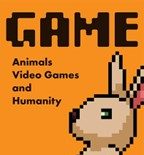
What can video games teach us about our relationship with animals? Hanna Hellesø Lauvli's review of GAME by Tom Tyler urges us to see life from the other side of the food chain.
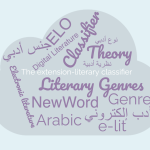
Reham Hosny (University of Cambridge and Minia University) asserts that works of e-lit resist straightforward classification due to their "hybrid and mosaic nature." This complexity poses formidable hurdles in the development of computational models aimed at categorizing e-lit into distinct genres. The challenge is further compounded by issues such as media format obsolescence, ephemerality, interactivity, and the wide array of manifestations across different platforms. Despite these formidable challenges, Hosny not only explores potential solutions but also provides a comprehensive framework for understanding the core issues associated with the classification of e-lit.
On this first Sunday in July 2023, as the Electronic Literature Organization prepares for its meeting in Coimbra, Portugal, we present a set of reflections by four ELO members who co-organized this Organization's 2021 conference fully virtual conference, titled "Platform (Post?) Pandemic." What we have is an insightful critique of platform conferencing. The concepts of datarama turned dadarama offer a refreshingly literary way of reorienting the discourse of the ELO's annual conference.
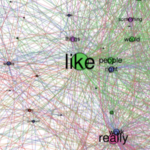
Cayley's image is an apt illustration of an essay that's also a work of 'digital language art.' Although Cayley incorporates new material and newly contextualized examples, referring chiefly to his own work, what follows is also the reconfigured rewrite of a recent essay for a series of conferences and a peer-reviewed online journal, Political Concepts, which can be found online at: https://www.youtube.com/watch?v=LDJRQYRWpvQ.