2023
"Why," Serafina Aquilino asks, "is Internet literature so popular in China, compared to other countries?" The answer may be found in the Chinese "unique literary production." Print, nothing less, is responsible for China's world leadership in e-Lit. An unexpected emergence that Aquilino describes in her "brief history" of e-Lit in China, from Cai Zhiheng’s The First Intimate Contact (1998) to the present rise of Chinese literary forums and literary websites.

Taking an ironic, Icarian twist on Steve Tomasula's Ascension, Stuart Moulthrop situates Tomasula's novel in a subterranean, encyclopedic lineage that includes print fictions like Joyce’s Ulysses, Dos Passos’ U.S.A. trilogy, Pynchon’s Gravity’s Rainbow, DeLillo’s Underworld, David Foster Wallace’s Infinite Jest, and Zadie Smith’s White Teeth – novels that are, as Edward Mendelson put it, “the products of an epoch in which the world's knowledge is larger than any one person can encompass.” It's an experimental lineage that is, arguably, one of the more noteworthy carryovers from print to digital literature; a genre that Moulthrop (2013) and his near contemporary Michael Joyce (2007) have termed the “novel of internet.”
This article examines how the formation of data can be seen as an aesthetic way of making sense. Following work in digital aesthetics, the article proposes to understand digital artifacts and processes via formalization and operation of media language. Li traces this idea through several examples from recent literature, film, games, and artwork in South-East Asia. Together with these examples, Deleuze’s philosophical thoughts on a genesis of sense production are re-considered in order to understand a formal way of making sense in producing the new. The notion of “abstraction” from ancient Chinese mathematical thought offers a re-consideration of Deleuze’s “intensive virtual”, that is, the way the formal, the operative and abstraction determine the extensive intensive. Sense-Data and atmospheric language address computation’s materiality in engendering the formal and the operative modalities of media language, as a way of producing states of being and becoming in cultural activities in which the digital is an agency.
Davin Heckman offers thoughts on Matthew Kirschenbaum's now well-known essay in The Atlantic, The Textpocalypse (2023). Contemplating our own limits in digital media scholarship, including the reinforcing of technological determinisms, Heckman discusses the concept of transindividuation and its relationship with technology, or, the process of becoming an individual through participation in culture and society.
Avoiding the "twin pitfalls of either Luddite dread or AI boosterism," in this essay George MacBeth offers a close Re-Reading of Jhave's ReRites.
In this republished Medium essay, Ian Demsky takes a personal and playful dive into AI image generation.
In this substantial and original analysis (which is more a review essay than a simple review) Joy Wallace further extends a series of five reflective pieces on the renowned Australian poet, performer, and multimedia writer, Hazel Smith.

2022
In his review of Glitch Poetics, Richard Carter finds more than a close reading of contemporary e-lit and AI enhanced writing. In a book that is both aesthetic and machinic, critical and creative, Jones explores the nature of writing itself "and, indeed, reading, in an environment saturated by the rhythms and predilections of digital code."
What Mario Aquilina and Ivan Callus accomplished in their "13 Ways of Looking at Electronic Literature", Lisa Swanstrom does for Ecocriticism. Taking as her starting point, Cary Wolfe's book on Wallace Stevens, Swanstrom explores each and every one of Stevens's "13 Ways of Looking at a Blackbird." What emerges, alongside Wolfe's ecocriticism is a resurgence, in literary studies, of the art of close reading.
Where Tomasula (in his own words) makes “no attempt to historicize the field,” preferring to offer “a snapshot” of a vibrant body of conceptual literary art, Gonzalez in this review arrogates the position Tomasula passes on, and proposes that the many texts in Tomasula's "immensely rewarding" anthology continue in the spirit of postmodern literary forms and show the continuing potency of the postmodern toolbox.

After having lived through three generations of electronic literature, and having experienced pre-web, web, and post-web literary periods, Will Luers takes a step back and advocates an "independent digital culture" in which literary artists might explore "a reality between language and the ineffable (be it artistic, religious or secular)." A mixture of technics and magics, we may be approaching a fourth generation of e-lit that is closer to pre-industrial folklore than it is to our present, technically managed space for individual and collective "creativity."
In this article, Richard Carter outlines an ongoing critical and creative engagement in electronic literature, digital sensing, and ecological concerns. Like many who are now publishing critical and creative works together (particularly in The Digital Review), Carter situates his practices in a set of entangled disciplines, and then discusses his developing project Landform.
While Gastropoetics is a marginal practice, these culinary experiments explore the relational dynamics of cooking, hospitality, and eating as persistent humanistic practices, even as such practices are increasingly mediated by "food selfies" and other emerging, performative taste practices. Key to understanding the appeal of gastropoetics is the ad hoc nature of human production and consumption (see de Certeau's "everyday life") performed under the constraints of the generated menu, of the platform, and of the mnemotechnical system itself.
Dani Spinosa reflects on the relocation of e-Lit scholarship and pedagogy "in the remote classroom for the precariat writ large."
While presenting a series of four selected E-Lit artworks, Marques and Gago demonstrate how our recent pandemic will affect new media art, similarly to the ways in which the Athens Plague affected the writing (and reception) of Greek tragedies. And the same goes for Cinema and Aids, smallpox and illustration, photography and the third bubonic plague, usw.
As a follow up to the series of interviews with Ben Grosser in February and March 2021 (published later that year in ebr), we include here a more settled, post-pandemic set of reflections. In the interviews, Grosser noted how "the realities of the pandemic necessitated back then," and maybe still does, "a degree of vigilance about new information": is there anything new that we need to know? The flood of information, however, has been less about knowing and acting on that knowledge than it is about keeping us engaged, and returning us daily, hourly, and minute by minute to our digital doomscrolls. For this newly produced populace that is largely stuck online, Grosser here discusses a net art / e-lit project of his own, an alternative software interface called The Endless Doomscroller.
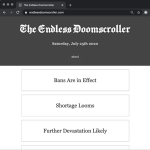
A critical encounter with one of alt-lit (alternative literature) movement’s most renowned contributors, whose moment (like many in this scene) has passed. Citing Christian Howard, Leah Henrickson advances the argument that “[w]e’re at a turning point in literary studies, and we need to confront how the changes in mode are affecting – and are affected by – the alternative networks of circulation within these digital spaces.”
Through the examples of three types of digital stories, including an interactive narrative for the smartphone based on notifications, a web narrative based on a real time data flow, and the widely used social media feature of stories, Bouchardon and Fülöp explore the relationship between the digital, temporality, and narrative. They ask, "what new narrative forms, or even new concepts of narrative do these new temporal experiences provided by digital technology offer to us?"
Reflections on an emerging digital poetry whose primary theme is ecological loss, and personal reminiscence.
While defining the art object in a post-digital world, Maria Goichoechea de Jorge observes in media artists a nostalgia for an analogue craftsmanship; a rebellion against machinic perfection; and a resistance to forms of human creativity that propel us into an ever more profound symbiosis with our technological lifeworld.