2007
Marjorie Perloff reflects on the legacy of misreadings of Robert Creeley's work and argues that his complex poetics should be read transnationally.
In his review of two of Robert Creeley's last published books, Douglas Manson urges us to read these late poems as sending ideas outward, toward an "outside," so that we begin gathering in tomes, searching for quotes.
Douglas Barbour reads Marjorie Perloff's Differentials: Poetry, Poetics, Pedagogy as a notable addition to her oeuvre, another grab-bag of pertinent, impertinent, and always provocative readings of both a wide range of works and some of the social/cultural contexts in which we read them.
Søren Pold explores the ways in which Christophe Bruno's Iterature expands the notion of literary form and shows what happens when words are no longer only part of a language.
Adalaide Morris considers 'tutor texts' in the Electronic Literature Collection and, in doing so, articulates a poetics for the emerging field of e-lit. Instead of fulfilling Ted Nelson's dream of 'computer lib,' the most compelling entries in the Collection emphasize the continuing necessity of writing under constraint. When the revolution turns out to be, not a liberation from a culture of control but its transformation, practices long familiar to experimental poets in print become generali...

John Zuern considers the significance of the first volume of ELO's Electronic Literature Collection for the future of electronic arts.
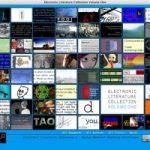
Chris Funkhouser reads the Electronic Literature Collection Vol. 1 as a crucial document, an effective reflection of literary expression and areas of textual exploration in digital form.
Sandy Baldwin identifies Eduardo Kac as a conceptual artist, a forerunner of electronic poetry, and a critical writer whose essays perform their own content: "writing on new media art as new media art."
Eugene Thacker resituates the work of Eduardo Kac, not as art applied to the life sciences, but as a form of bio-poetics, consistent with the electro-poetics that has been a longtime focus of critical writing in ebr. Rather than reduce the work to its material (in life-forms, or in text, or in code), Thacker identifies ways that language, form, and life intersect in works of bio-art.
For Jay Murphy, Clayton Eshleman in his JUNIPER FUSE makes a resounding case for lived experience, for the tortuous growth, however partial or fragmented, as rooted in self-suffering as modes of vision and dream.
For Angela Szczepaniak, Canadian poet Stephen Cain visually distorts language by blurring the borders of poetic language and national identity, which are often assumed to be much more clear and distinct than they actually are.
The collection of innovative writing Biting the Error: Writers Explore Narrative is, for Janet Neigh, also a refreshing example of innovation of the anthology genre itself.
Three recent poetry publications by Nate Dorward's press The Gig are reviewed by Greg Betts; these are not poems so much as environments outside of, perhaps astride, the contingencies of systems.
Mike Barrett evaluates Steve Tomasula's The Book of Portraiture in terms of its place between tradition and artistic innovation in the 21st century.
Katherine Weiss revisits Hugh Kenner's playful work of scholarship Flaubert, Joyce, and Beckett: The Stoic Comedians, a book which offers a glance into the more experimental scholarship of 1960s France and provides an analysis that to this day seems original.
In a reading of Christopher Nolan's films (with and against texts by Poe, Wittgenstein, Searle, and Derrida), Walter Benn Michaels examines the autonomy of the work of art.
Stephen Hawkins engages with the "web of counterintuitive, paradoxical, contentious and yet important claims" that he identifies in Gilles Deleuze's Proust and Signs.
Stephen Hawkins reviews Ronald Schleifer's Analogical Thinking, arguing that despite Schleifer's attempts at interdisciplinarity, his book falls short of a truly collaborative approach.
Geneviève Brassard defends Gerald Graff's original approaches in Clueless in Academe against his critics - for the problem with Graff's book does not lie between the covers but rather between the ears of those who fault him excessively for sins of omission and commission.
Darren Tofts and Lisa Gye introduce the collection of essays, appearing here in the electropoetics thread, from the Alt-x e-book The Illogic of Sense.