2026
Interface simulations work by making digital tools feel like the ones you already use, but what happens when you actually use those tools for a living? This review tracks how s.p.l.i.t.'s amber-on-black terminal horror turns most convincing precisely where it becomes most uncomfortable for the expert player.
In this review, Roger Whitson looks into the book Living Surfaces: Images, Plants, and Environments of Media by Aberlardo Gil-Fournier and Jussi Parikka for insight into how the aesthetics of earth can become visible through media mapping.
In this perceptive review, Mehulkumar Desai examines Deena Larsen's Stone Moon throughout Larsen's creative journey, first as an unreleased work in Storyspace in the 90s to being released in Twine in 2025. Uniting cultural and archival praxis, Desai's review discusses how we might look at creativity in the technological continuum.
Kiera Obbard reviews Reading #Instapoetry: A Poetics of Instagram, a new collection of essays on the often maligned genre of Instapoetry.

Daniel Johannes Rosnes' playful review of Kyle Booten's Gyms sees Rosnes at the mercy of an AI writing companion, who aides his reflection on the exercises Booten provides and the ways in which they reveal the potentialities and pitfalls of large language models.
In this review, Deena Larsen provides a fantastic overview of N. Katherine Hayles' latest book, Bacteria to AI. By diving deep into the panpsychic realities of Hayles's views on cognition, Larsen ultimately questions whether electronic literature could be integral to understanding the umwelt(s) of AI.
Bengü Demirtaş's analytical review of Joseph Conte's latest book, takes the reader on a blow-by-blow breakdown of Transnational Politics in the Post-9/11 Novel's central arguments. While praising the book's positives, Demirtaş reveals the difficulty both Conte and the transnational novelists he examines encounter in 'representing the unpresentable'.
2025
Cecily Raynor reviews Cartografía crítica de la literatura digital latinoamericana, a collection of essays that shines the spotlight on the vast and diverse corpus of Latin American electronic literature.

Will Luers contributes to current debates on AI by engaging with Jeffrey West Kirkwood's Endless Intervals: Cinema, Psychology, and Semiotics. Luers examines the parallels between AI and cinema technology as "thinking machines," both structured around intervals that produce perceptual and conceptual unities. What we have, in cinema and AI no less than human cognition, "is a reevaluation of the unity of consciousness."
Gabriela Jarzębowska reviews Interpreting Meat by Teddy Duncan Jr. By unmasking the hidden libidinal and discursive investments in meat, Duncan urges us to imagine a different kind of relationship with animals—one grounded not in domination or guilt, but in awareness, responsibility, and a reshaping of desire itself.

2024
Research-librarian John-Wilhelm Flattun reviews Tactical Publishing: Using Senses, Software, and Archives in the Twenty-First Century by Alessandro Ludovico. In the digital era of reading and writing — where new forms are constantly emerging old traditions wither away — how can we navigate the ever-changing landscape of publishing?
Lea Laura N. Michelsen reviews Machine Vision: How Algorithms are Changing the Way We See the World by Jill Walker Rettberg. Machine vision is all around us, for good and bad, but who has the power to influence how we use it?
A total solar eclipse occurs when the moon slides between the sun and the Earth, aligned precisely so that the lunar body appears to block the solar surface entirely from view. In this autobiographical essay, Steve Tomasula, an Illinois-based writer known for collaborative image-text assemblages, from TOC to Ascension, that convey how and why humans’ existential sense of reality can vary so radically across time and space, recalls an April 2017 Midwestern road-trip pursuing the path of the total eclipse. In Tomasula’s account of the totality, the multiple meditations surrounding this predictable celestial event only intensify the sublimity of the shared experience and its disruptive systemic effects.

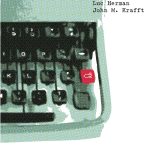
Little is known about the famously private Thomas Pynchon, but can we learn anything from an early manuscript of V.? Hanjo Berressem reviews Becoming Pynchon by Luc Herman and John M. Krafft.
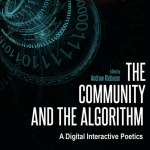
Daniel Punday reviews Andrew Klobucar’s edited collection of essays, The Community and the Algorithm: A Digital Interactive Poetics.
2023
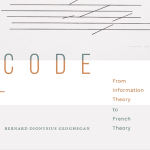
Is it possible to discover digital prophecies in thinkers like Lacan, Barthes, Derrida, Foucault, Deleuze, and Baudrillard? Heckman has a go at it in this close reading of Dionysius Geoghegan's Code: From Information Theory to French Theory.
Martin reviews Astrid Ensslin's Pre-Web Digital Publishing and the Lore of Electronic Literature, a book that addresses the knowledge gaps surrounding the early era of digital creation and publishing, while testifying to the necessity for multidisciplinary approaches to this field of study. Martin discusses the reconstructivist stance from which Ensslin labors to embed digital literature into our larger understanding of the literary arts.

In his review of Mark Amerika's My Life as an Artificial Creative Intelligence (2022), David Thomas Henry Wright highlights Amerika's negotiation of human, nonhuman, symbiotic creative practices in comparison with more traditional (including traditionally experimental) forms of writing.

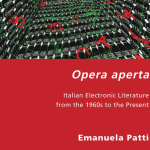
Starting with Umberto Eco's 1962 essay, "Opera aperta," and progressing into Emanuela Patti's tentative forays into Italian Electronic Literature from the 1960s to the Present, Roberta Iadevaia nicely locates a trajectory for Italian e-Lit, albeit one that is still open, "in contention," without any "encyclopedic guarantee, and no single world order on which our imaginative projections can rest."
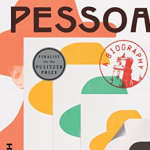
For Fernando Pessoa, as for the roughly 600 texts that make up his Book of Disquiet, and the estimated 136 heteronyms that Pessoa inhabits in his own writing, there "is life, and there is writing, and they must remain immiscible." Richard Zenith's attentive biography of Pessoa succeeds, in the words of Portuguese literary scholar Manuel Portela, in "forming a homogeneous mixture" when all of the names and textual experiences are brought together in a single, biographical narrative.