2026
If electronic literature does not exist in Wikipedia, it does not exist for AI or search engines either. Larsen issues an urgent call for writers, scholars, and readers to become Wikipedia editors before the field disappears into algorithmic silence.
Mary Shaver cautions budding writers against thinking that their biggest tragedies need to defined their work, and instead offers some alternative exercises to find interesting stories in the mundane.

In this essay, Jon Ippolito discusses the meaning of "friction" in the context of higher education, via an exploration of what friction entails, what varieties are beneficial for students, and what aren't. In doing so, he creates the starting point for conversation in "Friction and Education: The Discussion".

In this provocation, Jon Ippolito questions what human capabilities AI extends and what capabilities it removes. In doing so, he charts the evolution of human writing processes alongside technology while speculating on what future human writing practices will look like.

In his speech from Joseph Tabbi's festschrift in May 2025, Daniel Johannes Rosnes discusses his brief time spent working with Tabbi, covering the trust and responsibility he was immediately offered to the importance of Tabbi's view of publishing as a collaborative effort, formed by a "network of people".
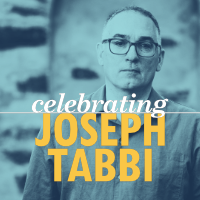
Taking a trip to the first page of publications available on the current ebr website, Cary Wolfe frames electronic book review as an overlapping network of people connected over a lifetime by Joseph Tabbi. A network Wolfe himself became involved with after spotting a magazine notice in the 1990s.
In this recollection—published as part of the Celebrating Joseph Tabbi gathering—Kurt Heintz chronicles the early days of a strand of the electronic literature community as it moves from Chicago's Belmont Avenue to the UCLA'S 2002 ELO Conference. In doing so, Heintz argues that, then and now, Joseph Tabbi acts a vital point of convergence for the electronic literature field.
Jan Baetans delivers a personal message to ebr's co-founder and long-time editor-in-chief, Joseph Tabbi, celebrating his retirement. Describing Tabbi as "the ideal today of the digital humanities," Baetans celebrates Tabbi's ability to synergize traditional humanities methods with the digital turn.
In a print version of his speech given at Joseph Tabbi's festschrift, Nick Montfort discusses Tabbi’s instrumental role in the understanding of index-card-based composition and collaborative glossary development. In doing so, Montfort both contrasts and connects these two disparate means of writing, while arguing that Tabbi led a second life as a cyberpunk, thanks to the founding of ebr.
Continuing the celebration of Joseph Tabbi's work, John Cayley discusses Tabbi's foresight and ability to gather his peers together, which led to the creation of vital knowledge infrastructure for the blossoming field of electronic literature.
N. Katherine Hayles, in a personal contribution to the Celebrating Joseph Tabbi gathering, details the many ways her and Tabbi's paths have crossed over the decades. Noting the changes she's observed in Tabbi over time, Hayles reflects on the positive outcomes of aging.
In her speech, originally given at Joseph Tabbi’s festschrift, Tegan Pyke details how she met Tabbi and became a part of two of his key knowledge infrastructure projects. Discussing Tabbi’s innate ability to connect with people and collaborate, Pyke frames community building as a vital part of Tabbi’s academic legacy.
In a brief, personal message to Joseph Tabbi, Søren Bro Pold reflects on the many ways Tabbi contributed to the academic community surrounding electronic literature and the importance of electronic book review as a lasting arena for open discussion in an age of closed platforms.
In ebr co-founder Mark Amerika's speech from Joseph Tabbi's festschrift—originally given at the University of Bergen, Norway—Amerika explores the founding of electronic book review, the radical foresight Tabbi provided, and the journal’s links to post-publishing practice. As part of this, Amerika poses Tabbi's legacy not as something fixed, but as a challenge of continuing reconceptualization.
Anna Nacher connects the ecosystem within Coimbra's Biblioteca Joanina to networks of care within academia and, in this speech originally given at Joseph Tabbi's festschrift, thanks Tabbi for his role as friend and mentor. As part of this, Nacher stresses that time is essential to building the type of service Joe has performed through his career; the building of community.
In his opening speech at Joseph Tabbi's festschrift, Scott Rettberg details Tabbi's journey through academia, his many achievements, and the projects he founded. Rettberg also reflects on his friendship with Tabbi, which started in Chicago in 1999 and, over the decades, has spanned the globe and numerous life events.
In this essay, David Ciccoricco reflects on his early challenges in the then-emerging field of electronic literature and the pivotal role Joseph Tabbi played in Ciccoricco’s studies. In doing so, Ciccoricco sees the similarities between his and Tabbi’s thinking. Namely, that literary narratives create a reciprocal loop between media and cognition.
2025
Hannah Ackermans introduces The Living Glossary of Digital Narrative via a discussion of digital communities and unintentional acts of exclusion, highlighting the importance of a shared vocabulary for accessibility in scholarship.

In this conversation with Yolanda De Gregorio Robledo, e-poet María Mencía discusses her journey as an artist and scholar. In doing so, María reveals her artistic interests, the influences the electronic literature community has had on her work, and the importance of highlighting women's contributions to the field of electronic literature as a whole.
A special call for papers celebrating the work of Joe Tabbi—electronic book review's founder and long-term editor-in-chief—which will be published in a special issue of electronic book review during the journal's 30th anniversary year.