2022
In this in memoriam, Patrick Lichty remembers community member and artist, the late Jeremy Hight. We at EBR remember Jeremy fondly. His creative works will continue to be respected for the contributions they make to e-literature.
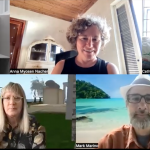
Anna Nacher chats with Mark Marino, Cathy Podeszwa, Joellyn Rock, and Rob Wittig—artists, designers, and new media theorists all—to discuss the impetus and impact of their long-running netprov collaborations (communal and improvisational creative writing conducted online). Interview conducted October 2022.
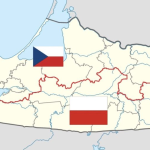
Anna Nacher explores the emergence and spread of the viral hashtag "Kralovec," a satirical Czech language meme protesting the Russian annexation of Ukrainian territory in September 2022. In discussing the social and political impact of memes as collaborative sites of making meaning through media, Nacher analyzes the "creative frenzy" that emerges when protest becomes memetic.
Melinda M. White's itinerary through the iDMA 2022 Weird Media Exhibition in Winona consider the various forms of weirdness or strangeness evoked by the exhibited works. She explores how strangeness characterises human relationship to constantly transforming technologies, how it manifests itself in our difficult pasts, and how it points to alternative of unexpected futures. While the weird encounters with the exhibition works in no way point to a single, unifying thread or approach to the theme, White's account reveals shared concerns, tendencies, and connections among them. Temporal distance and experiences of loss render familiar technologies, objects, or places unfamiliar; the borders between human and non-human entities and perspectives is blurred or even discarded; humor and surreal irreverence are employed to raise urgent questions on ecology, ethics, and individual or collective narratives and subjectivities.
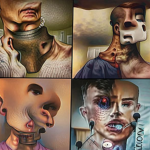
Mariusz Pisarski takes us on a detailed tour through the cognitive intricacies of hypertext classic Victory Garden's migration from Storyspace (circa 1992) to the Web. In so doing, Pisarski observes how years of Stuart Moulthrop’s experience as a mentor and teacher of digital literature, and as a practicing hypertext scholar and writer, are built into the anniversary edition of Victory Garden.
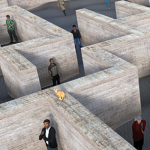
"I too am a psychic automaton." Mark Amerika, a founding publisher of ebr, shares the onto-operational sources of his (capital C) Creativity with ebr editor Will Luers.
In a series of interviews led in February and March 2021, Nacher, Pold and Rettberg examined how contemporary digital art and electronic literature responded to the pandemic. Their project on COVID and electronic literature was funded by DARIAH-EU and resulted in the exhibition prepared for the ELO 2021 Conference & Festival and the documentary film that premiered in June 2021 at the Oslo Poesiefilm Festival. xtine burrough is one of the creators of 13 works that were interviewed for the project. She generously shares her thoughts on life and creativity, collapsing spaces and the meaning of a domestic art practice during the pandemic.

Jeremy Douglass and Mark C. Marino reflect on the activities of the Critical Code Studies (CCS) Working Group 2020.
Mark C. Marino and Jeremy Douglass discuss the field of Critical Code Studies (CCS) and introduce three reports about the discussions of the CCS Working Group 2020.
Meredith Finkelstein surveys key methodological aims of CCS, and considers the ways attending to code can enrich understanding of digital works, looking specifically at digital artist and programmer Eugenio Tisselli’s code for Amazon.html
Patricia Silva explores the impact of Google’s Search algorithm on BIPOC and queer cultures and highlights the iconoclastic work of the Feminist.AI collective, a community of academics, artists, and designers who seek to empower people with ethical ways to store, use, and search information.

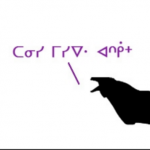
Kalila Shapiro discusses the problematic supremacy of English in global programming, and explores ways that Indigenous programming languages, including Jon Corbett’s Cree#, have sought to break down this “cultural coding barrier”
2021
In a series of interviews led in February and March 2021, Nacher, Pold and Rettberg examined how contemporary digital art and electronic literature responded to the pandemic. Their project on COVID and electronic literature was funded by DARIAH-EU and resulted in the exhibition prepared for the ELO 2021 Conference & Festival and the documentary film that premiered in June 2021 at the Oslo Poesiefilm Festival. Ben Grosser is one of the creators of 13 works that were interviewed for the project. He generously shares his thoughts on life and creative practice during the pandemic, the impact of platforms on the digital culture and creativity and platform culture in general.

Jin Sol Kim and Lulu Liu interview the Decameron 2.0, a Canadian collaborative made up of professors and artists who are inspired by Giovanni Boccaccio’s plague narrative The Decameron (1348-1353) to develop creative works during and in response to the COVID-19 pandemic.
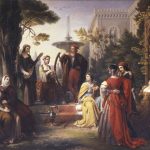
Nacher, Rettberg, and Pold offer a curatorial statement about the COVID E-Lit Exhibition--one of the many exhibitions held at the ELO 2021 conference. This Exhibition in particular, they explain, focused on reactionary, reflexive, and recovery-based art in response to the COVID-19 pandemic.
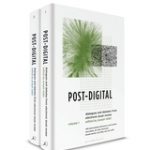
The lively dialogue among the contributing authors, ebr’s longest-serving and newly appointed editors, and the engaged and interested audience, which accompanied the Post-Digital / Dialogues and Debates book launch in September 2020, is an interesting insight into the recent debates on the multifaceted ramifications of digital disruption and the ways in which it has transformed our society, culture, and aesthetics. The discussion throws some light as well on the always fascinating history of the early electronic literature initiatives which had laid the groundwork for what eventually turned out to become the whole new field of intermedia literary practice and the sub-discipline of trans- and interdisciplinary academic inquiry. The authors of the mammoth 2-volume anthology recruit from the variety of contexts and offer diverse looks at the post-digital condition of our contemporaneity.
In this conversation with ebr Editor Lai-Tze Fan, internationally acclaimed artist Caitlin Fisher talks through her origins, inspirations, and processes with a clear message: things can always be unlocked with more than one key and stories can always be told with more than one method. Fan asks Fisher about the 20th anniversary of These Waves of Girls at the end of Flash, the archival impulse of her stories from doll collections to hand-held museums, and the importance of creating tiny stories out of high technologies and giant institutional labs. Of the many lives Fisher has already lived and of her works to come, this conversation gives only a glimpse—a snap of the universe.
Dani Spinosa and Lai-Tze Fan discuss the need for a Canadian digital poetics, as well as for an understanding of its past developments, present shifts, and future possibilities.
Dani Spinosa asks Bertrand Gervais about the place of digital literatures across Francophone and Anglophone Canada, the issue of genre and labelling in the field, and his work with NT2. Gervais here foregrounds the ground-breaking contributions of Québécois writers, artists, and scholars that are foundational to Canadian digital humanities and media studies across the country, and speaks to how important it is that digital publishing prioritize accessibility and evolution.

The ELMCIP Electronic Literature Knowledge Base is a large-scale digital humanities database that emerged from a six-nation European research project on electronic literature. The Knowledge Base has since grown to become the most comprehensive open-access contributory database in the field, and is still actively developed. The project director, Scott Rettberg, reflects on the process involved in developing the database and the challenges involved in continuing to document the ever-changing landscape of the field of electronic literature.