2024
This roundtable discussion, featuring Danielle Dutton, Edwin Frank, and Martin Riker took place at the Gaddis Centenary Conference in St Louis, on October 21st 2022. It has been lightly edited for clarity and was transcribed by Marie Fahd.

Chaired by Rone Shavers, transcribed by Marie Fahd, and joined by Jeff Jackson and Jacob Singer, this roundtable and discussion took place at the Gaddis Centenary Conference in St Louis, on October 22nd 2022. It has been lightly edited and expanded.
Synthesising the published record, Ted Morrissey chronicles and analyzes the relationship between literary Williams Gaddis and Gass, which began in 1976 after Gass had helped secure the National Book Award for Gaddis's J R. Morrissey examines not only the pair's shared social history of meetings, conferences, and letters, but also examines the commonalities in their approaches to literature, and their affinities of taste, habit, and vision.
We asked our contributors a set of simple questions: what do you think Gaddis Studies has best covered already, what do you think are its prospects for the future, and what future avenues would you like to see explored?
Ali Chetwynd's introduction to the Gaddis centenary gathering on ebr.
A talk given on October 20th 2022 at the William Gaddis Centenary Conference at Washington University St Louis. The version presented here is the talk as delivered, with minor edits only for clarity on the page and standardized grammar. Steven Moore prefers to leave the talk as a document of its original presentation, rather than changed into an academic article with the attendant scholarly apparatus of footnotes, works cited, and so on.
Davin Heckman on how his penchant for pranks got him to appreciate netprov and how he turned it into a versatile pedagogic tool that helps to broaden his students’ social sensibilities.
2023
EBR would like to express thanks to Dene Grigar and Deena Larsen at Washington State University Vancouver, for organizing and hosting a memoriam for Marjorie C. Luesebrink and for letting us share the memoriam in our journal.

Returning to past formats in the electronic book review such as 'designwriting from the mid-1990s,' ebr co-editor Lai-Tze Fan alerts readers to a feature that is as much a part of our journal's publication, and positioning, as the essays themselves. As annotations in the margins of print texts allow readers to reference earlier texts, a more interactive, intertextual and perhaps more accessible conversation is made available within and among digital texts.
Multimodal AI trained on YouTube-TikTok-Netflix (object-segmented and identified audio-video-speech) and public domain science data (that exceeds the spectrum of human sensorial field) will be grounded in a world that is in some ways vaster than that experienced by a single human neurophysiology.
The editors at ebr asked Bobby Arellano to draft a reflection on the passing of George Landow. Working with Landow in the early years of the Victorian Web, Arellano transferred most of the documents from the Intermedia system into Storyspace and relinked them. We present Arellano's reflection, in memoriam, along with an official obit provided by Ruth Landow (George's friend of 78 years and his wife of 57 years).

Rob Wittig and Harlin/Hayley Steele — a larpmaker and media artist whose work explores tactical performance and “narrative care,” a collaborative process of excavating narratives that have been pushed underground through systematic forms of harm — discuss Harlin/Hayley’s roots in the live action roleplaying (LARP) world and synergies between LARP and netprov. While laughing a lot.
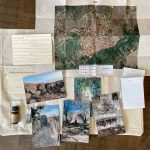
A post-closing catalog essay on a curious and original exhibition, one that rethinks the very idea of a group show, from singular research journeys by Kate Collyer (not her first) to Alaska, Megan Porpeglia to Sardinia (on a residency for the first time visiting her family roots), and Lorrie Fredette to Cape Cod. Like McElroy's own literary works, these twenty-two artworks are presented through several shifting lenses.
Rob Wittig and Alex Mitchell discuss the very beginnings and the most recent iterations of Netprov, with a focus on generative AI, collaboration and improvisational writing.

Rob Wittig and Scott Rettberg discuss the pioneer times in digital writing and electronic literature, a time long ago, in a Galaxy far away, when the audience at literary events did not have a clue about hypertext and links.
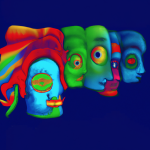
Rob Wittig and JT Johnson – a digital artist and writer – chat on the beginnings of Netprov, design of fictional worlds, and talent shows.
Image: DALL·E 2023-03-02 20.01.05 - "electronic literature can only exist up to a certain point, and then it dissolves itself as it becomes a discipline."

Rob Wittig and Johannah Rodgers – an independent scholar and a digital writer – discuss the collaborative and community-building nature of Netprov.
Image: DALL·E 2023-03-02 19.55.13 - "a group of people writing collectively a novel on financial crisis."

Rob Wittig and Claire Donato - a writer, a multidisciplinary artist, and a netprov contributor – discuss how a sense of performativity linked with playfulness and joy of collaborative improvisation constitute the very core of netprov.
Image: DALL-E, at a prompt: “A futuristic image of a group of people and AI improvising a theater play”.

Rob Wittig and Jean Sramek - a playwright and netprov contributor – discuss how netprov as networked collaborative writing has changed since one of its earliest instance, Grace, Wit & Charm.
Image: DALL-E, at a prompt: “A group of people, plants and animals collaborating on digital platforms to write a poem”
