2017
Reading practices have changed along the course of history. Before the ‘democratization’ of the written word - from Homer's Iliad to the medieval troubadours and to more recent public and private oral reading traditions -, reading has long been associated with listening. Today, in the age of algorithms and ‘smart’ interfaces, the sharing of language between humans and computational devices is increasingly ubiquitous and, with the standarization of artificial intelligence systems like Siri, Cortana, and Google Now, we are starting to speak and to listen to machines. In the field of digital literary creation, one example of aesthetic reflection on the questions raised by such networked ‘smart’ interfaces is John Cayley's The Listeners (2015), "a linguistic performance — transacted by visitors and Amazon’s voice-activated Artificial Intelligence and domestic robot, Alexa" (Cayley, 2015b). Through an analysis of The Listeners, articulated with Bernard Stiegler’s notion of the digital pharmakon, this paper aims to reflect on the encounter between literature and digital technologies. Three ideas will be highlighted: 1) the ways in which the technical, economic and political layers that constitute our digital devices pre-determine their usage (how they operate and are operated); 2) the automatic processing of language and orality as interfaces of mediation between humans and “smart” devices; 3) the literary implications of aurality and aurature.
In this review of Mark Seltzer’s The Official World, Ulmer reflects on the interdependence of “the official” and “the unofficial” in contemporary constructs of reality.

In a review that addresses (and exposes) the founding myth of the "digital humanities" (DH), formerly known as "humanities computing,” Roberto Simanowski and Luciana Gattass measure just how much the 99 articles collected by Mathew Gold and Lauren Klein have overturned "academic life as we know it."

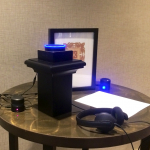
Amazon’s Alexa, Apple’s Siri, Microsoft’s Cortana, and Google Now: How will our encounters with these intelligent personal assistants - robots we’ve invited into our homes to speak with and listen to us, who share this data with vectorialist institutions that monitor our networked transactions - alter both human language and our efforts to lead meaningful lives? In a wide-ranging, philosophical essay that exposes various myths of computation while presenting a candid assessment of the rapidly evolving culture of reading, poet John Cayley speculates that literature will be displaced by aurature. Listen up, readers: A major challenge in the programming era will be to develop linguistic aesthetic practices that intervene significantly and affectively in socio-ideological spaces thoroughly saturated with synthetic language that are largely controlled by commercial interests. The time for aesthetic experiments that disrupt the protocols of a still-nascent aurature is now.
This essay was reprinted in part for the Handbook on Electronic Literature (Bloomsbury 2018).
2016
An Introduction to the gathering.

In this introduction to her gathering on Digital and Natural Ecologies, Lisa Swanstrom pulls back from the tendency towards apocalyptic speculation that is commonplace in popular discourse of technology and nature. Instead, Swanstrom offers a more grounded discourse that addresses the impact of the digital on the natural.

Bernard Stiegler's "Relational Ecology and the Digital Pharmakon."

2015
In Pasts and Futures of Netprov, Rob Wittig articlates a theory for Networked Improv Narratives, or "Netprovs." Wittig, an innovator in this novel form, situates netprov at the interesection of literature, drama, mass media, games, and new media. Transcribed from a presentation given at the Electronic Literature Organization conference in Morgantown, WV, Wittig explores a number of antecedents to the form, documents current exemplars of this practice, and invites readers to create their own networked improvisations.

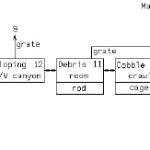
Jerz and Thomas identify our fascination with natural cave spaces, and then chart that fascination as it descends into digital realms, all in order to illustrate the importance of "the cave" as a metaphor for how we interact with our environment.
In the course of examining a number of key concepts in New Materialism, eco-criticism, and feminist philosophy, Melanie Doherty delves into Jamie Skye Bianco's digitally generated "postnature writing." Doherty's rich knowledge of contemporary ecofeminist debates helps to contextualize Bianco's hybrid performance-based works that draw upon a database of philosophical texts and landscapes, like the Salton Sea and Dead Horse Bay, that have been marred by histories of human misuse.

In this keynote address to the 2014 Electronic Literature Organization Conference, Illya Szilak highlights the power of "minor forms" in digital literature. Through a wide-ranging survey of works, Szilak identifies the tendency for "failure" in electronic literature as its most powerful feature: its capacity to deterritorialize the parameters of discourse and expand the potential of subjectivity in the process.
In Sublime Latency and Viral Premediation, Kim Knight addresses the “eco-poetics of the viral” across the biological, social, and digital. Through an analysis of the spread of digital infection, the dynamics of anti-virus software, and digital arts practices, Knight discusses a poetics of fear and desire that is instrumental to the transmission of this virtual pathology. Knight continues, drawing parallels with crowdsourced epidemiology apps that track illness and promote physical health, and makes a powerful case for what Richard Grusin has called the “premediation” of anxiety as a strategy for managing affect in the 21st Century.

Bridging Superfund sites and video games, Alenda Chang’s essay revisits media- and computation-centered definitions of remediation to extend media and mediation past the pale of digital visual technology. Through a parallel consideration of what’s known as environmental remediation—cleaning up or cordoning off polluted sites, using technological or biotechnological methods—Chang argues that human and nonhuman bodies and ecosystems are equally enmeshed in practices of communication and transformation.
*This essay was selected by Cary Wolfe for his print Gathering in the first volume of Post-Digital: dialogues and debates from electronic book review (Bloomsbury 2020).

In this essay, John Cayley builds upon a critical legacy that reflects intensively on the process of literature in an age of machine language. Building on a legacy that includes ebr classics like “The Code is not the Text” and many points in between, “Beginning with ‘The Image’” points to the difficulties of translating a procedural code-based text that “finds” its substance in the repository of text known as the World Wide Web.
Salter's "Convergent Devices, Dissonant Genres" assesses the implications of the iPad for the state of literature. Looking at "traditional" approaches that re-mediate print for digital devices, "enhanced" approaches which add "special features" to extant texts and forms, pre-tablet eliterature re-experienced in the new environment, and finally the creation of original apps with literary qualities, Salter's work is a critical document of the impact a single interface can have on the development of literary culture in the 21st Century.
2014
E-lit authors Stephanie Strickland and Marjorie Luesebrink organized a panel on the "Future of E--Lit" at the ELO 2012 conference, allowing emerging and early career authors to articulate institutional and economic, as well more familiar technological, developments that constrain and facilitate current practice. The panel papers were released in ebr in March 2014. Luesebrink and Strickland followed up with comments on the papers, offering a "progress report" on the future of the field. The individual responses are available as glosses on the essays and in full here.

Jill Walker Rettberg’s Visualizing Networks of Electronic Literature maps the fragmentary and dynamic field of electronic literature by analyzing citations in 44 doctoral dissertations published between 2002 and 2013. Applying “distant reading” strategies to the ELMCIP Knowledge Base, Rettberg identifies key works in the field, shifting genres, and changing approaches to scholarship.
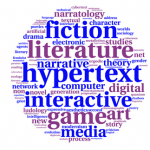
Scott Rettberg's essay, "An Emerging Canon?", highlights the potential for macroanalytic approaches to literary study, specifically in the field of electronic literature. Through his study of the richly populated ELMCIP Knowledge Base, Rettberg analyzes the impact that specific works have had within scholarly and creative communities, and enumerates the potential benefits that this work might have for the preservation, study, and understanding of the field.
In "Nature's Agents," Lisa Swanstrom discusses the agency of objects operating within networks. Specifcally, Swanstrom addresses works which allow nature to correspond with humans in a shared environment, posing provocative questions about the idea of agency itself as expressed in an ecology of action.
This essay is excerpted from Swanstrom's monograph, Animal, Vegetable, Digital: Experiments in New Media Aesthetics and Environmental Poetics (under contract to be published by the University of Alabama Press).
In the following essay, Luciana Gattass discusses the formation of a Brazilian Electronic Literature Collection via analysis of works identified in the ELMCIP Knowledge Base. Positioned between the existence of geographical data and the question of a national literature, Gattass considers the role of the human critic in the age of big data.