2008
Eric Lang (with Pat Harrigan) explains the advantages writers have in crafting adaptations of literary franchises into collectible card games. Lang maintains that, while attempting to remain true to the original, when turning narratives into games, one must "respect the medium."
Jeff Bursey argues for a coherent, if unlikely, set of predecessors for William T. Vollmann: Aleksandr Solzhenitsyn, Blaise Cendrars, and John Cowper Powys. In the process of tracing this genealogy, Bursey defends Vollmann against critics who attack his alleged objectification of his subjects - prostitutes, the poor, and victims of violence.
Jon Adams rifles through the instrument cabinet of the man upstairs by way of William J. Jackson's Heaven's Fractal Net. Adams finds more problems than solutions in Jackson's position that fractals are a fundamental and universal structure of life - a position Jackson stakes out by vacillating between scholarly proof and speculative guruism.
2007
Jeff Tidball contends that the Second Person collection deals too much with the mechanics of narrative and too little with the emotion it can evoke.
Pat Harrigan and Noah Wardrip-Fruin justify their focus on the experience of play over theory in their assemblage of the essays by game designers, players, and critics featured in Second Person - the book.
Brian McHale looks back on the movement in "What Was Postmodernism?" He contrasts postmodernism's canonization with critical constructions of modernism, and moves through contemporary painting to reflect on intersections between the violence of recent history and postmodernism, as the postwar world lived "in the ruins of our own civilization, if only in our imaginations."
Paola Cavalieri challenges the book's notion that human superior ethical worth can be preserved.
Charles Bernstein. Keyword: speed. Speed as a morally coded concept. Speed as success. An ethics of speed. Speed-reading. Virtual reading. Cultural speed-up. Speed kills.
Reading Stephanie Strickland's V: Losing L'una/WaveSon.nets/Vniverse, Jaishree Odin explores the implications of the paradigm shift from modernity to postmodernity for our understanding of reading, writing and living.
Paul Czege explains that he aimed for My Life with Master to be an engine for story creation rather than just another variation on the traditional role-playing game system.
Marjorie Perloff reflects on the legacy of misreadings of Robert Creeley's work and argues that his complex poetics should be read transnationally.
In his review of two of Robert Creeley's last published books, Douglas Manson urges us to read these late poems as sending ideas outward, toward an "outside," so that we begin gathering in tomes, searching for quotes.
Douglas Barbour reads Marjorie Perloff's Differentials: Poetry, Poetics, Pedagogy as a notable addition to her oeuvre, another grab-bag of pertinent, impertinent, and always provocative readings of both a wide range of works and some of the social/cultural contexts in which we read them.
Søren Pold explores the ways in which Christophe Bruno's Iterature expands the notion of literary form and shows what happens when words are no longer only part of a language.
Adalaide Morris considers 'tutor texts' in the Electronic Literature Collection and, in doing so, articulates a poetics for the emerging field of e-lit. Instead of fulfilling Ted Nelson's dream of 'computer lib,' the most compelling entries in the Collection emphasize the continuing necessity of writing under constraint. When the revolution turns out to be, not a liberation from a culture of control but its transformation, practices long familiar to experimental poets in print become generali...
John Zuern considers the significance of the first volume of ELO's Electronic Literature Collection for the future of electronic arts.
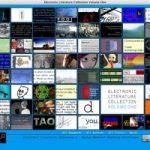
Chris Funkhouser reads the Electronic Literature Collection Vol. 1 as a crucial document, an effective reflection of literary expression and areas of textual exploration in digital form.
Sandy Baldwin identifies Eduardo Kac as a conceptual artist, a forerunner of electronic poetry, and a critical writer whose essays perform their own content: "writing on new media art as new media art."
For Angela Szczepaniak, Canadian poet Stephen Cain visually distorts language by blurring the borders of poetic language and national identity, which are often assumed to be much more clear and distinct than they actually are.
The collection of innovative writing Biting the Error: Writers Explore Narrative is, for Janet Neigh, also a refreshing example of innovation of the anthology genre itself.