2001
Elise Kermani writes about her work with sound and invites readers to locate sounds of their own on the spectrum from noise to sound to music. database programming: Allison Hunter and Ewan Branda.
Cary Wolfe investigates why the reviewers were so rattled by the Lars von Trier film, and in the process puts Jacques Derrida, Stanley Cavell, Slavoj Zizek, and Judith Butler into conversation.
Jaishree K. Odin on the hyperfiction of M.D. Coverley.
A reluctant response to Markku Eskelinen's "Cybertext Theory: What An English Professor Should Know Before Trying," where Hayles discusses her admiration for Espen Aarseth's work... and the limitations within it she has perceived.
Considering hypertext as a subset of cybertexts, Markku Eskelinen offers seven examples of how to implement Espen Aarseth's seven-fold typology.
In response to Nick Montfort's review of Cybertext, N. Katherine Hayles coins an alternative term, cyber|literature.
Marjorie Coverley Luesebrink performs an autopsy on the hypertextual corpse.
For Daniel Punday, Bernard Siegert's historical materialism - a difficult synthesis of historical, literary, and institutional analysis - falls somewhere between Derrida and Foucault. But see also the review in ebr by historian Richard John, who considers Siegert in the line of Walter Ong, Elizabeth Eisenstein, and Harold Innis.
Stephanie Strickland investigates an epistemological shift in web-specific art and literature, from an understanding that is less about structure and more about resonance.
Linda Brigham sees Zygmunt Bauman's Globalization: The Human Consequences as a provocative introduction to our current environmental and economic predicament.
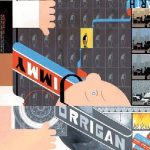
Jan Baetens argues that Chris Ware's print-based comic book, Jimmy Corrigan, has already produced the revolution longed for by Scott McCloud - a revolution, however, that will not be digitized.
Allison Hunter shows how an artist can be fully contemporary without digitizing, streaming, or projecting imagery. Presenting jacquard looms and punch card technologies from the 1950s, difference engines and magnetic core memory stacks, silicon chips in wood housing and digital code on 18th-century woven fabric, Eve Laramee manipulates history like a medium.
In spite of the millennial call for an end to issues in Winter y2k, ebr11 - a new issue - went online at the turn of the year 2000/2001. There would be yet another issue a year later ("Music/Sound/Noise") before the transition to the new interface could be completed.
2000
Tom LeClair surveys six gargantuan texts—both hyper- and print—and finds that size is not all that matters.
Geoffrey Winthrop-Young takes the outside perspective on German media studies.
hypertext? cybertext? hypermedia? webart? while new media critics debate the terms, Talan Memmott has produced the thing itself, a creative use of applied technology.
Every crank has an idea. Every American is a crank. Philip Wohlstetter is an American, therefore - well, you get the idea.
Perusing websites pertaining to literary matters, Eye magazine cites HTML's "gaptoothed rawness" as a hindance to readability in ebr (prior to the journal's redesign).
Paul Harris examines the theoretical aspects of constrained thinking in the age of electronic textuality (in 2000 words, natch!)