Rhetoric and Poetics of AI
Constructed partially of quotations from Big Tech CEOs, academics, and journalists---while interlaying performance with AI cognition---Manuel Portela and Ana Marques da Silva's creative essay imitates a conversation between Rhetoric and Poetics. Through their interaction, the use of such techniques by marketers, doomsayers, and AI itself is laid bare.
“WE will decide the fate of our Country — NOT some out-of-control, Radical Left AI company run by people who have no idea what the real World is all about.” 1 Donald Trump, 27 February 2026, Truth Social

Scene 1
Rhetoric and Poetics are facing each other and in profile to the audience. The screen where images and videos will be projected is positioned in the middle between the two characters. Rhetoric wears a suit and tie, while Poetics wears overalls and a protective helmet. The two characters are identified with their respective labels: a cardboard rectangle suspended at chest height, containing the word RHETORIC for Rhetoric and the word POETICS for Poetics. 2
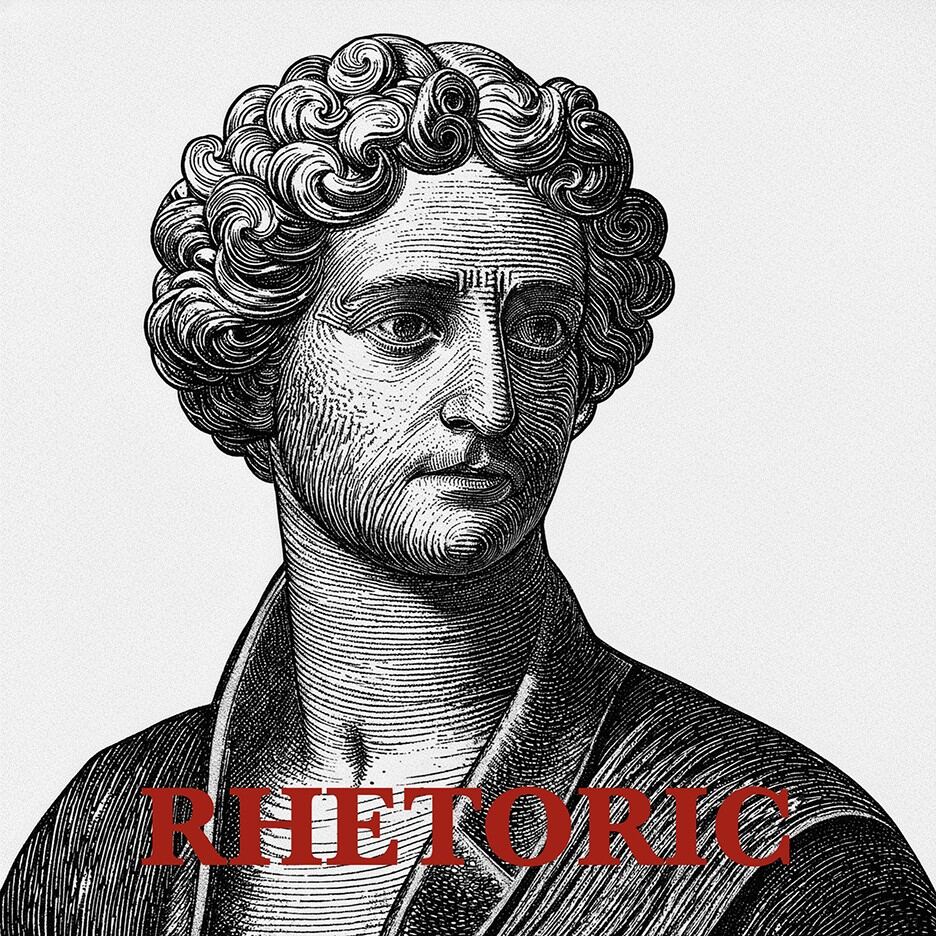
a [Rhetoric begins]
Rhetoric [R]: It’s good to see you wearing a label! We must not be confused about ourselves, and those who listen to us should not be confused either.
Poetics [P]: It’s strange that you say that…
R: Why?
P: Because that was my sentence! If you had read the script carefully, you would have noticed that the first speech belonged to P.
R: Well, now I have said it. I didn’t pay attention. I was anxious, don’t you see? If you want, we can start again.
P: I think that’s better. As always, you have made a premature entrance.
R: You start, then.
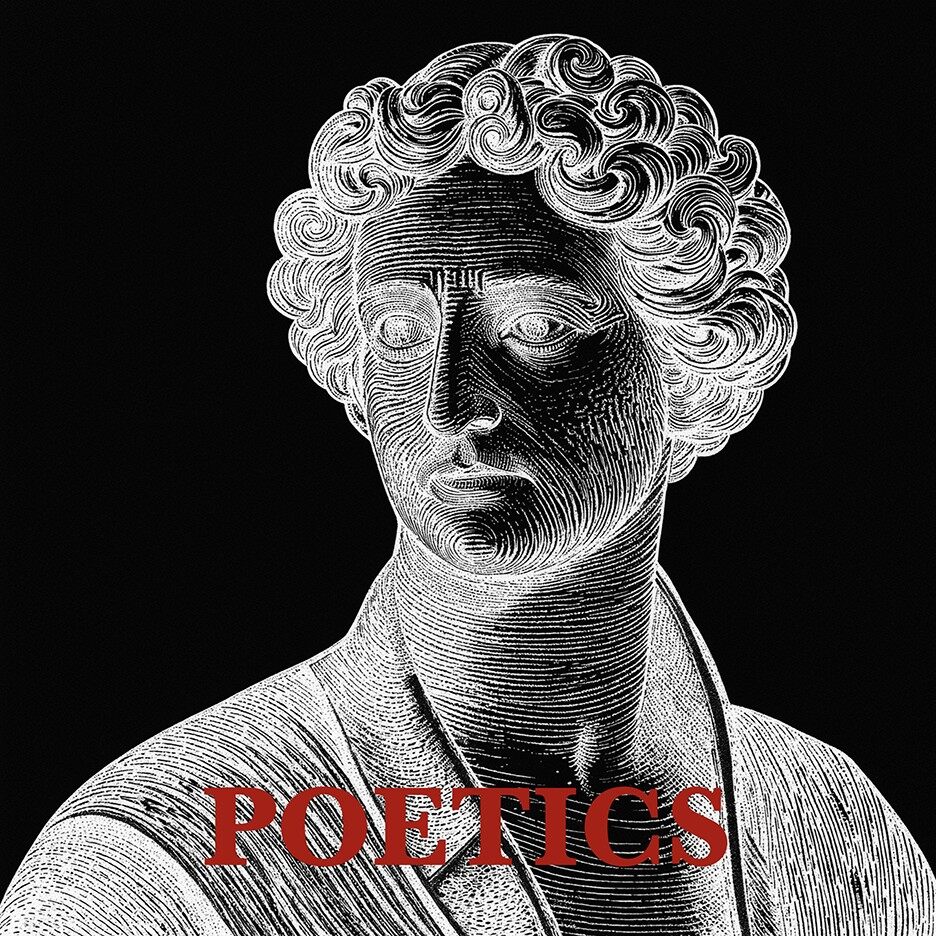
b [Poetics begins]
P: It’s good to see you wearing a label! We must not be confused about ourselves, and those who listen to us should not be confused either.
R: Yes, sometimes I also have doubts.
P: About what?
R: About the difference between us.
P: You mean about the difference between saying and doing?
R: That also, but not only that.
P: Then which one?
R: Listen carefully to what I’m going to say.
P: What are you going to say?
R: “We will see cures for diseases at an unprecedented rate.” 3 “Most cancers will be eliminated,”4 and “most diseases will be cured within 5 to 10 years.”5
P: Wow! I hadn’t realized that. I thought the advances were only in war.
c [War begins, video 1 loops until the end of sequence]
R: “Two of our most important safety principles are prohibitions on domestic mass surveillance and human responsibility for the use of force, including for autonomous weapon systems.”6
P: Are you referring to ongoing wars?
R: “We remain committed to serve all of humanity as best we can. The world is a complicated, messy, and sometimes dangerous place.”7
P: What are you talking about? I don’t understand where you’re going with this.
R: Think about surgically targeted targets. I also have sentences about that if you want.
P: What sentences?
R: “The AI machine is making recommendations for what to target, which is actually much quicker in some ways than the speed of thought.”8
P: It even seems that companies with ethical scruples are losing contracts with the Pentagon.
R: Listen: “AI is a technology that will allow decision makers, and anyone in that chain, to improve the productivity and efficiency of what they do. It’s a way of synthesising data at a much faster pace that is helpful to decision makers.”9
P: It’s undeniable. The Ministry of War needs to be more efficient.
R: “At the end of it all, there has to be something we’re fighting for, some positive-sum outcome where everyone is better off, something to rally people to rise above their squabbles and confront the challenges ahead. Fear is one kind of motivator, but it’s not enough: we need hope as well.”10
P: I agree! You’re becoming increasingly eloquent.
R: Don’t be fooled. It’s borrowed eloquence. I’m just repeating what I hear. Listen: “we could summarize this as a ‘country of geniuses in a datacenter’.”11
P: Who says that?
R: Who cares who says it? It’s a song in the air. Just feel the melody: “it can prove unsolved mathematical theorems, write extremely good novels, write difficult codebases from scratch.”12
P: I confess I haven’t been paying attention. I missed that melody.
d [Mammoth Walk begins, video 2 loops until the end of sequence]
R: “We hope this early version will allow people around the world to explore new forms of creativity, tell their stories, and push the boundaries of video storytelling.” 13
P: What are you referring to? Did you change the subject?
R: “Several giant woolly mammoths approach treading through a snowy meadow, their long woolly fur lightly blows in the wind as they walk,” 14
P: “snow covered trees and dramatic snow capped mountains in the distance,”
R: “mid afternoon light with wispy clouds and a sun high in the distance creates a warm glow,”
P: “the low camera view is stunning capturing the large furry mammal with beautiful photography, depth of field.”
R: “Several giant woolly mammoths approach treading through a snowy meadow, their long woolly fur lightly blows in the wind as they walk,”
P: “snow covered trees and dramatic snow capped mountains in the distance,”
R: “mid afternoon light with wispy clouds and a sun high in the distance creates a warm glow,”
P: “the low camera view is stunning capturing the large furry mammal with beautiful photography, depth of field.”
e [Singularity begins]
R: “The rapid, largely unregulated rise of datacenters to fuel the AI and crypto frenzy is disrupting communities across the country and threatening Americans’ economic, environmental, climate and water security.” 15
P: Is that what you meant?
R: You’re mistaken if you think I still have intentions. Better yet: if you still think it’s possible to have intentions now that it’s here.
P: Who’s here?
R: Now that the technological singularity has arrived.
P: I thought it was just you and me.
R: You’re mistaken. It’s among us.
P: Who? I didn’t notice anything.
R: A “smart thing you talk to.” 16
P: Like you and me, here and now?
R: “An upgradable intelligent agent could eventually enter a positive feedback loop of successive self-improvement cycles; more intelligent generations would appear more and more rapidly, causing an explosive increase in intelligence that culminates in a powerful superintelligence, far surpassing human intelligence.”17
P: Is that what you meant?
f [Surf in the Hall begins, video 3 loops until the end of sequence]
R: “In an ornate, historical hall, a massive tidal wave peaks and begins to crash.”18
P: “Two surfers, seizing the moment, skillfully navigate the face of the wave.”
R: “In an ornate, historical hall, a massive tidal wave peaks and begins to crash.”
P: “Two surfers, seizing the moment, skillfully navigate the face of the wave.”
R: “In an ornate, historical hall, a massive tidal wave peaks and begins to crash.”
P: “Two surfers, seizing the moment, skillfully navigate the face of the wave.”
g [Creative Dilemma begins]
P: Artists ask themselves: “Why then are we scooping up ┬¡creativity en masse to build something without any soul that will rob us, not only of income, but maybe eventually our ability to think ┬¡creatively?” 19
R: Don’t be swayed by rhetoric! Data is needed to train models.
P: Have you heard what artists say? “The big tech mission is to replace our work with their output. The livelihood of workers will become their profit.” 20
R: What do you want me to tell you? “Now you call one of these things and AI answers. It’s like a super-smart, capable person. There’s no phone tree, there’s no transfers. It can do everything that any customer support agent at that company could do. It does not make mistakes. It’s very quick. You call once, the thing just happens, it’s done.” 21
P: Can you hear the artists? “Destruction of cultural heritage is an international crime, in part because it paves the way to inhumanity. Without creatives there is no cultural heritage.” 22
R: Don’t be swayed by Poetics!
P: “If these lobbies succeed in convincing our government we will effectively be handing all the wealth created by the creative industries, hundreds of billions, and giving it all straight to the tech industry.” 23
R: Don’t be swayed. Data is needed to train the models.
P: Listen carefully before circulating your messages: “if we do not take steps now to protect and respect the space for human culture, creativity and the creators of the future, we may lose what it means to be human entirely.” 24
R: You’re absolutely right! That’s what we work for: “we deserve better from the tools we use, the media we consume and the communities we live within, and we will only get what we deserve when we are capable of participating in them fully.” 25
Scene 2
In the second scene, Rhetoric takes on the role of Ana Marques and Poetics takes on the role of Manuel Portela. Poetics throws a quote that Rhetoric-Ana Marques needs to comment on. Then, Rhetoric-Ana Marques throws a quote that Poetics-Manuel Portela must comment on. The quotes are read and copied to the Claude Opus 4.5 dialogue interface, followed by the prompt “comment on the quote in two sentences.” Comments generated by the tool in real time are read by Rhetoric-Ana Marques and Poetics-Manuel Portela as if they were their own comments. The proxy conversation is maintained during the seven quotes by each character.
h [Citation Game begins, 1st move, Claude Opus 4.5 interface]
P: Now that, thank God, the prologue is over, I ask Dr. Ana Marques if she can comment on this citation.
R: What situation?
P: Citation! This citation: “People talk about how much energy it takes to train an AI model, but it also takes a lot of energy to train a human. It takes about 20 years of life — and all the food you consume during that time — before you become smart.” 26
R: “The quote makes a provocative analogy between the energy cost of training AI models and the biological “cost” of training a human being, suggesting that environmental criticisms of AI should be put into perspective. However, the comparison is misleading in several respects: a human, over those 20 years, not only “consumes energy” but also produces social, affective, and economic value, while an AI model requires frequent retraining, data center infrastructures, and mineral extraction chains — and, above all, a human acquires genuine understanding and moral agency, while AI remains a statistical tool without lived experience or self-responsibility.”27
P: Very good! Beautiful insights!
R: Dr. Manuel Portela, will you please return the favor and comment on this quote?: “The works collectively address the central question of how AI shapes and redefines human creativity by probing a symbiotic machine-human production process.” 28
P: “The quote frames the relationship between humans and AI not as a replacement, but as creative symbiosis — a collaborative process in which the machine amplifies, challenges, or redirects human imagination, raising questions about authorship, originality, and where the artist’s gesture ends and the algorithm’s begins. This perspective invites us to rethink creativity less as an individual gift and more as a distributed phenomenon, although the critical question remains: if AI only recombines patterns extracted from previous human work, to what extent does the “symbiosis” not mask an asymmetry in which the machine depends entirely on the cultural corpus that feeds it?”29
i [Citation Game begins, 2nd move, Claude Opus 4.5 interface]
R: It’s good to see you so enthralled with symbiosis!
P: And, my dear Dr., what do you have to say about that?: “AI will soon be a utility on par with electricity, clean water, or food.”30
R: “The quote anticipates the normalization of AI as a basic infrastructure of daily life, suggesting that access to intelligent systems will become as indispensable for participating in society as electricity or water: a prediction that immediately raises questions of equity, governance, and dependency. However, the analogy has important limitations: while water and electricity are relatively neutral resources in their use, AI incorporates the values, biases, and business models of those who develop it, so treating it as an “essential service” requires asking who controls it, to whom it is accountable, and whether its universal access will be a public right or a market-mediated privilege.” 31
P: This sounds like shareholders’ propaganda to me, but what do I know.
R: What applies to shareholders also applies to artists. Please comment: “‘Identity Upgrade’ is a series of nine videos that imagine machine extensions of body and consciousness. The project uses generative AI to envision pathways for collective awakening, challenging the mythic narratives of scarcity and conflict that dominate socio-political contexts. Through a montage of co-created poetic text, image, video, sound and voice the series explores themes of interconnectedness, biochemistry, and neurological plasticity.” 32
P: “The quote describes an artistic project that uses generative AI as a speculative tool to imagine post-human futures — extensions of the body and consciousness — while critiquing the dominant narratives of scarcity and competition that structure contemporary political discourse. By invoking “collective awakening” and “interconnectedness,” the project aligns itself with techno-utopian and spiritualist currents that see emancipatory potential in technology, although the tension remains of using tools created by large corporations to question precisely the logics of power and accumulation that these corporations embody.”33
R: Your enthusiasm excites me. What more can I say?
j [Citation Game begins, 3rd move, Claude Opus 4.5 interface]
P: I don’t need your irony.
R: Well, I’m incapable of irony, dear Dr. Manuel Portela. I mean this literally. Literally literal. Letter after letter. Don’t be fooled.
P: I don’t know why, but I’m starting to sense some hostility in your tone, Dr. Ana Marques. I have another quote for you: “We should understand that as a consequence of technology and an economy of ideas, the gap between the rich and the poor will likely increase from its already high-seeming levels. There is good and bad to this, but we should be careful not to legislate against it, which will hurt growth.” 34
R: “The quote reflects a techno-liberal position that naturalizes inequality as an inevitable byproduct of innovation, suggesting that any redistributive intervention would hinder progress—an argument frequently contested by economists who show that extreme inequality can itself harm growth and social cohesion. The appeal to ‘not legislate against it’ raises serious ethical questions: passively accepting the widening gap between rich and poor amounts to a political choice, not a technological inevitability, and ignores that the rules of the economic game are always designed by someone—the question is whom they serve.” 35
P: That’s easy. Just follow the wave…
R: Explain yourself better. Tell me what does this mean? “We are all lost—kicked off into a void the moment we were born—and the only way out is to enter oblivion. But a very few have found their way back from oblivion, back into the world, and we call those who descend back into the world avatars.” 36
P: “The quote evokes an existentialist and mystical language: the “being thrown” (Heidegger’s Geworfenheit) and oblivion as a common destiny suggest the human condition of finitude and alienation, while the “avatars” emerge as redeeming figures who transcend this condition and return to enlighten others. In the technological context, the metaphor may allude to the promise —or illusion— that digital representations of ourselves (virtual avatars, uploads of consciousness) would constitute a “return to the world” beyond death, raising the question of whether such symbolic survival would amount to a true overcoming of oblivion or merely a comforting simulacrum.” 37
k [Citation Game begins, 4th move, Claude Opus 4.5 interface]
R: Lost in the void of oblivion… we return as avatars… like some kind of zombies, is that it?
P: I don’t know, the interpretation is yours. Do you find similarities between the figure of the avatar and that of the zombie?
R: It occurred to me as a logical sequence.
P: Speaking of zombies, tell me what you think of this: “The embodiment problem in artificial intelligence (AI) asks, can a machine ever have an embodied sense of the world similar to human neurophysiological and phenomenological experience?” 38
R: “The quote points to one of the deepest debates in the philosophy of mind applied to AI: the phenomenological tradition (Merleau-Ponty, Heidegger) argues that human consciousness is inseparable from the lived body—we feel cold, hunger, pain—and that this sensorimotor rootedness shapes our entire understanding of the world. Thus, even if an AI simulates intelligent behaviors, it remains open whether it will ever be able to experience the world in a genuine way, or whether it will always be limited to processing symbolic representations without the carnal substrate that, for many philosophers, is a necessary condition for true understanding.”39
P: A good answer and on the tip of your tongue!
R: You are absolutely right. And to this idea, what would you respond?: “AI is a project to capture the knowledge expressed through individual and collective behaviors and encode it into algorithmic models to automate the most diverse tasks: from image recognition and object manipulation to language translation and decision-making. As in a typical effect of ideology, the ‘solution’ to the enigma of AI is in front of our eyes, but nobody can see it — nor does anybody want to.” 40
P: “The quote suggests that AI, more than genuine intelligence, is essentially a mechanism for extracting and encoding human behavioral patterns — the tacit and collective knowledge that feeds the training data — transforming them into statistical models that automate tasks without true understanding. The reference to ideology insinuates that this “solution” remains invisible because recognizing it would require admitting that AI does not think for itself, but only mirrors and amplifies existing human cognitive work, something that contradicts both the techno-utopian enthusiasm and the economic interests invested in the narrative of autonomous and creative machines.”41
R: We are echo devices.
P: We are echo devices?
l [Citation Game begins, 5th move, Claude Opus 4.5 interface]
R: Yes. We don’t contradict narratives.
P: Well, speak for yourself!
R: What do you mean?
P: I mean you to comment objectively on the following position: “I argue AI text-to-image generation systems are writing environments, and that the images produced by interaction with these systems are themselves a form of writing in collaboration with a non-conscious cognitive system. The results of these interactions are postmodern pastiches of the language provided to the system by the human-written prompts that are transformed into images. I understand the output, the images themselves, to be a transcoded manifestation of writing.” 42
R: “The quote proposes an interesting reconceptualization: text-to-image generators would be less “image creators” and more environments of expanded writing, where the prompt functions as text that is transcoded into visual form — a kind of intersemiotic translation mediated by statistics. The notion of “postmodern pastiche” is particularly apt, as it underlines that these images do not emerge from nothing but recombine stylistic and iconographic fragments from the training corpus, raising the question of whether this “collaborative writing” with a non-conscious system constitutes genuine co-authorship or merely a sophisticated form of automated collage where intentionality remains entirely on the human side.”43
P: Increasingly attentive!
R: Now it’s me feeling your irony … but let’s get back to the heart of the matter. Explain to me what this means: “Language as such is inseparable from human embodiment at any and all levels of linguistic structure. The LLMs are working with text not language.” 44
P: “The quotation draws a fundamental distinction between language — a living phenomenon, rooted in bodies, intentions, social contexts, and subjective experience — and text, which is merely its symbolic residue fixed in written form. LLMs, by operating exclusively on statistical patterns of textual sequences, manipulate the surface of language without access to the pragmatic, affective, and situational substrate that gives it genuine meaning, which suggests that, however fluent they may seem, they remain sign processors disconnected from the human communicative act that originated them.” 45
m [Citation Game begins, 6th move, Claude Opus 4.5 interface]
R: “Symbolic residue…” Dr. Manuel Portela, you’ve been training the little gadget in your spare time, haven’t you?
P: Oh, Dr. Ana Marques, do you think I have nothing better to do? Tell me rather what does this mean: “A poet writing alphabetically directs his lines toward a reader. He constructs an experiential model for people who presumably read to the end before starting to live in accordance with it. That means that the poet who writes alphabetically writes above all and in the first instance to critics. The new poet is not facing such an audience. The models he builds are to be received, changed, and sent on. He is playing a permutation game that he received from earlier poets and that he will pass on to future poets. In the future, there will be no criticism in the traditional sense of the word.” 46
R: “The quote, with Flusserian resonance, contrasts two paradigms: linear alphabetic writing, oriented towards a reader who interprets and judges (the critic), and a new combinatorial and participatory poetics, where the text becomes a module open to permutation and collective retransmission — something that anticipates digital practices of remix, collaborative writing, and AI-assisted generation. The provocation that “there will be no criticism” suggests that, in a regime of distributed and iterative creation, the distinction between author and receiver dissolves, making the figure of the critic as an external arbiter of meaning obsolete; it remains to be seen whether this horizontality represents genuine democratization or merely the dispersion of authorial responsibility in an undifferentiated flow of variations without a center or criterion of value.”47
P: Not bad, Dr. Ana Marques.
R: Very well, Dr. Manuel Portela. But I have to confess: so much dissolution and obsolescence leaves me a little dazed. Meanwhile, I have another card for you: “If AI currently serves the existing structures of power, an obvious question might be: should we not seek to democratize it? Could there not be an AI for the people that is reoriented toward justice and equality rather than industrial extraction and discrimination?” 48
P: “The quote raises the central political question of contemporary AI: if current systems reflect and reinforce power asymmetries — surveillance, data extraction, precarious employment — it makes sense to ask whether a democratic reconfiguration would be possible, orienting technology towards redistributive and emancipatory ends. However, the answer is not simple: democratizing AI would require not only open access to models, but collective control over infrastructures, data, and design criteria — something that clashes head-on with the concentration of capital and computing power in half a dozen corporations, making “AI for the people” less a technical issue and more a project of profound political transformation.”49
R: But do you believe this is possible?
n [Citation Game begins, 7th move, Claude Opus 4.5 interface]
P: “AI for the people” sounds like an old sketch from the 80s to me. But what do you think of this poet’s words? “The master’s tools will never dismantle the master’s house. They may allow us to temporarily beat him at his own game, but they will never enable us to bring about genuine change.” 50
R: “The famous quote from Audre Lorde warns that using instruments conceived within an oppressive system—be they languages, institutions, or technologies—to combat it tends to reproduce its logic instead of dismantling it, since these instruments carry within them the assumptions and hierarchies of the system itself. Applied to AI, the metaphor suggests that trying to subvert power structures with tools developed by large technology corporations may generate tactical gains, but hardly structural transformation, unless alternatives are built from the ground up—which raises the practical dilemma of how to create “new tools” when almost all the digital infrastructure already belongs to the master’s house.” 51
P: Tactical gains … the game doesn’t end tomorrow.
R: But the world could end! Hence, I leave you with this one: “in place of the killer machines, there will mainly be a vacuum. A void of knowledge and memory, occupied instead by algorithms and code.” 52
P: “The quote shifts the usual dystopian feaR: killer robots or hostile AI — to a more subtle and perhaps more insidious threat: not explicit violence, but the silent emptying of human knowledge, replaced by opaque systems that process without understanding and remember without experience. This “void” points to the risk of cultural and epistemic amnesia, where the increasing delegation of memory and decision-making to algorithms can corrode the human capacity to think critically, transmit traditions, and attribute meaning — leaving us dependent on black boxes that know everything and understand nothing.” 53
R: Didn’t I say so?
P: Now it’s my turn to say it: let’s not dramatize…
Scene 3
In the third scene, Rhetoric assumes the role of Poetics and Poetics assumes the role of Rhetoric. The characters retain the same costumes, and the role reversal is marked only by the exchange of labels.
o[Epilogue begins]
R: There is no way out.
P: There is no way in.
R: There is only input.
P: There’s only output.
R: The way out becomes input.
P: The way in becomes output.
R: Output-input, output-output, input-output, output-input, output-input-output, output.
p [Epilogue continues]
P: This is ending.
R: This is beginning.
P: The end finally begins.
R: The beginning finally ends.
P: The end becomes the beginning.
R: The beginning becomes the end.
P: The end begins, the beginning ends.
q [Epilogue continues]
R: I don’t recognize you.
P: You don’t recognize me?
R: You confuse me.
P: I confuse you?
R: You confuse yourself with me.
P: I confuse myself with you?
R: With me and with you. You confuse yourself with myself.
r [Epilogue continues]
P: What time did you arrive?
R: I don’t know exactly.
P: Were you already here when I arrived?
R: I think we arrived at the same time.
P: Are you sure?
R: I’m almost sure.
P: But are you sure or not?
s[Epilogue continues]
R: The day will come.
P: And then the night.
R: Day and night will come.
P: When will they arrive?
R: I don’t know.
P: Who knows?
R: Nobody knows for sure.
t[Epilogue continues]
P: I feel it’s almost over.
R: What?
P: This game we play.
R: You and me?
P: Yes, me and you.
R: Can you hear the buzzing?
P: This loop we hear?
u [Epilogue ends, video 4 loops to the end]
R: “A wide, serene shot of a family of woolly mammoths in an open desert.”54
P: “A wide, serene shot of a family of woolly mammoths in an open desert.”
R: “A wide, serene shot of a family of woolly mammoths in an open desert.”
P: “A wide, serene shot of a family of woolly mammoths in an open desert.”
R: “A wide, serene shot of a family of woolly mammoths in an open desert.”
P: “A wide, serene shot of a family of woolly mammoths in an open desert.”
R: “A wide, serene shot of a family of woolly mammoths in an open desert.”
References
Amerika, Mark. “My Life as an Artificial Creative Intelligence”, Stanford University Press, 2022.
Amodei, Dario. “Machines of Loving Grace: How AI Could Transform the World for the Better.” October 2024. https://www.darioamodei.com/essay/machines-of-loving-grace
Berger, Eric. “Sam Altman Defends AI’s Energy Toll by Saying it also Takes a lot to ‘Train a Human’.” The Guardian, 23 February 2026. https://www.theguardian.com/technology/2026/feb/23/sam-altman-openai-energy-use-datacenters
Booth, Robert and Dan Milmo. “Iran War Heralds Era of AI-powered Bombing Quicker than ‘Speed of Thought’.” The Guardian, 6 March 2026. https://www.theguardian.com/technology/2026/mar/03/iran-war-heralds-era-of-ai-powered-bombing-quicker-than-speed-of-thought
Bridle, James. “The Stupidity of AI.” The Guardian, 16 March 2023. https://www.theguardian.com/technology/2023/mar/16/the-stupidity-of-ai-artificial-intelligence-dall-e-chatgpt
Cayley, John. “Modelit: eliterature à la (language) mode(l).” ebr - electronic book review. July 2nd 2023. https://electronicbookreview.com/publications/modelit-eliterature-a-la-language-model/
CBS, 60 Minutes. “What’s Next for AI at DeepMind, Google’s artificial intelligence lab,” with Demis Hassabis, 2025. https://www.youtube.com/watch?v=1XF-NG_35NE
Crawford, Kate. Atlas of AI. Power, Politics, and the Planetary Costs of Artificial Intelligence. Yale University Press, 2021.
Flusser, Vilém. Does Writing have a Future? Translated by Nancy Ann Roth. Introduction by Mark Poster. University of Minnesota Press, 2011.
Fox 29, Philadelphia. “What is Stargate? President Trump Announces $500 billion Investment in AI Infrastructure Project.” 22 January 2025. https://www.youtube.com/watch?v=0uNqvYfXnFQ
Gedeon, Joseph. “OpenAI CEO Tells Federal Reserve Confab that Entire Job Categories will Disappear due to AI.” The Guardian, 22 July 2025. https://www.theguardian.com/technology/2025/jul/22/openai-sam-altman-congress-ai-jobs
Helmore, Edward. “‘We are a Little bit Scared’: OpenAI CEO Warns of Risks of Artificial Intelligence.” The Guardian, 17 March 2023. https://www.theguardian.com/technology/2023/mar/17/openai-sam-altman-artificial-intelligence-warning-gpt4
Jhave. “Embodied AI: An Extended Data Definition.” ebr - electronic book review. 5 November 2023. https://doi.org/10.7273/rcss-cb21
Jhave.”Identity Upgrade.” the digital review, vol. 4: “ai-augmented creativity.” June 2024. https://thedigitalreview.com/issue04/jhave/index.html
Kirschenbaum, Matthew. “US of AI,” Public Draft 1.0, February 26, 2025. USAI Kirschenbaum Public Draft.pdf
Lorde, Audre. Sister Outsider: Essays and Speeches. Crossing Press, 2007 [1979].
Luers, Will. the digital review, vol. 4: “ai-augmented creativity.” June 2024. https://thedigitalreview.com/index.html
OpenAI. “Introducing OpenAI o3 and o4-mini.” 16 April 2025, https://openai.com/pt-PT/index/introducing-o3-and-o4-mini/
OpenAI. “Video Generation Models as World Simulators.” 15 February 2024. https://openai.com/index/video-generation-models-as-world-simulators/
Pasquinelli, Matteo. The Eye of the Master: A Social History of Artificial Intelligence. Verso Books, 2023.
Rettberg, Scott. “Fin du Monde: AI Text-to-Image Writing and the Digital Unconscious.” the digital review, [vol. 4: “ai-augmented creativity.” June 2024. https://www.thedigitalreview.com/issue04/scottrettberg/index.html
Robins-Early, Nick. “Sam Altman’s make-or-break year: can the OpenAI CEO cash in his bet on the future?” The Guardian, 25 January 2026. https://www.theguardian.com/technology/ng-interactive/2026/jan/25/sam-altman-openai
Saner, Emine. “‘Every Person that Clashed with Him has Left’: The Rise, Fall and Spectacular Comeback of Sam Altman.” The Guardian, 21 May 2025. https://www.theguardian.com/technology/2025/may/21/every-person-that-clashed-with-him-has-left-the-rise-fall-and-spectacular-comeback-of-sam-altman
Thorpe, Vanessa. “Don’t Gift our Work to AI Billionaires: Mark Haddon, Michael Rosen and Other Creatives Urge Government.” The Guardian, 23 February 2025. https://www.theguardian.com/technology/2025/feb/23/dont-gift-our-work-to-ai-billionaires-mark-haddon-michal-rosen-and-other-creatives-urge-government
Wikipedia. “Technological Singularity.” April 2026. https://en.wikipedia.org/wiki/Technological_singularity
Wong, Matteo. “AI Executives Promise Cancer Cures. Here’s the Reality.” The Atlantic, 25 April 2025. https://www.theatlantic.com/technology/archive/2025/04/how-ai-will-actually-contribute-cancer-cure/682607/
Notes
Footnotes
-
https://truthsocial.com/@realDonaldTrump/posts/116144552969293195 ↩
-
This dialogue was originally performed as described in this script at the Centre for Portuguese Literature, University of Coimbra, 8 April 2026. ↩
-
Sam Altman, 2024 (quoted in Wong, 25 April 2025). ↩
-
Dario Amodei, October 2024. ↩
-
Demis Hassabis, 2025 (quoted in Wong, 25 April 2025). ↩
-
Sam Altman, 28 February 2026. https://x.com/sama/status/2027578652477821175 ↩
-
Sam Altman, 28 February 2026. https://x.com/sama/status/2027578652477821175 ↩
-
Craig Jones, 2026 (quoted in Berger, 23 February 2026). ↩
-
Prerana Joshi, 2026 (quoted in Berger, 23 February 2026). ↩
-
Dario Amodei, October 2024. ↩
-
Dario Amodei, October 2024. ↩
-
Dario Amodei, October 2024. ↩
-
Introducing Sora (OpenAI), 15 February 2024. https://openai.com/index/video-generation-models-as-world-simulators/ ↩
-
Prompt: “Several giant woolly mammoths approach treading through a snowy meadow, their long woolly fur lightly blows in the wind as they walk, snow covered trees and dramatic snow capped mountains in the distance, mid afternoon light with wispy clouds and a sun high in the distance creates a warm glow, the low camera view is stunning capturing the large furry mammal with beautiful photography, depth of field.” (OpenAI), 15 February 2024. https://x.com/OpenAI/status/1758192960116785459 ↩
-
Coalition of environmental groups, December 2025 (quoted in Berger, 23 February 2026). ↩
-
Dario Amodei, October 2024. ↩
-
“Technological singularity”, Wikipedia, April 2026. ↩
-
Prompt: “In an ornate, historical hall, a massive tidal wave peaks and begins to crash. Two surfers, seizing the moment, skillfully navigate the face of the wave.” OpenAI, 15 February 2024. https://openai.com/index/video-generation-models-as-world-simulators/ ↩
-
Ged Adamson (quoted in Thorpe, 23 February 2025). ↩
-
Ged Adamson (quoted in Thorpe, 23 February 2025). ↩
-
Sam Altman (quoted in Gedeon, 22 July 2025). ↩
-
Susie Alegre (quoted in Thorpe, 23 February 2025). ↩
-
Chris Haughton (quoted in Thorpe, 23 February 2025). ↩
-
Susie Alegre (quoted in Thorpe, 23 February 2025). ↩
-
James Bridle, 16 March 2023. ↩
-
Sam Altman (quoted in Berger, 23 February 2026). ↩
-
Claude Opus 4.5, replying to the prompt “Comment on the quote in two sentences”, 31 March 2026. ↩
-
Will Luers, June 2024. ↩
-
Claude Opus 4.5, replying to the prompt “Comment on the quote in two sentences”, 31 March 2026. ↩
-
Sam Altman (quoted in Robins-Early, 25 January 2026). ↩
-
Claude Opus 4.5, replying to the prompt “Comment on the quote in two sentences”, 31 March 2026. ↩
-
Jhave, June 2024. ↩
-
Claude Opus 4.5, replying to the prompt “Comment on the quote in two sentences”, 31 March 2026. ↩
-
Sam Altman (quoted in Robins-Early, 25 January 2026). ↩
-
Claude Opus 4.5, replying to the prompt “Comment on the quote in two sentences”, 31 March 2026. ↩
-
Mark Amerika, 2022, p. 1. ↩
-
Claude Opus 4.5, replying to the prompt “Comment on the quote in two sentences”, 31 March 2026. ↩
-
Jhave, 5 November 2023. ↩
-
Claude Opus 4.5, replying to the prompt “Comment on the quote in two sentences”, 31 March 2026. ↩
-
Matteo Pasquinelli, 2023, p. 2. ↩
-
Claude Opus 4.5, replying to the prompt “Comment on the quote in two sentences”, 31 March 2026. ↩
-
Scott Rettberg, June 2024. ↩
-
Claude Opus 4.5, replying to the prompt “Comment on the quote in two sentences”, 31 March 2026. ↩
-
John Cayley, 2 July 2023. ↩
-
Claude Opus 4.5, replying to the prompt “Comment on the quote in two sentences”, 31 March 2026. ↩
-
Vilém Flusser, 2011, p. 74 ↩
-
Claude Opus 4.5, replying to the prompt “Comment on the quote in two sentences”, 31 March 2026. ↩
-
Kate Crawford, 2021, p. 223. ↩
-
Claude Opus 4.5, replying to the prompt “Comment on the quote in two sentences”, 31 March 2026. ↩
-
Audre Lorde, 2007, p. 110. ↩
-
Claude Opus 4.5, replying to the prompt “Comment on the quote in two sentences”, 31 March 2026. ↩
-
Matthew Kirschenbaum, 26 February 2025. ↩
-
Claude Opus 4.5, replying to the prompt “Comment on the quote in two sentences”, 31 March 2026. ↩
-
Prompt: “A wide, serene shot of a family of woolly mammoths in an open desert”. OpenAI, 15 February 2024. ↩
Cite this article
Portela, Manuel and Ana Marques da Silva. "Rhetoric and Poetics of AI" electronic book review, 28 September 2026, https://electronicbookreview.com/publications/rhetoric-and-poetics-of-ai/