Familiarity as Estrangement in the Interface Sim: s.p.l.i.t. and the Expert Problem
Interface simulations work by making digital tools feel like the ones you already use, but what happens when you actually use those tools for a living? This review tracks how s.p.l.i.t.'s amber-on-black terminal horror turns most convincing precisely where it becomes most uncomfortable for the expert player.
Title of work: s.p.l.i.t.
Author: Mike Klubnika
Publisher: Mike Klubnika, Oro Interactive
Platform: PC, available on itch.io and Steam
Link: https://mikeklubnika.com/games/split
Brief Description: In s.p.l.i.t., you play as a technician attempting to hack into an unethical superstructure using terminal commands and IRC chat to coordinate with your crew. It’s a tense psychological horror experience that uses authentic-looking terminal interfaces to immerse you in the role of a hacker.
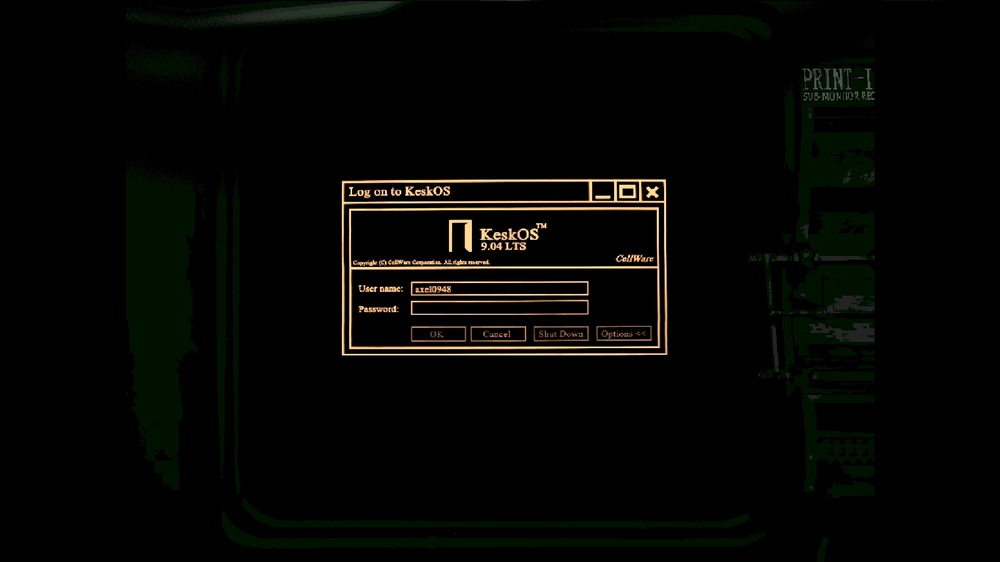
The sound of a hard drive whirring to life. Amber text flooding the screen in a cascade of boot logs, then yielding to the logo of the operating system and a hollow, resonant startup chime. A login screen appears. You type your credentials. A chat window opens, and your team is already talking - about the job, about the risks, about their way out if things go wrong. Death, it turns out, is the least of their worries. This is the opening of s.p.l.i.t. by Mike Klubnika, a psychological horror game and an example of what a professor and I call an interface sim.
Unlike fantasy interfaces invented for fictional worlds or non-diegetic UI common across genres, interface sims recreate the mundane digital tools we use every day - email clients, operating systems, command prompts - and use that familiarity to create presence and meaning. Because they simulate rather than emulate these tools, as in Emily Is Away (Kyle Seeley, 2015) - a short narrative game in which the player types messages to a drifting childhood friend over an AIM-style instant messenger - they can simplify interactions in service of narrative while still evoking the player’s real experience with related systems. The result is that story and interface become synchronous: the technology through which the story is delivered is itself a conscious part of the narrative, immersing the player while making them aware of how digital interfaces mediate experience.
As a computer science student, a home server enthusiast, and a game developer, interface sims are something I think about a lot because they sit at the intersection of my technical knowledge and my interest in how games create immersion. I spend hours each week in real terminals managing servers and writing code, which makes me both the ideal audience for these simulations and perhaps their most critical observer. When I booted up s.p.l.i.t., I expected my familiarity with real terminals to enhance the experience. Instead, it complicated my experience of the simulation in ways I didn’t expect.
s.p.l.i.t. is roughly a one-hour experience with multiple endings (I’ve played twice and discovered one). You play as a hacker tasked with bringing down an unethical superstructure called the Centrifuge - some kind of computer system, though the game keeps the specifics deliberately obscure. Throughout the game, you coordinate with a small team of fellow hackers and company insiders via an IRC-style chat interface on a left-hand monitor, while simultaneously executing your hack through a terminal on a monitor to your right. The gameplay involves navigating directories, examining files, and running programs to solve puzzles, with the goal of taking down the Centrifuge. Additionally, typing sequences appear throughout the game that seem to materialize your character’s thoughts.
s.p.l.i.t. arrives during a wave of 1990s and early 2000s nostalgia - particularly for PlayStation-era graphics and retro desktop interfaces - that has been building since the early 2010s. Games like MOUTHWASHING (Critical Reflex, 2024), Needy Streamer Overload (WSS playground, 2022), and Crow Country (SFB Games, 2024) exemplify this trend, and s.p.l.i.t. fits squarely among them. The game uses PS1-style graphics with low-poly models and low-resolution textures that bring to mind highly influential psychological horror classics such as _ Silent Hill_ (Konami, 1999) and Resident Evil 2 (Capcom, 1998). As game designers Patrick Dolan and Andrew Bailey argue, this aesthetic has become popular in contemporary indie horror because the “severe aliasing, and unfiltered textures” create an uncanny quality that leaves interpretive gaps for players to fill with their imaginations (Dolan and Bailey). A major practical benefit is that this style is also much easier for small teams or solo developers to create - the Haunted PS1 community has even developed and freely shared custom tools specifically to help indie developers achieve these effects (Dolan and Bailey).
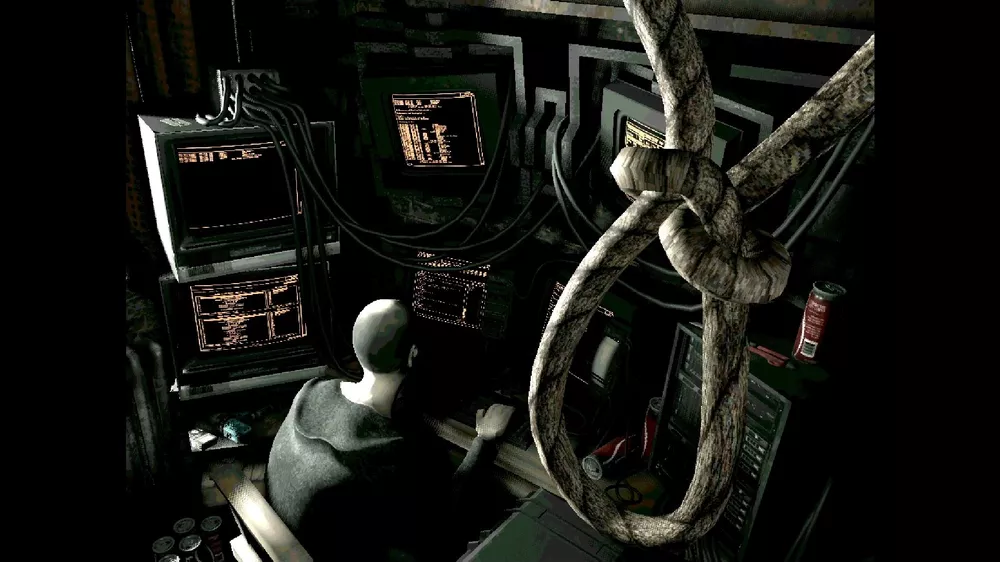
In s.p.l.i.t., this retro aesthetic manifests most noticeably in its amber-on-black terminals. The Internet relay chat interface features visual icons above the chat window that evoke early Windows releases, while the amber terminals and gritty textures reinforce the dystopian atmosphere. The first time you see your character’s face, it’s distorted, paired with a cut to a rope referred to as his “way out.”
The sound design amplifies the atmosphere considerably - droning hard-drive sounds hum constantly in the background, and even the pause screen features a fuzzy ambient sound that unsettled me enough to unpause quickly. The music reinforces this further, echoey and reverberating, almost dissociative, ebbing and flowing with the gameplay and ramping up to frantic intensity during high-energy moments. More than enhancing the atmosphere, the hard drive hum, typing sounds, and notification chimes evoke the experience of actually sitting at a computer as much as the visuals do. In interface sims, this evocation can be used to great effect, drawing out the player’s own relationships with the evoked interfaces to further put them in the role of the player-character. However, it can be a double-edged sword. The more convincingly s.p.l.i.t. recreates the feel of sitting at a real workstation, the more it invites the expectations that come with one. When you bring puzzles into the mix - and s.p.l.i.t.’s gameplay loop is largely puzzle-based - the mismatch between expectations and what has actually been included in the simulation can work against the immersion that interface sims tend to achieve so effectively.
s.p.l.i.t. is ambitious in what Henry Jenkins might call an enacted narrative - a game that enables players to physically perform narrative events rather than simply pressing a button to make them happen (Jenkins 124). In s.p.l.i.t., this means typing on your keyboard to make Axel communicate with his team and typing out thoughts that materialize on screen. But this is where the enacted narrative and the open, immersive opportunities offered by a simulated operating system and command line game misses for me. In the IRC chat interface, you must physically press keys on your keyboard - any keys - to make your character Axel type his responses. While I appreciate this as a way to embody what your character is doing, I found it sluggish and distracting, rather than creating the tension of needing to communicate quickly while executing my hack. Separately, the game prompts you to type out physically materialized thoughts your character is having, which works more effectively. The thoughts are evocative but vague enough that they don’t dictate how you should feel, and during frantic moments, the game demands speed, highlighting errors in red when you mistype. You feel his frantic train of thought as you try to keep up with the words on screen.
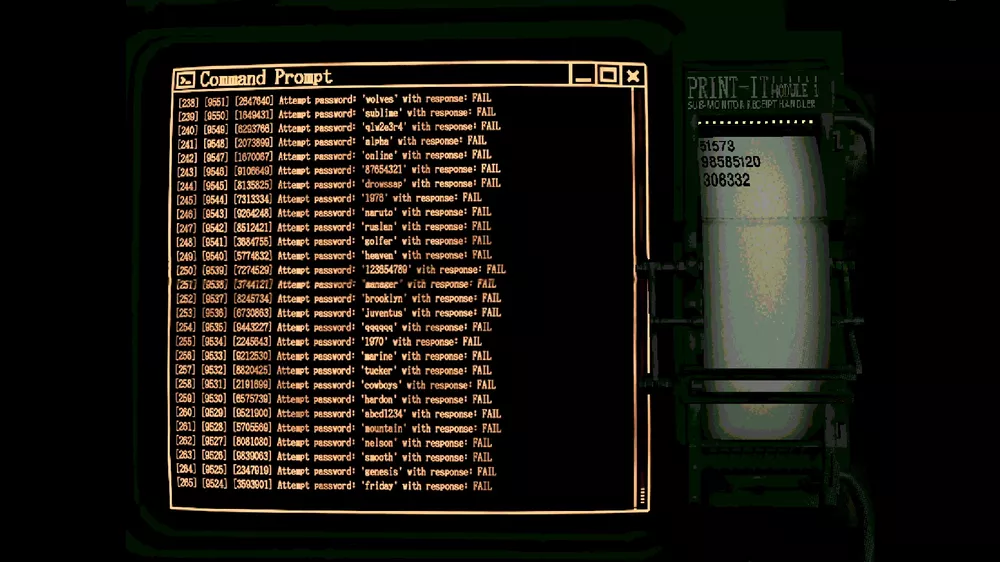
Despite these issues with specific interaction choices, the interface simulation aspect works well overall. By keeping the entire experience confined to two monitors, the game stays focused on building narrative through the chat and engaging the player in hacking-themed puzzles via the command line interface. You’re doing what a hacker actually does: reading files, typing commands, coordinating with your team. In fact, performing these actions yourself, rather than just watching a cutscene or clicking dialogue options, creates a direct, unmediated sense of presence. This is the core strength of the interface sim as a format - by placing the player inside a familiar interface rather than an invented interface unique to the game world, the actions you perform don’t need translation.
However, as someone who works with terminals regularly, this is also where s.p.l.i.t.’s authenticity works against itself. The game gets close enough to a realistic terminal to trigger my real-world expectations, but not close enough to meet them, like a kind of uncanny valley for interfaces. I expected to be able to pass a full file path to commands like nano, but the game requires you to cd into each directory one at a time. I found myself reaching for tab autocompletion that wasn’t there. I understand why these limitations exist - the game needs to control pacing, guide players through its puzzles, and remain accessible to people who aren’t terminally online in the literal sense. And, frankly, a one-hour indie game doesn’t need tab autocompletion, but the simulation was just close enough to feel slightly off. This reveals something fundamental about interface sims: they must balance authenticity against accessibility and where that balance lands depends entirely on who’s sitting at the keyboard.
Despite this friction, s.p.l.i.t. is emblematic of contemporary indie horror and Mike Klubnika’s resourcefulness as a solo developer. It uses PS1-era graphics to evoke atmosphere and terminal interface simulation to have players enact the hacker role. I’d recommend it to players who enjoy puzzle-solving and have at least basic familiarity with terminal interfaces. Complete beginners might struggle, but anyone with some command-line experience will find it accessible.
For me, s.p.l.i.t. surfaced a tension I suspect is inherent to interface sims: the more authentic they feel, the more they risk alienating the players who know the real thing best, especially when use of the interface is needed to solve puzzles. That is less of a flaw, more of a tradeoff, and for most players, s.p.l.i.t. will land on the right side of it.
Works Cited
Dolan, Patrick, and Andrew Bailey. “Ghastly Graphics: Tool Fandom, Bad Cinema, and the Haunted PS1 Game Development Community.” _International Journal of Creative Media Research, vol. 10, 2023. https://ijcmr.online/2/article/view/16/19.
Jenkins, Henry. “Game Design as Narrative Architecture.” First Person: New Media as Story, Performance, and Game, edited by Noah Wardrip-Fruin and Pat Harrigan, MIT Press, 2004, pp. 118-130.
Cite this review
Drabenstadt, Jack. "Familiarity as Estrangement in the Interface Sim: s.p.l.i.t. and the Expert Problem" electronic book review, 30 June 2026, https://doi.org/10.64773/ut7d-g2b3