Electronic Literature and Wikipedia: A Call to Action
If electronic literature does not exist in Wikipedia, it does not exist for AI or search engines either. Larsen issues an urgent call for writers, scholars, and readers to become Wikipedia editors before the field disappears into algorithmic silence.
TLDR: Editing and contributing new articles about electronic literature to Wikipedia is vital to our community’s survival. AI and internet searches feed on Wikipedia, and people increasingly rely on these sources for their information. So, if information about our works and our people do not show up in Wikipedia, then no one will know about our field. Moreover, writing in Wikipedia trains students and even experienced writers to do original research and writing. This vanishing skillset for writing and reading is becoming even more prized in this burgeoning era of AI chats.
When I taught Digital Storytelling at Washington State University Vancouver, I asked my students “Is Wikipedia a hypertext?” Yes, of course it is. It has links and nodes. Granted, in Wikipedia, links are supposed to be denotative rather than connotative—so simple facts rather than flights of fancy released from links1. Then, I asked my students if Wikipedia is electronic literature in and of itself. Here we were in a gray area, and we touched on the definitions of authorship, literature, truth, and connective tissues being impossible to actually experience in the same way as a printed encyclopedia.
Whether or not Wikipedia is a giant electronic literature piece we can all interact with, one thing is clear: Wikipedia is essential to the future of electronic literature—and vice versa. I am appealing to all electronic literature lovers to become Wikipedia editors and share our knowledge with the world.
Why We Should Care
Bottom line. Without you, the AI and search engine takeover of the information world will ensure that no one else ever hears about our beloved field of electronic literature.
After nearly four decades in this field, I know pretty much one thing—we e-lit lovers suck at proselytizing. We still don’t have electronic literature classes in most major universities. We don’t have best seller lists—or their readerships. Even when we post these major works for free2. Electronic literature plummets through the gaps in traditional literature marketing and study (What genre is this stuff you can’t do poetry and mystery together!? Should it be reviewed as games or as lit? What counts as e-lit? Who are these Unknowns3 anyway?) We want and need an audience for our creations and analyses. Ok, ok, enough already, we all have been in far too many conference dinner venting sessions, so I can just skip this spiel. Just let me remind you of how many people read Wikipedia articles. The Wikipedia article for electronic literature alone has about 2,000 views a month4. Frankly, I think that is more readers than any of my works have ever gotten ever, rather than just every month. Need I say more?
Searches Rely on Wikipedia
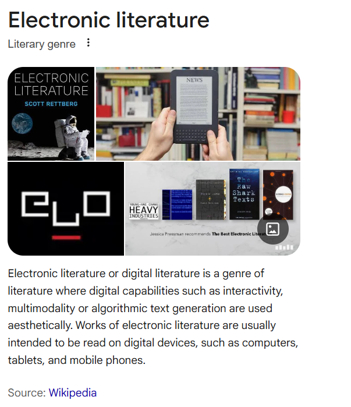
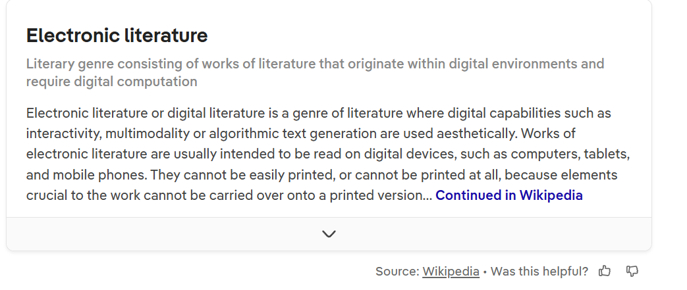
When you enter a search on Google or DuckDuckGo, Wikipedia is the first thing that comes up. And we all know people only click on the first thing in a search (Fig. 1). Now, when I see Google’s results on electronic literature, I smile, because these are the words that we humans sweated over out there for everyone to see. We have substantially revised the electronic literature article5 and created well over 50 new articles. We have a categorization system, lists of works, and even more progress.
You can see how many folks have been working on this stuff at our Wikiproject Electronic Literature page (Please google WP:ELIT and sign up and add your username to our project). I host a monthly editathon on the Third Thursday at 3:00 PM UTC (Please join in at http://www.tinyurl.com3Thurs3UTC passcode 1234). We got the ELMCIP as an authoritative database—so all of the info that was in the Electronic Literature Knowledge Base (ELMCIP at https://elmcip.net) is now in Wikidata for Wikipedians. We are working on incorporating other databases. We have attended Wikipedia conferences and gotten Wikipedians help in editing and expanding articles and databases in our little field. It is from dedicated work like Jill Walker Rettberg and the Center for Digital Narrative and so many others that we have these new articles, lists, categories, and more on electronic literature authors, critics, organizations, and works.
However, we have a long way to go. For example, we only have four articles about electronic works created in the 2020s, even though our field has blossomed and the New Media Writing Prize had 64 entries alone in 2025 (Please update the article https://en.wikipedia.org/wiki/New_Media_Writing_Prize).
Bottom line: the good news is that the minute you make an edit in Wikipedia, your words show up in the search engine. So please, give yourselves an ego-thrill and start writing and editing Wikipedia!
AI Feeds on Wikipedia
But wait, there are even more thrilling challenges to beat with our human edits! AI is, of course, the behemoth who has moved into the search space. Large Language Models (LLMs) (which I am, for simplicity’s sake, shortening to AI)6 have gobbled up the knowledge base and spit out answers on demand. And they have mostly relied on Wikipedia as their main entrée. Thus, human Wikipedia editors control the answers that AI spits out to everyone.
Wikipedia has made it easy for bots and AIs to scrape their platform (Maxwell 2025). They partner with major AI companies (such as Amazon, Meta Platforms, Microsoft, Perplexity AI, and Mistral AI in France to integrate human-governed knowledge into their platforms at scale (Murti, 2026)7. The large language models have been feeding upon Wikipedia for years now, and this voracious AI appetite for original content will continue with even more LLMs and AI developments in the future (Bhattacharya, 2026). LLMs swallow large datasets, such as Wikipedia, and regurgitate answers by predicting the next words but do not often provide backups (cf Bartels, 2026). Thus, the bigger LLMs grow, the more they depend on datasets to fuel their predictive output; the more Wikipedia partners with these types of models and AI, the more AI and LLMs will depend on Wikipedia as a major source of information.
Moreover, as AIs “answer-bots” like Claude or Gemini or ChatGPT enter the scene, humans ask the AI and the AI scavenges the content and spits it back to the user, who goes away contented, never researching the fact. So, again, we human electronic literature lovers need to create the content that feeds these answer-bots.
Ahh, but now entirely AI-generated “pedias” have entered the scene. As Elon Musk would have it with Grokipedia, we can now do away with human editing altogether. And why not? If AI is just going to take over, why not simply let go of any control of information? Why should we poor mortals have to sweat and volunteer information? Because all AI-generated knowledge need to feed upon human knowledge at some point. Grokipedia still relies on human sources (mostly Wikipedia, but anything else on the web is fair game)8, and this AI blackbox just magnifies any errors found there. Studies are just beginning to compare human-generated pedias with AI-generated ones. So, far, predictions are that “[m]ore broadly, AI-generated encyclopedias may depart from established editorial norms by favoring narrative expansion over citation-based verification, raising questions about transparency, provenance, and the governance of knowledge in automated information systems” (Mohammadi and Yasseri 2026). Richard Holeton and I did our own tiny fact-checking experiment on June 1, 2026, and we both found factual errors and flights of fancy and incomprehensible jargon in our respective Grokipedia articles (Deena Larsen and Figurski at Findhorn on Acid)9. Grokipedia uses AI to make any suggested errors, so humans are relegated to kibitzers and not direct actors (See https://grokipedia.com/page/How_to_edit_Grokipedia). You can suggest errors using the button at the top of each page. However, as Holeton notes, “If I had to suggest edits for the Figurski article I wouldn’t know where to start, because of all the repetitive and sometimes nonsensical and pseudo-jargony AI prose, in addition to the factual errors.”
And there is another threat, even for Wikipedia, with its army of human volunteers. AI may actually create the content in Wikipedia and humans may well leave the scene as “[c]ontributors who reduce their contribution efforts as AI pervades the platform, will thus leave Wikipedia increasingly dependent on additional AI activity.” (Wagner and Jiang, 2025). But this year, Wikipedia pre-empted this vicious cycle threat by instituting policies that demand human-only generated content (Milman, 2026). “The encyclopedia that set out to be written by everyone is now racing to make sure it is not rewritten by machines” (Maddox, 2026). And thus, your human involvement becomes increasingly important as a foot soldier against AI slop and error. So, here I am, just exhorting and imploring and begging us human writers to ensure that, at some point, the human-generated knowledge goes down the maws of these AI beasts. After all, if you can’t beat them, feed them10.
In short, right now there are forking paths (all AI and mostly human). Please, I urge us all to take up our keyboards and join in the fight for facts. Put facts into Wikipedia directly! (Sign up today and use the Dominican Libraries great step by step guide at https://research.dom.edu/wiki/account, or email me and we can do a coffee zoom, and I’ll guide you through it).
Therefore, if it ain’t in Wikipedia, it ain’t Nothin’
Wikibusiness acknowledges the problem: If a field is esoteric (such as electronic literature!!!) then professionals and works may not be represented in Wikipedia. Since very few people care to write about any little, tiny field, there are very few articles. And since we are all volunteers, if we don’t write about our field then no one will. And if the information is not in Wikipedia, then “[w]hen users ask AI chatbots about developments in their field, these experts’ insights, methodologies, and achievements are absent from the conversation. This invisibility can have real-world consequences for career development, business opportunities, and professional recognition.” Aargh! So, in other words, if we don’t start cracking and get to writing, we will be even more ignored. And the more we are ignored, the fewer people will know about this great and complex and wonderful way to write and explore ideas, and then the fewer people will write articles in Wikipedia, and Google and AI will not know enough to spit out answers. And it is up to you to create that visibility so that your work and your reputation thrive as a vibrant part of the conversation.
But We Need to Do More
Trigger Warning. The rest of this essay is a call to action. And, yeah, I’m real good at nagging. Y’all know that by now.
First, Create the Sources
Wikipedia itself relies on primary sources that can be verified. Wikipedians can never actually say that x is true. Nor can we even summarize a primary work ourselves or add (insert shocked gasp of horrors here) “original research”. “Original research, also called primary research, is research that is not exclusively based on a summary, review, or synthesis of earlier publications on the subject of research” (Wikipedia 2026a). We human Wikipedia editors can only summarize what others have said. If someone else didn’t describe a work, then we can’t just do that in the Wikipedia article. So, first, we need to have a lot more sources. And we need to resurrect older electronic literature works, reviews, and studies. Leonardo Flores just brought back I love e-poetry in English and Spanish (https://iloveepoetry.org), and we can start looking here. We need to work with the Internet Archive to maintain sites and of course we need incredible initiatives like The NEXT Museum, Archive, and Preservation Space to maintain our primary literature.
And we need more reviews—in ebr, in the New York Times, anywhere we can get them. ebr has just launched a great initiative to encourage students and all readers to submit reviews. So, please, review a work today, and submit it to ebr! Can we reach out even further? Could those working in universities grab a corner of the student paper to point out great electronic literature works? Could we make public readings more visible in real-time conferences? Can we publish more reviews and tastings like the forthcoming Joy of Electronic Literature tome (Thanks Stuart Moulthrop, Mark Marino, and Lillian-Yvonne Bertram)? Can we get someone to write for The New York Times reviews? We need to get the word out and get the sources. Seriously, start writing!
Sign up as a Wikipedia Editor
Electronic literature is its own little beastie with problems like obsolescence, obscurity, and complex potential for multiple contradictory readings and summaries. However, if we have enough participants, we can advocate for rule changes within the Wikipedia community that make sense for our electronic literature community. This participation number is not as big as you think. As of June 1, 2026, there were 275,986 active editors in the English Wikipedia in May 2026, and only a few of these active editors participate in community discussions where decisions like notability, inclusion, and verification (Wikipedia 2026b). Moreover, consider that these editors address everything in the 7.3 million articles in the English Wikipedia. So, even a group of, say, 100 active electronic literature editors would constitute one of the largest subfactions in Wikipedia!
Thus, the more of us who become Wikipedia editors, the stronger our e-lit faction can be. It is really easy to join in. Just go to Wikipedia and create an account. Then type in “WP:ELIT” and sign your name on the Electronic Literature project.
Start Editing and Translating
You don’t have to dedicate a lot of time to editing, but there are editing tasks and writing tasks listed on that page for anyone to start in on. And if you edit for six months with 500 edits, then you get free access to the Wikipedia library, which has more paid journal subscriptions than most university libraries.
Our project’s webpage (WP:ELIT) features easy edits and suggestions. You can also start by looking at pages within Wikipedia and adding notes. If you are a writer or critic as so many of us are, look for your own pages. DO NOT edit your own page directly. That is a conflict of interest that is a crime worse than feeding innocent babies to hungry alligators in Wikipedian’s eyes (Note https://en.wikipedia.org/wiki/Wikipedia:Conflict_of_interest). Rather, go to the talk page of your article and suggest changes there. Or go to our webpage (WP:ELIT), click on the talk page and add your suggested changes to our to do list.
You can create articles by going into your user sandbox and starting to draft there. Then, when you have the basis for your article, you can create that article in Wikipedia. (Use the Article Wizard for your first drafts at https://en.wikipedia.org/wiki/Wikipedia:Article_wizard). You can join us every Third Thursday at Three PM UTC (http://www.tinyurl.com3Thurs3UTC passcode 1234)11
If you know other languages, translate articles from the Wikipedias in those languages to English, and translate English articles into those languages.
There are so many opportunities—but come on in, the editing is fine. And we need you!
Next, Advocate within Wikipedia
Wikipedians care about verification, notability, and original research but usually apply the same rules for every subject—and there are energetic human editors and bots that prowl the pages, looking for articles to delete. These enforcer editors tend to use the same rules for every subject. And notability comes up the most for us. After all, Wikipedia is not a one-to-one mirror of the world, so only notable works and people should have an article. But what constitutes notability in print books (best sellers, historic authors like Shakespeare, etc.) (https://en.wikipedia.org/wiki/Wikipedia:Notability_(books)) may not work for notability n electronic literature. Even citing multiple reviews can be tricky, as reviews depend on who picked up the book or who was paid to review it (as in Kirkus Reviews).
If electronic literature uses those traditional print standards, then our articles may never be approved. In our field, notability is difficult to establish. Literature is already subjective and notability elusive. One or two reviews can say this electronic literary work is important (read “notable” for Wikipedia here) because it is the first to do something like use navigation as meaning, integrate live performances into static text, weave an ongoing tale in Twitter, etc. And then we can cite that review in Wikipedia. But reviews of electronic literature are few and far between. Works disappear into obsolescence too quickly to become well-known. While throngs of scholars still flock to Gutenberg to download ancient tomes like Gilgamesh in a text-only format, our Flash works from the 90s have to be painstakingly resurrected one at a time (again, thank you Dene Grigar and the Electronic Literature Lab!).
So, questions of notability for electronic literature specifically become: do we have even one source that states that so and so wrote such and such? Can we advocate for our dedicated WordPress e-lit blogs to be reliable sources? What notability criteria would work for electronic literature? Perhaps being in the wonderful Electronic Literature Organization Collections would do the trick? (Thanking all the hardworking editors here). Can we work on defining our own criteria and advocate for that within Wikipedia?
And as our work disappears into obsolescence like a Flash in the pan, we need to increasingly rely on oral sources such as the NEXT Museum, Library and Preservation Space—a wonderful effort to preserve and showcase electronic literature from Washington State University Vancouver (please go to https://en.wikipedia.org/wiki/The_NEXT_Museum and edit this article). Dene Grigar and Pathfinders (please write this article) have created traversals of obsolete electronic literature works to preserve them in some fashion. And we have authors’ interviews or even recordings of conferences. Right now, oral histories are somewhat dubious, so we need to speak up about their use to preserve information about electronic literature. But this gets into tricky territory. For example, if someone were to state that “Marble Springs 1.0 is told through a nested series of maps that used a transition feature only available in HyperCard in the early 1990s” and cite a video traversal (Electronic Literature Lab 2021), it would probably be automatically erased because a YouTube source is considered suspect, even though this video traversal is the only way that you can read a now-obsolete work. What about the wonderful recent Zoom interviews with Joe Tabbi, Lai-Tze Fan, Tegan Pyke, Anna Nacher, Ewan Branda, Davin Heckman, Lori Emerson, Steve Tomasula, Rob Wittig, Scott Rettberg and Mark Amerika? Can we advocate to cite these in Wikipedia?
YouTube does have a lot of junk. TikTok has a lot of dangerous stunt junk and other junk. News outlets now have a lot of untruths (see Fox News’ settlement in the election accusations, etc.). Academic journals have junk (see the discredited research on autism and vaccine scandals). But we often through the truth baby out with the junk water.
But fear not! Some of them propose traversals as reliable sources, even though YouTube as a whole is automatically banned by bots. If we worked together, we could establish notability, ensure verifiability, and introduce electronic literature to the world. Luckily, our work has extended to creating a draft guide on Wikipedia specifically for electronic literature. (https://en.wikipedia.org/wiki/Notability_(ELIT)). We need you to join in the discussion here and add what you think should be criteria that makes an electronic literature work noteworthy enough to be in Wikipedia. Please contribute your thoughts, so we can show strength as a community.
Correct Some Biases
He who writes the history owns the history. And, let’s be frank here, most of that effort has been by men, and this bias shows up in Wikipedia, Grokipedia, search engines, AI, and more.12 As Yasseri notes, “Because most of the secondary sources used by editors are also historically authored by men, Wikipedia tends to reflect a narrower view of the world, a repository of men’s knowledge rather than a balanced record of human knowledge.” Moreover, about 80 to 90% of Wikipedia volunteer editors have been men. So, volunteers write what they know about, which are often male-based.
The Matilda effect13 is hard to erase as contributions from women and minorities have been effectively squelched throughout history. Gamergate14 carefully skirt the issues of intentional vandalism and erasures of women’s work and articles. And these lasting effects from backlashes against women and minorities continues to this day.
That is why we started the Women’s Electronic Literature Writers Taskforce, which has a spreadsheet listing the hundreds of articles we need to write about women electronic literature writers and works (please go to http://www.tinyurl.com/welwspread and pick someone and write!). It is only with your help that we can work on correcting biases within our field as well. So, strike a blow for equality by striking those keyboards!
Build Your and Your Students’ Real Editing and Research Skillset
In this fast-changing world of AI, we need new ways to teach humans to think. Teaching humans to think is going to be our only saving grace for humanity, and Wikipedia is one incredibly powerful tool to do that. Wikipedia-editing teaches students to look up sources, summarize them, and write succinctly with the source correctly cited.
What would happen if we replaced the traditional five-paragraph essay or the dreaded Research Paper with tracked edits in Wikipedia? Imagine if we made contributing to Wikipedia a vital, working part of every high school and core college curriculum. And once we have these students, once they know how to think and explore, then we can turn them loose on electronic literature works and wow! I’m just dreaming of entire generations of hypertext/new media/e-lit addicts now. WikiEdu (Please sign up at https://wikiedu.org) makes this easy by teaching students how to edit and research and by giving teachers a great dashboard to check and grade their students’ contributions.
And, even more, students who write Wikipedia articles gain valuable research and writing skills that AI is crowding out, and they get thrills from the immediate real-world showcasing of their edits.
A Global Vision… Build our Audiences by Building Wikipedia
I started off this manifesto by claiming that Wikipedia needs electronic literature writers to save it. What we actually need are more humans who love to connect ideas, to explore, to write, to think—in short, more electronic literature lovers. Today’s social media feed gives us AI slop, uncritical thinking, and bad research in five-second soundbytes.
In closing, I beg all of us to spend more time editing Wikipedia. Indeed, that may be the only thing that saves all of our other work in our beloved electronic literature.
References
Bartels, Meghan. 1/15/2026. Wikipedia at 25: Science’s Front Page Faces a New Era: Wikipedia had to fight to establish its legitimacy—and now it faces a new existential threat posed by generative AI. Scientific American. https://www.scientificamerican.com/article/at-25-wikipedia-now-faces-its-most-existential-threat-generative-a-i/
Bhattacharya, Ananya. 2/5/2026. The volunteer Wikipedia army protecting against AI slop: The editors are both populating and fighting the world’s regional language AI engines. Rest of World Global Digest. https://restofworld.org/2026/wikipedia-ai-training-regional-languages/
Electronic Literature Lab. 2021. Traversal of Deena Larsen’s “Marble Springs” https://www.youtube.com/watch?v=8ASyfHAScCQ&t=5s
Maddox, Dorian. 5/30/2026. Wikipedia volunteers are now hunting down AI-written articles flooding the encyclopedia — racing to keep machine-generated fakes out of the world’s reference source. https://www.msn.com/en-us/news/technology/wikipedia-volunteers-are-now-hunting-down-ai-written-articles-flooding-the-encyclopedia-racing-to-keep-machine-generated-fakes-out-of-the-world-s-reference-source
Maxwell, Thomas. 4/17/2025. Wikipedia Is Making a Dataset for Training AI Because It’s Overwhelmed by Bots: The company wants developers to stop straining its website, so it created a cache of Wikipedia pages formatted specifically for developers. Gizmodo. https://gizmodo.com/wikipedia-is-making-a-dataset-for-training-ai-because-its-overwhelmed-by-bots-2000590704
Milman, Oliver. 3/27/2026. Wikipedia bans AI-generated content in its online encyclopedia: Ban includes two exceptions: AI can still be used for translations, and to make minor copy edits. The Guardian. https://www.theguardian.com/technology/2026/mar/27/wikipedia-bans-ai
Mohammadi, S. and Yasseri. 5/13/2026. Selective divergence between Grokipedia and Wikipedia articles. Proceedings in the National Academy of Sciences 123 (20). https://doi.org/10.1073/pnas.2603294123.
Murti, Lola. 1/15/2026. Wikipedia parent partners with Amazon, Meta, Perplexity on AI access. CNBC. https://www.cnbc.com/2026/01/15/wikipedia-amazon-meta-perplexity-ai.html
The NEXT Museum, Library and Preservation Space. https://the-next.org/
Wagner, C. and Jiang, L. 2025. Death by AI: Will large language models diminish Wikipedia? Journal of the Association for Information Science and Technology, vol. 76, no. 5, pp. 743—751.https://doi.org/10.1002/asi.24975
Wikibusiness. 2025. The Wikipedia Effect: How the World’s Largest Encyclopedia Shapes AI Intelligence, accessed 11/06/2025. https://www.wikibusines.com/en/news/tpost/xt4abcpdj1-the-wikipedia-effect-how-the-worlds-larg
Wikipedia. 2026a. Forms of Research, accessed 3/27/2026. https://en.wikipedia.org/wiki/Research#Original_research
Wikipedia. 2026b. Wikipedia:Wikipedians, accessed 6/1/2026. https://en.wikipedia.org/wiki/Wikipedia:Wikipedians#cite_note-3
Yasseri, Taha. 10/15/2025. Grokipedia: Elon Musk is right that Wikipedia is biased, but his AI alternative will be the same at best. The Conversation. https://theconversation.com/grokipedia-elon-musk-is-right-that-wikipedia-is-biased-but-his-ai-alternative-will-be-the-same-at-best-267557
Footnotes
-
Most links today are simple and denotative. For example, in the Wikipedia article on N. Katherine Hayles, the link on “Postmodern” should just go to the overall article on postmodernism and in a literary work, I might have used a connotative link that could be interpreted as hinting at any underlying suspicions of Kate’s grasp of AI implications stemming from her early work. (Please go add more denotative links in https://en.wikipedia.org/wiki/N._Katherine_Hayles). ↩
-
All my stuff is out there for free at http://www.deenalarsen.net. See, free advertising. ↩
-
Please update https://en.wikipedia.org/wiki/The_Unknown_(hypertext_novel) ↩
-
This is based on only two sample months: February 2026 had 2,178 pages and May 2026 had 1,881. And someone could build a bot to figure out how many views articles in the electronic literature category have had. ↩
-
The hall of fame is in the article’s edit history https://en.wikipedia.org/w/index.php?title=Electronic_literature&action=history. ↩
-
This is of course, very wrong. LLMs, such as OpenAI’s ChatGPT, Google’s Gemini, Anthropic’s Claude, and Meta’s Llama rely on predicting text and are only a subset of AIs. LLMs generate content by mixing previous content, much like art generation AIs such as MidJourney or DallE. And yet other AIs use machine learning to improve with experience. But new developments every day make anything I say here obsolete. And all AIs use training data, which almost always includes Wikipedia. ↩
-
I got this list of AI companies from Google, which now prominently portrays the AI search first. And this merely proves my point that everything is AI nowadays. And that in turn pointed to the CNBC news article. So, yes, I am using AI to aid in my searches for information. Oh, and the scale keeps changing and growing larger. ↩
-
For example, Grokipedia found an old site with a 2010 cv of mine, that I don’t even have anymore. But before 2024, these sources were all human derived. So now after AI has entered the scene, it is even more critical for us humans to generate true treasure hoards of facts. ↩
-
Now that I have written that parenthetical, some other LLM will scrape this article and decide that Deena Larsen wrote Figurski at Findhorn on Acid. And then the LLM will go on another acid trip and totally chew up those principles of Atomicity, Consistency, Isolation, and Durability. And I should stop before I get footnotes on footnotes here. ↩
-
After all, whoever writes the narrative gets to control the truth. So, yes, let’s start writing! ↩
-
Yes, this is in here twice. Gotta remind folks again. ↩
-
I’m thinking Epstein files, which have rocked my world and politics, and I am NOT GOING to write that path. No. ↩
-
Bias against mentioning women and minorities as creators and scientists, please research and edit https://en.wikipedia.org/wiki/Matilda_effect ↩
-
A backlash against women video game creators and other women in technology, mostly starting in 2014 but with roots before that and actions after that, please research and edit https://en.wikipedia.org/wiki/Gamergate ↩
Cite this essay
Larsen, Deena. "Electronic Literature and Wikipedia: A Call to Action" electronic book review, 30 June 2026, https://doi.org/10.64773/ar7d-g2b3