Electrifying Detail: Writing and Reading Triggers in Textual Zoom (armaselu)
As the name "Electrifying Detail" suggests, this essay shows how detail is an aesthetic category within electronic literature. The essay points out the ways in which reader and writer alike can "focus on the text as a process rather than the product."
As the name “Electrifying Detail” suggests, this essay shows how detail is an aesthetic category within electronic literature. The essay points out the ways in which reader and writer alike can “focus on the text as a process rather than the product.”
In her book Reading in Detail: Aesthetics and the Feminine, NaomiSchor describes the recent period as an age when the detail has achieved prominence. Her analysis traversing different domains - philosophy, literature, painting, photography, cinema, gender studies and socio-political criticism – retraces the history of detail as connected to the decline of classicism and the ascent of realism, and to events like the invention of the quotidian or the development of consumerism, mechanical reproduction means and democratization (xlii). While paying attention to the feminine connotations of the detail in a historical-cultural context and to the shiftingcharacter of the aesthetic paradigms, she also brings into discussion, pointing back to Hegel and Barthes, the hypothesis that every type of artistic medium could involve a specific use or status of the detail (110).
Given the actual trends in a detail-consuming culture, this hypothesis may lead to further inquires about the detail as an aesthetic category within the framework of electronic literature and connected studies, or electronic culture at large. The essay does not aim to draw a standpoint on the subject but rather to identify possible paths of reflection starting from a particular model: a form of zoomable text (z-text) and interface (zoom-editor) allowing the text to be structured on levels of detail and to be explored by zoom-in and zoom-out. The questions that we intend to address concern the role of the detail as a trigger fostering both the writing and reading process, by urging the writer to say and the reader to ask more about what has already been said. Focusing on literary and digital features (textual unfolding based on a visible/hidden detail dynamics), the article also refers to conceptual constructs related to the print and photographic medium, such as Schor’s delayed, absorbed (or absent)detail, and the punctum proposed by Barthes’ reflections on photography. The shared particularity of these types of detail consists in their implied meaning pertaining to a process - expansion for the first and third ones, absorption for the second - potentially suitable for scrutiny within the process-centered realm of the digital.
Dynamics of the Detail
A pinpointing account on the detail, perceived not only as the minute, partial, hidden but also from the time-dependent perspective of its discovery, is Francis Wey’s daguerreotype anecdote, published in France in 1853 and cited by Schor in the Theory of the Portrait (53-54). After his return to Paris from Athens, a French diplomat, M. Baron Gros, discovers, by means of a magnifying glass, in a daguerreotype taken at the Acropolis a few years earlier, the figure incised in the stone of a lion devouring a serpent. Schor’s comment on the anecdote highlights the expansion power of the photographic technique which dilates both space - by opening the territory of the “luxuriant, inexhaustible detail” - and time - since the details recorded by the daguerreotype and discovered by magnification are “by definition delayed details”.
Even though perhaps not initially intended to evoke a digital pattern, the label encloses a certain dynamics and a hint of duration, if not resistance, which may call to mind either the response time of the medium in revealing a more detailed representation or, as we will see later, a particular intention to defer the disclosure of details in a piece of electronic work.
Another noteworthy occurrence, this time from Lukács’ aesthetics, is the projection on a vertical axis of the individual, special, and universal, categories delineating a gradual scale to put on display the literary production, from novel to epic, passing through drama. According to Schor, Lukács’ cancellation of the individual in the special represents his “most promising contribution to a theory of the detail”. The model allows us to identify the presence of the detail even if it appears absent, to find its trace in the totality into which it has been absorbed, and to become aware of its capacity to “persist and inform in absence” (72).
If the cancelled individuality could “subliminally” condition the reader’s response although not explicitly materialized in the text, as Schor observes, the electronic medium, by its inner change-oriented mechanism, should let us inscribe in the text the cancellation process itself, as well as its reverse. Imagine, for instance, a scene moving gradually under the magnifying glass (or other digitally-devised tool) from an external exposition of events towards a deeper and deeper insight into the hidden, psychological incentives of the characters’ actions. A single, expandable description, provided with a variable granularity feature, could therefore sweep, according to the interest of the reader or writer, the whole scale, from the individual to the universal and conversely. How this scalable mold challenges our way of reading and writing would be a matter of experiment and imagination.
In his study on photography, Barthes argues that the expansion energy of certain details may elicit the spectator’s subjectivity and a more individualized response, going beyond the mere understanding of the intentional (cultural) framework set by the photographer. Opposed to the studium, which encompasses a range of conventions (historical, socio-cultural, political, ethnographical, aesthetic, etc.) coded in the photographer’s intent, the punctum is often a detail which disturbs the unity of the whole and “pricks” the viewer like an arrow unexpectedly raised from the picture (26). This incident, which triggers the spectator’s “absolute subjectivity” and “affective consciousness”, has actually a “power of expansion”, firstly because it tends to metonymically fill the whole scene, and secondly since it represents an “addition” to the photograph, an addition of “what is nonetheless already there” (45, 55).
The studium in James Van der Zee’s portrait of a black American family from the 1920s conveys, in a Barthesian view, a sense of conformity to the norms of family life and respectability, and a commitment to social advancement with its implicit assumption of the white man’s prerogatives. While the studium may stand for a sort of common basis of interpretation shared by most of the observers, the punctum calls for a status of uniqueness, since its very nature and triggered reactions can highly differ from viewer to viewer. For Barthes as spectator, the punctum in Van der Zee’s photograph is represented by the necklace worn by one of the women in the portrait. Not apparent to him as “the real punctum” from the beginning, that “slender ribbon of braided gold” silently evolves from an indefinite feeling of sympathy and tenderness towards the figure in the picture to a miniature story of the cheerless life of a female relative wearing the same kind of jewelry (53).
What fascinates about Barthes’ depictions of the punctum (from the dusty road in Kertész’s The Violinist’s Tune, the Danton collar and the finger bandage in Hine’s Idiot Children in an Institution, the boy’s crossed arms in Nadar’s Savorgnan de Brazza to the kilted groom in Wilson’s portrait of Queen Victoria) consists in its promise (materialized or not after the first shock which punctures the viewer’s affectivity) to be eventually articulated in a story that adds new facets to the already present. If we change the register from visual to textual, isn’t it, this promise, the very gist of the writing process itself? According to Manovich, the “interactive computer media” allow to “externalize and objectify mind’s operations”. He mentions, as an example, the hyperlinking principle which gives expression to the associative functioning of the mind (74). In itself an act of externalizing the mind, the writing process should include as well some aspects replicable in an electronic context. As the studies of folios in genetic criticism have recently revealed, the paper has been proved an appropriate support for recording the different stages in the genesis of a text (which allude to mental operations inherent to the creative process). We assume that part of the energy implied by these mechanisms may be captured by the gradual expansion of a text in a series of punctum-like additions, and rendered traceable within an elastic layout that only the electronic medium can completely afford.
Z-text Model
One of the questions often evoked while talking about digital/traditional narrative forms relates to the opposition between immersion and interactivity, the former considered emblematic of the print, the latter of the electronic medium. Mary-Laure Ryan allocates an interlude chapter, Dream of an Interactive Immersive Book, to the description of a science-fiction novel which seems to offer a pathway (if not in practical, at least in conceptual terms) towards a possible “reconciliation of immersivity and interactivity” (335). The novel is Neal Stephenson’s The Diamond Age or, a Young Lady’s Illustrated Primer which proposes a fictional construct, a primer whose content expands itself in its interaction with the reader:
“Once upon a time there was a little Princess named Nell who was imprisoned in a tall dark castle on an island in the middle of a great sea, with a little boy named Harv, who was her friend and protector. She also had four special friends named Dinosaur, Duck, Peter Rabbit, and Purple. Princess Nell and Harv could not leave the Dark Castle, but from time to time a raven would come to visit them …”
“What’s a raven?” Nell said.
The illustration was a colorful painting of the island seen from the sky. The island rotated downward and out of the picture, becoming a view toward the ocean horizon. In the middle was a black dot. The picture zoomed in on the black dot, and it turned out to be a bird. Big letters appeared beneath. “R A V E N”, the book said. “Raven. Now, say it with me.” […] (Nell’s first experiences with the Primer, 95-96).
In printed novels, immersion is generally considered to rely on the capacity of the textual content to induce in the mind of the reader a sort of “relocation” in the fictional world. In Nell’s primer, immersion appears frequently linked to episode expansion. The reader becomes caught up in the story by asking more details about events and characters that gradually reveal themselves in this question-answering scenario. The salient feature of this type of narrative machine resides in its duality, implying both an interactive mechanism, which generates new branches of the story, and an immersive factor, driven by the curiosity of the reader.
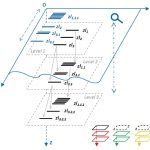
The model of z-text was inspired by this fictional schema of a self-expanding story answering readers’ questions. Unlike it, the questions are not explicitly formulated by the reader but enclosed in the text itself, seen as a collection of potentially extensible entities, called z-lexias, explored by zoom-in and zoom-out. A z-lexia (after Barthes’ lexia in S/Z, a unit of reading and analysis) can vary from an empty line, a few words, phrases, to one or several paragraphs including text and possibly images. The most common unit envisioned so far is the paragraph. In Le livre sous la loupe (where the model and its possible applications are described in more detail), we make the hypothesis that a z-lexia (except for the empty line) may contain elements that trigger a more detailed representation of the unit content. A z-textual layout supposes a hierarchical structure of z-lexias disposed on levels of detail, along with the Z-axis. The processes of reading and writing z-lexias are called z-reading and z-writing. A parent z-lexia consists in a fragment which has engendered descendants, i.e. has been expanded on the subsequent levels of the representation, like zl1 and zl3 in Figure 1. Suppose that initially all the three z-lexias from the Level 1 were shown on the blue roll (the display device pictured in blue in the figure). After you have zoomed-in twice - on zl1 and on its child zl1.1, and once on zl3, the roll displays the 3rd-level descendant of the first unit (zl1.1.1), the second unit unchanged (zl2), and the 2nd-level descendants of the third unit (zl3.1 and zl3.2). Each zoom-in operation performed by the reader replaces a z-lexia visible on the roll with its next-level children (if any), while a zoom-out substitutes all the displayed children with their previous-level parent (if any). The zooming mechanism entails therefore a back and forth movement through the layers of text and the dynamic projection of z-lexias on the displaying device. Since its content can shrink and grow indefinitely, the device seems more similar to a roll rather than to a page.
Figure 1. Z-text model
The “tri-dimensional space” of a z-text can be turned multidimensional if the same z-lexia is expanded and then explored by different types of magnifying glass, i.e. following different points of view or perspectives (sometimes even contradictory). Imagine, for instance, the entry on the princess Ateh in Pavić’s Dictionary of the Khazars developed according to the three books, red, green and yellow, each corresponding to one source dealing with the Khazar question: Christian, Islamic and Hebrew. A zoom-in on Ateh with the red magnifying glass will produce an account about the Ateh’s role in the Khazar polemic, leading to the adoption of the Christian religion by the princess, the kaghan and his people. Examining the same entry by a green or yellow magnifying glass would yield different accounts, each one claiming the resolution of the controversy in favor of one or another color. The change of the magnifying glass creates thus parallel “universes” or a “polyphonic system” where every voice has its own “reality” to communicate. The Figure 1 (bottom right) symbolically represents a z-text conceived to be explored by several magnifying glasses. The level 1 (replicated in dotted lines) is common and contains z-lexias expanded along with different projections of the Z-axis (red, green, yellow) on the deeper levels. The pattern may be generalized to cases where episodes on a given level are expanded and examined from distinctive perspectives, like in rendering different narrators’ viewpoints on the same situation or separate analytic views on the same textual fragment (stylistic, character-centered, genetic, socio-cultural, etc.).
Going back to the primer, Stephenson also describes its self-expanding narrative as being “anfractuous” (full of windings and intricate turnings, according to Merriam Webster), a term relating to the fractal theory.
“This sort of thing no longer surprised or upset Nell because it had happened hundreds of times during her relationship with the Primer. Besides, she had known, from the very first day Harv had given her the book, how the story would come out in the end. It was just that the story was anfractuous; it developed more ramifications the more closely she read it.” (343)
In The Fractal Geometry of Nature, Benoit Mandelbrot draws attention to the peculiarity of highly convoluted coastlines, like that of Britain, whose length increases without limit while measured with smaller and smaller yardsticks (24-25). This phenomenon, due to the existence of details, can be illustrated by an iterative process, the construction of the Von Koch curve - considered, by analogy, a fractal approximation of the coastline (35-39). First, a portion of the coastline is
approximated by a straight line called initiator (see Figure 2, left). Then, it is assumed that a promontory becomes visible, and, in a second approximation, the initiator is replaced by a line broken into four segments of equal length, named generator. Additional details can appear if at each iteration every straight line is replaced by smaller generators. Paradoxically, while its length tends to infinity as the number of iterations increases, the Von Koch curve remains confined to a limited area.
Figure 2. Left: Von Koch curve iterations (after Sapoval, 1989: 19).
Right: The deviations from the line. Extract (Sterne, 2004: 378)
One can observe a certain analogy between the Von Koch curve generation and the replacement of z-lexias by their more detailed, deeper level counterparts. From the content point of view, this analogy may bring to mind Sterne’s digression style in Tristram Shandy, defined by a series of deviations from the main narrative line (Figure 2, right). The content of a z-text displayed on the roll may similarly grow more and more intricate, take an anfractuous shape and expand in unexpected directions as new details are added to it. There are also certain affinities with the cartographic zoom model, allowing the user to change the representation scale, from a view of the terrestrial globe to the image of a specific place on Google Earth, for instance. As G.R.P. Lawrence (4-5), Orford (200-201) and MacEachren (10) observe, the selection of cartographic details is not purely a technical and objective process but includes factors relating to the intended degree of generality, the subjectivity of the cartographer, the power relations and the socio-cultural milieu having influenced the production of the map. According to MacEachren, a map is not merely a representation of a region of the Earth but it can also possess some of the attributes of a “rhetorical discourse”. From this perspective, the methods of cartographic analysis would resemble more the methods of literary criticism rather than those of exact sciences.
The choice of details to be represented on every layer of a z-text is the result of a subjective and intentional procedure, too. The z-writing process should assume a certain strategy of stratification and selection of the textual material. Whether we are talking about the narrative technique, the way of accessing the characters’ psychology or the deployment of arguments in an essay, the author of a z-text makes choices when creating z-lexias for a particular level. The “surface” levels may correspond to a smaller scale of representation, characterized by a higher degree of “generality”, while the deeper levels, by including additional details, can move closer, like the approximation of the coastline, to the “reality” they describe. In this respect, the textual zoom resembles more the cartographic than the technical zoom on an image which does not assume the deliberate selection and the prior assemblage of details. It also supposes a “scalable” structure, a label that Ryan (213) borrows from Sheldon Renan while speaking of those interactive forms, like Stephenson’s primer, allowing the rapid shift “from the epic perspective to infinite detail”.
Detail as Trigger
The main ingredients of the z-text model described so far are the detail, as an expansion (and curiosity) trigger, and the magnifying glass, a tool-metaphor for textual folding and unfolding, closer examination and discovery. The following examples produced and displayed by means of the zoom-editor interface, focus on narrative, descriptive and logical aspects.
The first example contains excerpts from a z-text in progress, The Ursitoare Night (Ursitoare, the Romanian for Fates). The story starts with three paragraphs outlining a popular belief in Ursitoare, the three deities supposed to visit the house of a new born child, on the third night after the baby’s birth, to decide on the child’s destiny (Figure 3, screenshot 1). The picture shows how the text unfolds after several successive zoom-in operations on the first z-lexia and its descendants (screenshots 2, 3). As additional details from the deeper levels are brought to the surface, new characters and facts are added to the story. Some elements act like triggers of the expansion process and agents in the storytelling progression. For instance, the “change of scale” produces the growth of the story following the narrative line: sleeping house - grandparent’s house - great granddad - sepia portrait - uniform, plane - war. This progression presumes not only the narrative advance and the addition of new branches to the story, like the raven’s episode in Nell’s primer, but also a gradual change in the thematic register, from the popular mythology and fairy-tale-like storyline to a miniature account on the World War I.
Figure 3. Narrative triggers. The Ursitoare Night
If certain details can determine the narrative and topic dynamics, others may model the physical or emotional proximity and distance of the reader to an object in the textual space. The two fragments below extracted from Tolkien’s The Fellowship of the Ring slightly differ on the first and second level of the representation by a few descriptive details, initially subtracted and then put back in the original text (Figure 4).
Figure 4. Descriptive triggers. The Fellowship of the Ring (33)
After a zoom-in on the first paragraph, the viewpoint changes and this change may call to mind the movement of a camera corresponding to the perspective of a reader-observer. The first level fragment can be interpreted as a shot framing, from a certain distance, the two interlocutors in front of the open window in Bilbo’s house. By zooming-in, the reader is “approaching” the scene and more details enter into focus: the room (whose interior is possibly visible through the window) is “small”; the interlocutors are looking “out west”; the flowers, whose colors and types become discernible (“red and golden”, “snap-dragons, sun-flowers and nasturtians”) adorn the “turf walls” and the “round windows”. One can imagine a similar approach allowing the reader to get gradual access to the psychology of the characters, initially described only by their external, physical appearance. The technique, based on an ongoing, richer description triggered by particular details, may therefore emulate different positions of the reader as an observer moving in the physical or psychological space created by the textual content.
The third example proposes a “z-textual view” on Auerbach’s Odysseus’ Scar (Figure 5). The layout was inspired by the text itself and the general organization of the book, perceived as possessing a sort of stratified argumentation, each stratum adding a new line of reasoning or type of interpretative insight. In the Epilogue, Auerbach synthesizes the articulation points of his analytic method in Mimesis, i.e. “the interpretation of reality through literary representation or ‘imitation’ ”. The goal of his approach is not a comprehensive history of realism in general but an inquiry about the gradual incorporation of “realistic subjects” (like daily life reality) into literary representations treating them “seriously, problematically, or tragically”. According to Auerbach, the classical doctrine of the separation of styles places this kind of everyday reality within the literary frame of a low or intermediate style, going from “grotesquely comic” to “elegant entertainment”. It is with the story of Christ and its mixture of “everyday reality” and “sublime tragedy” that the classical rule of levels of styles begins to fade (554-556). Since this process spans over a long period of time, Auerbach proceeds by the study of a selection of texts corresponding to different epochs and literary movements, from Antiquity to Modernism, and the analysis of various factors having influenced their production (cultural, social, economic, etc.).
Figure 5. Logical triggers. Excerpts: Odyssey (19). Genesis (22). Odysseus’ scar (3-8)
Each chapter implies a methodological schema including elements like citation, close reading, comparative analysis as well as cultural, socio-economic and historical considerations on the context having determined the production of a specific work or tendency. Our interpretation of the method is illustrated by a hypothetical arrangement of fragments extracted from the texts examined in Odysseus’ Scar.
The first level of the representation contains two extracts, from Homer’s Odyssey (book 19) and Genesis (22) (screenshot 1). Although the two fragments are closely analyzed later, they are not reproduced in this first chapter as compact citations, like the opening texts in the other chapters of Mimesis. Since we have assumed that the argumentation in the book is organized according to a layered structure (Figure 5, foreground), where the first level is that of citations, we have added the two excerpts for illustrative purposes (imagine, for instance, that the reader is interested to scan firstly all the citations, in order to get a quick historical perspective on the works under consideration). Then, we supposed that the argumentative space is organized in depth along with an imaginary analysis axis. To enter this space the reader can zoom-in on the fragments. The second screenshot shows the result of these operations supposed to bring to the surface, in Auerbach’s own terms, the two accounts, the feet washing scene when Euryclea recognizes her master by his scar and the episode of God testing Abraham’s faith by asking to sacrifice his only son, Isaac. If the second level of representation implies a survey of what is narrated, we have imagined the third level as adding more elements from the stylistic perspective (how it is narrated), like for instance, the “foreground” strategy in the scar episode filling completely the stage and the reader’s mind in the Homeric text, or the laconic, mysterious way of leaving things unexpressed that call for interpretation, in the Genesis fragment. Zooming further, the reader can discover on the forth level new constituents acting like “binders” between the two - till now - separated analytic chunks (screenshot 3) and comparing directly the two texts belonging to different worlds of forms, the perfectly illuminated, externalized phenomena in the Homeric poems and the undefined, unexpressed, left in obscurity details in the biblical accounts. The analysis can continue on a deeper level by adding more general reflections on the “great and sublime” in the Homeric poetry, which always suppose events and characters related to the “ruling class”, while in the Old Testament stories the “sublime, tragic and problematic” can occur in the “domestic and commonplace”, to conclude with the influence of the two styles upon the “representation of reality in European literature.” (22, 23)
The experiment involved a number of assumptions and approximations in order to illustrate this kind of interpretative study “under the magnifying glass” and the gradual movement from particular literary texts to the general context having shaped them or been influenced by them. As the example shows, from the point of view of the content, there is no strict rule that the traversal of a z-textual structure, from the surface to the deeper levels, should always imply a movement from general to particular. Other alternatives are also possible (particular to general, simple to complex, concrete to abstract, abstract to concrete, etc.) depending on the author’s intentions and strategy to derive new z-lexias. For this case, it was assumed that the layers of the argumentative space can be built by extracting and then adding back details, so that, after traversing all the five levels (from the citations to the general assertions on the European literature), the whole Auerbachian text is displayed on the roll. The z-text layout was intended to capture some pieces of an interpretative perspective in movement, taking shape gradually, as it emerged from our reading of Mimesis. These hypotheses were based upon the observation that certain elements may act as triggers allowing the folding and unfolding of arguments (narrative, stylistic, comparative, historical, etc.), an argumentation which took for us the shape of a stratified, dynamic and elastic structure.
Electrifying the Detail
Revisiting Schor’s absorbed and delayed details or Barthes’ punctum, one can note certain similarities between the visible/hidden mechanism at work in the zoom-editor interface and the inner dynamics of these entities discussed in an earlier section. We may assume, for instance, that the “sleeping house” in The Ursitoare Night, the “open window” and the “garden” in the Fellowship description or the Ulysses’ scar encapsulate in themselves a potential for anticipation and absorption, as they trigger the disclosure of other details and determine a narrative development, a proximity/distance variation or a new argumentation line. Tracing back the path from the Caudron World War 1 planethrough the “sepia portrait” and the “grandparents’ house”, all these details from the deeper levels appear both absorbed or anticipated by the first level “sleeping house” and delayed since they are made visible only later, by successive zoom-in. It is the same for the “red and golden” “snap-dragons, sun-flowers and nasturtians” and their “garden” predecessor, or the “huge vista” of the “foundational modes for the representation of reality in European culture” anticipated by the “pointillist textual detail” of the scar, as Gallagher and Greenblatt called it (34).
Barthes’ punctum, on the other hand, can be approached from two perspectives, that of a reader or writer of a z-text. From the former’s point of view, an expandable fragment may trigger or not the curiosity or the “affective consciousness” of the reader, so that she or he is willing to zoom-in and discover what is hidden on the deeper levels of the representation, and thus become more involved in the z-textual world. For the latter, the “expansion power” of the punctum can be materialized by punctual additions to the text, triggered by elements contained or suggested by what is “already there”. In the z-textual scenario of Mimesis, the digression on the Ulysses’ visit to Autolycus and the boar hunt functions as an incentive for the expansion of the episode and the addition, layer after layer, of the analytic reflections leading to the overview on the literary representation of reality. Similarly, the “grandparents’ house” or the “open window” may act as stimuli in the writing process urging the author to say more about the occupants of the house and the events they were involved in, or about the two interlocutors in the room with windows open to the garden. It is possible that the elements that stir the reader’s curiosity in expanding a fragment are not the same as those inciting the writer to do so. There is a sort of expectation horizon defined by the ingredients the author has chosen to represent on a certain level and waiting for further development. However, this horizon may simply not coincide with the reader’s or be deliberately blurred to enhance the suspense or the effect of surprise. While not claiming that the process of writing and reading could be completely emulated by punctum-like additions or subtractions, we assume that a z-text, by its stratified structure that keeps track of a progression, may deal with some of the aspects involved in the creative or interpretative processes, like what factors motivate the growth of a text or its exploration, and why.
Finally, it was intended to address the question of the detail as an aesthetic category within the larger framework of the electronic literature, and its potential to bring into focus the text as a process rather than a product. The approach has not aimed to create a bird’s-eye view on the subject but was oriented toward the particular model of a text that can grow “indefinitely” still contained in itself, like the coast of “infinite” length inside a confined area. It is up to the reader now to further expand the electrified detail and its inherent assumption that the detail is not merely a detail but a trigger that can shape the “fate” of a text starting just with three outlining paragraphs.
Works cited
Auerbach, Erich, Mimesis. The Representation of Reality in Western Literature. Princeton University Press, Princeton and Oxford, 1953, 2003.
Barthes, Roland, S/Z, first edition1970, translated by Richard Miller, Hill and Wang, New York, 1974.
Barthes, Roland, Camera Lucida. Reflections on Photography, translated by Richard Howard, Hill and Wang, New York, 1981.
Gallagher, Catherine, Greenblatt, Stephen, Practicing New Historicism, The University of Chicago Press, Chicago and London, 2000, paperback edition 2001.
Genesis, 22, Abraham’s Faith Tested(accessed October 23, 2012).
Homer, Odyssey, Book 19, translated by A. T. Murray(accessed October 23, 2012).
Lawrence, G.R.P., Cartographic Methods, Methuen & Co Ltd, London, UK, 1971.
MacEachren, Alan M., How Maps Work. Representation, Visualization, and Design, The Guildford Press, New York, London, 2004.
Mandelbrot, Benoit B., The Fractal Geometry of Nature, W.H. Freeman and Company, New York, 1977, 1982, 1983.
Manovich, Lev, The Language of New Media, The MIT Press 2001, (accessed October 12, 2012).
Orford, Scott, “Cartography and Visualization”, in Questioning Geography. Fundamental Debates, edited by Noel Castree, Alisdair Rogers and Douglas Sherman, Blackwell Publishing, 2005, (pp. 190 – 205).
Renan, Sheldon, “The Net and the Future of Being Fictive”, in Clicking In. Hot Links to a Digital Culture, edited by Lynn Hershman Leeson, Bay Press, Seattle, 1996.
Ryan, Marie-Laure, Narrative as Virtual Reality. Immersion and Interactivity in Literature and Electronic Media, The Johns Hopkins University Press, Baltimore and London, 2001.
Sapoval, Bernard, Les Fractales. Fractals, Aditech, Paris, 1989.
Schor, Naomi, Reading in Detail: Aesthetics and the Feminine, first edition, 1987, Routledge, New York, London, 2007.
Stephenson, Neal, The Diamond Age or A Young Lady’s Illustrated Primer, Bantam Books, New York, 1995, new editions 1996, 2000, 2003.
Sterne, Laurence, The Life and Opinions of Tristram Shandy Gentleman, The Modern Library, New York, 2004.
Tolkien, J.R.R., The Fellowship of the Ring, Harper Collins Publishers, London, 1994, paperback edition 1999.
Vasilescu (Armaselu), Florentina, Le livre sous la loupe : Nouvelles formes d’écriture électronique, Ph.D. Thesis, Papyrus, University of Montreal Institutional Repository, June 2010. Earlier versions of the z-text model and its possible applications were published by Presses de l’Université Laval (2010) and Common Ground (2006, 2007).
Wey, Francis, “Comment le soleil est devenu peintre. Histoire du daguerréotype et de la photographie”, Musée des familles, vol. XX, juin 1853, p. 257-265, juillet 1853, p. 289-300, (accessed September 25, 2012).
Cite this essay
Armaselu, Florentina. "Electrifying Detail: Writing and Reading Triggers in Textual Zoom (armaselu)" electronic book review, 1 November 2012, https://electronicbookreview.com/publications/electrifying-detail-writing-and-reading-triggers-in-textual-zoom-armaselu/