Beyond the Page: Exploring Identity and Reality in the world of Steve Tomasula's Ascension

Steve Tomasula's Ascension refuses to let the novel sit still, weaving a plethora of multimodal practices into a form that insists reading is a physical, perceptual act. Saidi argues that identity and reality in the novel are never found but perpetually assembled by a reader who cannot remain passive.
In an age marked by digital technology, environmental uncertainty, and destabilized narratives of the self, Steve Tomasula’s literary works redefine the novel as an evolving multimedia form that resists passive consumption because meaning itself has become unstable in a data-saturated world. Known for his genre-defying works, Tomasula invites readers to engage with literature not merely as a linear narrative, but as a layered, interactive experience. In his works, he blends text, image, graphic design, visual arts, typography, scientific diagrams, and philosophical inquiry to challenge what a novel can be. As David Banash observes, echoing J.G Ballard’s prediction of a writer attuned to the changing conditions of modern perception, Tomasula exemplifies “the very writer Ballard imagined, a novelist willing to abandon the comforts of tradition and invent ways to encounter and represent a new world” (Banash 5).
One of his landmark achievements is TOC: A New-Media Novel, a work that epitomizes his commitment to innovation. It was released as both a book and an interactive digital narrative. It disrupts the linearity of print by embedding text within animated visual layers. TOC does not unfold in time; it makes time visible. The work asks a broader theoretical question: what does it mean to read and experience a story in an era shaped by digital media? Tomasula extends this experimental legacy in Ascension. The novel unfolds through three distinct yet interconnected parts, each organized around a different temporal horizon and mode of mediation. While the first two sections mobilize print-based strategies to explore scientific history and contemporary biotechnological inquiry, the third explicitly extends the novel beyond the page. In this final movement, Tomasula incorporates a digital counterpart to the printed text: QR codes embedded in the book directing the readers to online videos, including YouTube footage. This formal expansion of the narrative invites critical reflection on the novel’s use of multimodality; as Johanna Drucker observes:
In this epic-scale novel, Steve Tomasula uses multiple modalities and media formats to track the course of ecological impacts and change, from illustrations of contact encounters to a movie script, to elaborate aerial views and data visualization. Tomasula demonstrates his unique capacity to engage with technologies of knowledge in constructing his provocative narrative (Drucker).
Indeed, Ascension is not simply a novel but an evolving system of signs. Tomasula extends his project by taking readers on interwoven journeys in a near-future world dominated by biotech corporations and environmental decay. Ascension challenges both the form of the novel and our understanding of what it means to be human in a synthetic, data-driven age. Additionally, Ascension blurs boundaries between genres and disciplines, yet it compels the reader to confront the consequences of living in an era where data replaces memory and intentional human control replaces natural evolution. Structured in three parts, the novel follows the intersecting narratives of an array of characters whose journeys illuminate its central concerns and explore a world shaped by the rise of synthetic biology, the expansion of genetic engineering, the development of digital identity, the ecological collapse, and the commodification of life, all of which pervade the narrative. In “Transformation,” the Professor, a Western 19th century natural scientist and Raul, an indigenous guide, represent competing epistemologies: Western evolutionary science and Indigenous ecological knowledge. Their encounter exposes how scientific narratives are inseparable from colonial histories, power structures, and acts of erasure. “Little Truth” shifts to the 1980s and introduces Jane, an entomologist whose work on feather-lice intersects with scientific discovery, challenges of gendered dynamics of labor, and her pursuit of self-determination. Arthur, a filmmaker tasked with documenting her research, mediates nature through the camera lens, revealing how technologies of representation shape perception. Finally, Ascension,“set 15 minutes from now,” (Pactor) depicts characters such as Meadow, Gabe, Dan, and Olympia who navigate a world in which identity has become inseparable from metadata, digital archives, and algorithmic infrastructures. Their experiences dramatize the fragility of selfhood in a reality increasingly governed by data, surveillance, and accelerated evolution. Through a hybrid form that integrates text, diagrams, data visualization, fragmented, and cinematic language, Tomasula constructs not only a story, but a reading experience where meaning emerges through active interpretation and multimodal decoding and invites the reader to reflect on how reality is mediated through science and storytelling. Such a form invites what Roland Barthes describes as the “writerly” mode of reading, in which the text becomes a site of active production rather than passive consumption (Barthes 10).
This article argues that Ascension reconceives the novel form by merging thematic inquiry and formal innovation. I will first examine how the novel explores the interconnectedness of identity, evolution, and human-nature, showing how these relationships unfold across overlapping narrative threads, revealing that the self emerges within fragile ecologies: biological, cultural, and technological. I will, then, turn to the novel’s multimodal strategies: its intertextual frameworks, typographic play, and dense visual field to demonstrate how Tomasula constructs and destabilizes reality through form itself. Finally, I will focus on the role of the reader, arguing that Ascension demands an active, interpretive participation in which reading becomes a perceptual act shaped by fragmentation and media multiplicity.
Together, these elements reveal how Ascension not only narrates a story about the future but performs a storytelling for the future, one that reflects the complexities of living and making meaning in an age of technological saturation and posthuman inquiry.
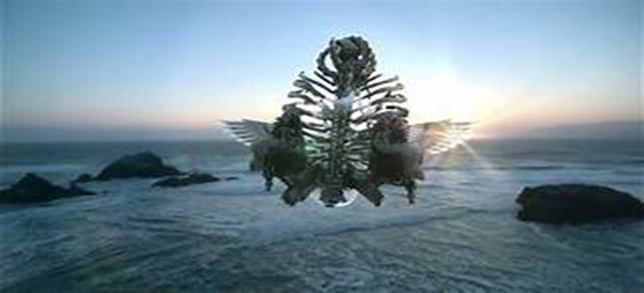
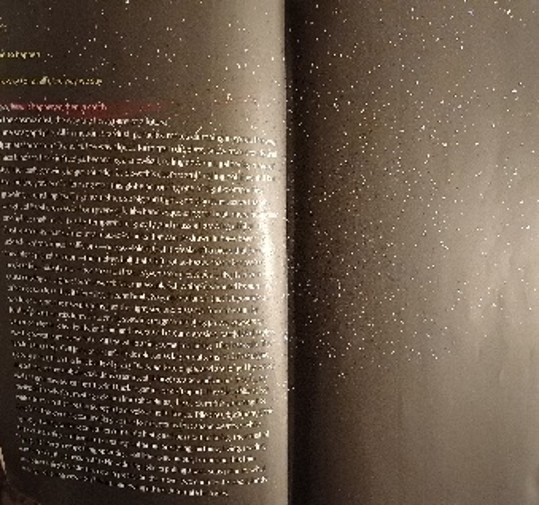
At first glance, the cover of Ascension (Fig. 1), visually encapsulates the novel’s preoccupation with fragmentation, hybridity, and transformation. It displays layered compositions—blending technical schematics, organic patterns and abstract forms (perhaps part-bird, part-machine composed of dark metallic ribs, wings, and segmented limbs)—that are not mere decoration but mirror the novel’s central tension between the natural and artificial, the human and the posthuman. The opening page establishes the novel’s structural and thematic framework, introducing a pattern that reverberates throughout the book. It moves deliberately from the vastness of cosmic origins to the intimate scale of human perception, beginning with a star-filled page accompanied by a compressed history of the universe (Fig. 2). This framing situates the reader within a sense of deep time, which in turn becomes the paradigm for the book’s continual oscillation between biological, ecological, social, and personal registers. Moreover, the visual stratification of scientific exposition, poetic diction, and abstract imagery on this first page already anticipates the novel’s hybrid form, which persistently blends diagrams, photographs, typographic experiments, field notes, and narrative shards. Because the opening asserts that the universe “didn’t have to happen this way,” (Tomasula 8) it introduces a principle of radical contingency that later governs the work’s treatment of evolution and ecological transformation. In this respect, the initial spread not only establishes the aesthetic grammar of Tomasula’s experiment but also functions as a conceptual map for the book’s non-linear architecture, revealing how Ascension mobilizes shifts of scale, visual forms, and the logic of chance to shape the reader’s experience in a world where knowledge is not only conveyed through text but embedded in visual systems, maps, and scientific renderings. This visual-textual interplay primes the reader for the novel’s deeper interrogation of evolution, biotechnology, and identity: How do humans continue to “evolve” when their environments and identities are increasingly constructed through digital, genetic, and mechanical design? I will explore how Ascension develops these concerns through the intertwined narratives of its characters.
Identity in the World of Ascension
Steve Tomasula’s Ascension establishes from its very opening the tension between humanity’s long-standing desire for mastery and the ecological, ethical and spiritual consequences of that desire. The biblical mandate to hold “Dominion over all the earth” (Tomasula 11) appears in the narrative not as victorious proclamation of human power but as an ironic prelude to the novel’s exploration of ecological disruption, scientific ambition, and the fragility of human identity. Indeed, the recurring evocation of “The Garden” underscores the contrast between an idealized origin and the fragmented technologically mediated world the characters inhabit. Thus, the novel positions evolution not merely as a biological process, but as a cultural one, shaped by myth, language, and the shifting relationship between humans and their environments.
Far from unfolding through discrete narrative strands, the novel assembles an interconnected constellation of characters whose trajectories illuminate different yet mutually reinforcing tensions between evolution, culture, and the fragile coherence of the self in its environment. Consequently, the analysis of themes in Ascension requires tracing the lines of connection that move fluidly across chapters, characters, and visual-textual forms.
In “Transformation,” the Professor and Raul articulate two sharply divergent yet intricately intertwined conceptions of identity, evolution, and human relationship to the natural world, and their encounter thus becomes a microcosm of the novel’s broader critique of Western epistemology. The Professor arrives on the island as the embodiment of 19th century scientific authority, bearing the tools of that tradition “Moroccan journal, telescope, […] a selection of books” (Tomasula 13) objects that suggest the equipment of a knowledge-power regime designed to classify, measure, and ultimately master Nature. However, Tomasula gradually destabilizes this epistemic confidence: as the Professor journeys inland, he experiences a temporal collapse “With every stroke, he could feel himself drawing nearer to the fossil he had devoted his life to find […] The date October 24th, 1859 seemed out of place here” (Tomasula 17), a disorientation that signals the dissolution of linear evolutionary logic and exposes modern scientific identity as fundamentally precarious. Moreover, the Professor’s own reflections reveal that he is torn between his role as an agent of modernity and his mourning for the cosmological frameworks that modernity has displaced. He perceives that:
[…] the tapestry embroidered by modern stitches would overrun even the eternal world of the forest natives, as by modern stitches as surely as it had all but erased the world he had been born into: an age when the study of nature was inseparable from the majesty of Nature, and the majesty of Nature one with the Divine (Tomasula 12).
Tomasula here exposes the colonial logic that underlies the Professor’s scientific project: the belief that Western knowledge does not simply study the natural world but actively rewrites it. The metaphor of the “tapestry” implies that the island functions as an archive fabric of ecological and cultural histories, and the Professor seeks to dominate it and ultimately overwrite it through modern science. His conviction that such “stitches” would inevitably erase indigenous worlds reveals a faith in the universality of scientific taxonomy. Raul’s presence in this framework challenges the Professor’s hierarchical worldview. Through this contrast, Tomasula exposes the fragility of any identity, scientific, colonial, or otherwise built upon the illusion of total mastery. Raul, meanwhile, presents an alternative mode of identity grounded not in articulation but in embodied ecological memory. The narrator observes that he “said little” (Tomasula 24), a silence that, far from rendering him enigmatic or romanticized, functions as what Homi Bhabha calls a “Third Space,” (Bhabha 53) where subaltern knowledge persists despite colonial and modern erasure. His identity is formed through a continuity with the forest, a landscape understood not as an object of study but as a living archive transmitted through generations; yet that forest was becoming unrecognizable “her people were all dead and the trees and animals had changed so much that he wouldn’t even recognize them” (Tomasula 17). His world undergoes forced transformation under external pressures, echoing ecological disruption and cultural dislocation. So, while the Professor seeks to inscribe the forest within scientific discourse, Raul navigates it through inherited, embodied knowledge, and both figures inhabit a space where identity is continually destabilized by competing ontologies. Their uneasy coexistence ultimately dramatizes Tomasula’s central claim that identity and evolution are not discrete categories, but mutually constitutive processes shaped by the entanglement of human desire, technological modernity, and ecological change. In addition, their interaction foregrounds the epistemological asymmetry at the heart of the novel. The Professor’s view of identity is grounded in data objectivity and genetic determinism, while Raul’s is rooted in cultural survival and environmental memory. Tomasula uses this contrast to expose the political dimensions of evolution. Accordingly, identity, in Ascension, is neither purely biological nor genetically fixed; rather, it is shaped by scientific, technological, colonial and ecological frameworks that claim to define it. In portraying the divergence between Raul’s embodied knowledge and the Professor’s empirical detachment, Tomasula foregrounds the question: who gets to define reality?
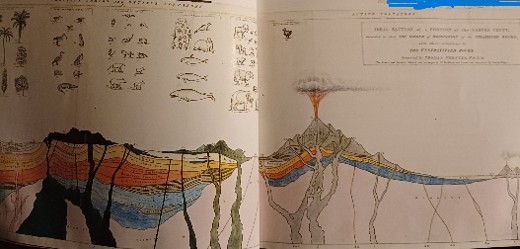
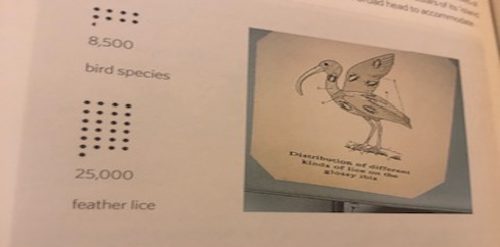
By aligning the visual and textual structure of the novel with this tension—layering maps, sketches, and data grids alongside fragmented prose—Ascension mirrors the disorientation experienced by those, like Raul, whose worlds are rewritten by systems not of their making. Furthermore, in the second section “Transformation”, Jane embodies the novel’s central tension between scientific rationality and the fluid, relational identity that evolution implies. Her work on the origins of birds, tracing their lineage back to feathered dinosaurs (Fig. 3), positions her within a scientific tradition seeking empirical “truth”. Yet, the narrative continually undermines the stability of that truth by embedding her research within a broader ecological philosophy. Early in the novel, the narrator asserts that “We are in nature, not apart from nature and so live within an all- powerful unity of life” (Tomasula 53). A statement that directly challenges Enlightenment taxonomies and the very hierarchies on which Jane’s field historically relied. Rather than standing above or outside what she studies, Jane is implicated in a continuum where human and non-human forms are inseparable. This ecological unity destabilizes the fixed categories—species, gender, expertise through which scientific authority is typically legitimized. It is within this unstable terrain that Jane must navigate a male-dominated scientific culture that questions her credibility. “It’s not that we don’t want to stay, it’s just that we’d have to have more to go on than a woman’s intuition” (Tomasula 63). Her struggle echoes the evolutionary process she studies that is never fixed but constantly negotiated.
This is also where the novel’s intertextual threads begin to surface. The unity of life evokes Darwinian continuity, but it also resonates with mythic and literary worldviews in which humans are embedded in a living cosmos rather than standing above it. These echoes prepare for Jane’s later self-comparison to Ahab, a figure she invokes not merely as a literary reference but as a performative act of identity. Her “Call me Ahab” in “Little Truth” becomes a moment of appropriation, irony, and rebellion: She aligns herself with a mythic male figure known for obsession, authority, and a doomed pursuit of truth. In reclaiming the Ahab figure, she repositions herself within, rather than outside, a lineage of authoritative storytellers and knowledge-seekers asserting a place in a tradition that traditionally excluded women. At the same time, this intertextual frame also intersects with Arthur’s presence in a markedly different way. His camera reframes Jane’s work within visual narratives that blend scientific documentation with filmic storytelling. Through photographs and fragmentary scripts, evolution is not presented as a stable, linear scientific process; instead, it becomes something staged, edited and narrated. In this sense, Arthur becomes a mirror to Jane: both attempt to capture truth, yet they do so through different media that are always already intertwined with myth, narrative and subjective framing. However, the nature of their search differs. Jane approaches evolution through scientific inquiry, treating biological fragments—lice, fossils, and amber—as material traces that may yield a “little truth”. Arthur, by contrast, approaches evolution as narrative material. For him, meaning does not originate in the object of study but in the style and arrangement of the story. Thus, where Jane seeks truth in evidence, Arthur insists that truth arises from narrative transformation. Their encounter embodies the novel’s broader claim: identity and knowledge emerge at the intersection of discourses—scientific, visual, mythic, and ecological—rather than from any single authoritative viewpoint. Arthur’s identity in Ascension is therefore inseparable from narrative itself. A filmmaker by training and temperament, he approaches the world as if it were already a sequence of scenes waiting to be edited, framed, or repackaged for an audience. By the final pages, he collapses the distinction between scientific inquiry and cinema, telling Jane, “We can still make your movie and mine. We can make a hundred thousand different movies with the same footage.” (Tomasula 158). His worldview depends on the belief that there is no essential hierarchy of representations, only better or worse stories. This perspective reveals Arthur as a figure shaped by a late-century media landscape that treats reality as raw footage.
Jane works within the conventions of scientific inquiry, whereas Arthur exposes how any representation of evolution can be shaped by framing, selection and narrative construction. Together, their perspectives reveal that evolution is not only a biological process but also a story told through scientific and cinematic forms, each shaped by interpretation and perspective. Both operate within media, scientific and cinematic, that are always already intertwined with myth, narrative and subjective framing. Their encounter embodies the novel’s broader claim. Identity and knowledge emerge at the intersection of discourses, scientific, visual, mythic—and not from any single authoritative viewpoint. For Arthur, meaning does not originate in the object of study but in the style and arrangement of the story. Where Jane treats biological fragments: lice, fossils and amber as material traces that may yield “a little truth,” Arthur insists that truth itself arises from narrative transformation.
This perspective reveals Arthur as a figure shaped by a late-century media landscape that treats reality as raw footage. He cites Melville’s epigram, “No great and enduring volume can ever be written on the flea” (Melville éd. 349) not to dismiss Jane’s work, but to argue that “enduring” truths depend on their narrative scale and dramatic appeal. Small organisms, minor details, or fragmentary evidence hold little value for Arthur unless they can be elevated through spectacle. His sense of self is inseparable from performance; he rehearses lines, imagines reactions, and anticipates how he will look when the camera turns toward him. Arthur’s relationship with Jane intensifies this tension between truth and representation. He attempts to absorb her scientific work into his aesthetic framework, positioning her discoveries as “a movie” that can be edited into whatever story the audience prefers. In doing so, he unintentionally reveals the fragility of his own epistemology: as a filmmaker, his sense of self depends on the capacity to transform truth into narrative. If Jane represents a form of knowledge rooted in microscopic organisms and evolutionary traces, Arthur represents the cultural machinery that transforms such knowledge into images, metaphors, and spectacles for mass consumption. Hence, he embodies the novel’s critique of the mediation of truth in contemporary culture. His cinematic vision is not malicious, but it reveals how the desire for narrative coherence can overwhelm the fragmentary nature of biological and historical reality. His identity is built not on empirical observation but on the affective power of storytelling, on the belief that a thing becomes true once it has been seen, circulated, and emotionally absorbed. Through Arthur, Ascension exposes the delicate boundary between understanding the world and editing it, between witnessing evolution and reshaping it into a narrative that audiences will believe a similar tension animates the intertwined stories of Jane and Arthur, for whom identity becomes inseparable from media, performance, and the unstable surfaces through which truth is produced. Their narratives reveal that in a world saturated by visual and digital mediation, authenticity becomes indistinguishable from performance; truth is not discovered but fabricated through technological filters.
Likewise, this instability is magnified in the last section, “Ascension,” through the emotional, mythic, and technological entanglements that shape the experiences of characters such as Meadow, Gabe, Olympia, and Dan. For instance, Meadow exposes the collapse of the 19th century belief in evolution as linear progress and reveals instead a movement toward dissolution, transcendence, and, ultimately, the instability of identity. Whereas earlier narratives imagined evolutionary change as growth toward an “everlasting type” (Tomasula 23), Meadow’s grief after losing her son in the tsunami repositions change as fragmentation and loss rather than as advancement. Consequently, her turn to W2, an apparatus promising visionary access or spiritual elevation, functions not as an improvement of the self but as an attempt to escape the limits of embodied life altogether. Moreover, the increasingly disjointed language and distorted visual compositions mirror her psychological disintegration, suggesting that ascent to a posthuman form of existence comes only through the erasure of stable subjecthood. Thus, Meadow’s desire for transcendence undermines the very premise of progressive evolution: instead of moving upward toward perfected humanity, she moves outward into a realm where identity becomes porous, diffused, and unmoored. In this way, Meadow’s story reframes evolution not as progress but as the unraveling of fixed forms, demonstrating how trauma transforms both the self and the natural order into contingent, unstable systems. Her reliance on W2 reverberates Raul’s earlier loss, yet whereas Raul’s story is grounded in cosmological continuity, Meadow’s is filtered through predictive analytics and automated decision-making. The formal parallel reveals Tomasula’s broader concern: that contemporary forms of absence and desire are mediated by systems that promise omniscience while hollowing out human experience. In the same way, Gabe inhabits a world marked by abandonment, fragmentation, and precarious belonging. Indeed, her presence foregrounds the novel’s broader critique of classificatory regimes, whether scientific or social. Her narrative participates in the novel’s larger exploration of kinship ruptured by mobility, warfare, and socioeconomic precarity. Similarly, Olympia, whose bodily presence is repeatedly reframed through technological interfaces, embodies the dissolution of the boundary between biological beings and its digital shadow. Moreover, Dan, marked by the trauma of military service, experiences the world through machinic perception, where screens, surveillance feeds, and tactical visualizations reconfigure both memory and identity. For Dan, evolution is less a biological concept and more a framework for meaning, a way to stabilize a world he experiences as chaotic, fragmented, and morally unanchored. Dan is not a scientist like Jane or Gabe; he approaches evolution through belief rather than scientific method, using it to explain human behavior, social hierarchies, and even moral worth. In his view, evolution represents a kind of progress narrative, a comforting story that the world is moving toward improvement, order, or purposeful change. He tries to read human society the way a naturalist reads species, imagining that competition, dominance, and adaptation justify social inequalities. Evolution becomes, for him, a moral alibi: a way to make sense of violence, ambition, and suffering by placing them within a “natural” hierarchy.
Significantly, these competing understandings of identity and evolution do not remain confined to the novel’s characters; rather, they are inscribed in the very structure of Ascension.
Hybrid Pages Typography and Visual Narratives in Ascension
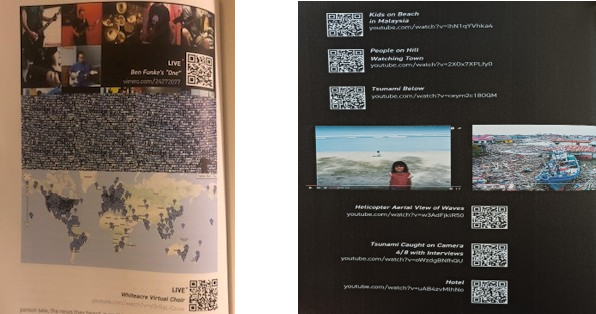
Rather than presenting a continuous storyline, the novel constructs a mosaic of media: maps, taxonomic diagrams, film strips, social-network visualizations, metadata flows, and typographic experiments, each of which reshapes how readers perceive truth and subjectivity. Moreover, Tomasula extends this multimodal logic beyond the printed page through the integration of QR codes that link to songs (Fig.4), documentaries (Fig. 5), and news footage hosted on digital platforms. This gesture situates Ascension within contemporary new media fiction, where narrative unfolds across multiple technological interfaces. As Banash observes, such works require readers to negotiate “multiple media simultaneously,” producing meaning through relational rather than hierarchical engagement (Banash). In doing so, the novel collapses the boundary between reading and viewing, text and context, reinforcing the idea that reality itself is mediated, fragmented, and contingent.
Furthermore, Tomasula’s experiments compel the reader not only to interpret events but also to navigate the material conditions that shape knowledge, memory, and perception. This formal dimension, therefore, cannot be separated from the novel’s narrative concerns; instead, it expands them, generating a deeply intertextual field where meaning arises through juxtaposition, fragmentation, and the active participation of the reader. This plurality echoes Roland Barthes’ description of the text not as a finished object but as a generative process, a “tissue” that is “worked out in a perpetual interweaving,” in which “the subject unmakes himself, like a spider dissolving in the constructive secretions of its web” (Barthes 64).
In Ascension, meaning arises precisely from this perpetual weaving. The reader must assemble fragments across languages, diagrams, numerical displays, and competing narrative voices, becoming part of the textual fabric rather than a passive decoder of a single truth. Tomasula’s typographic and visual experimentation therefore produces pages that are not merely hybrid in form but hybrid in meaning-making: the text does not reveal so much as it continually generates one through the interplay of its materials. In this woven space, subjectivity, whether authorial, narrative, or even the reader’s own, becomes fluid, dissolved into the network of discourses that constitute the novel’s visual and textual texture.
Typography and Visual Narratives
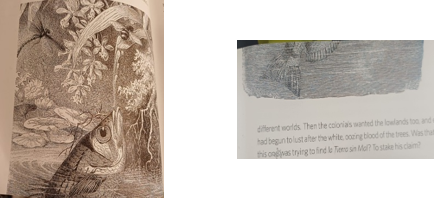
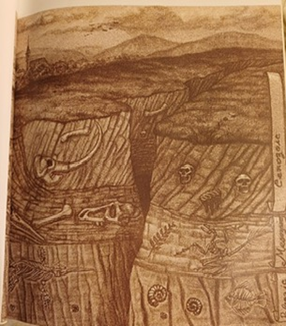
In the early chapters of the novel, the visual materials—geological cross-sections, fossil sequences, and natural-history engravings—create a visual rhetoric that mirrors both the environment’s deep temporal layers and the characters’ changing relationships to the land. The progression of these visuals is not merely decorative; instead, it parallels the novel’s evolving portrayal of knowledge, authority, and belonging. As the images move from rigid, scientific diagrams (Fig. 3) toward more organic, overflowing illustrations (Fig. 6), they reflect the way the characters themselves are pushed from fixed assumptions toward more fluid understandings of evolution and environment. This visual trajectory is especially important in framing the tension between the Professor’s rationalist worldview and Raul’s experiential knowledge of the land. While the Professor initially interprets the environment through diagrams and classificatory grids, the visuals ultimately reveal the insufficiency of his perspective, aligning instead with Raul’s lived awareness of the land’s layered, unpredictable history. The geological cross-section reinforces the Professor’s conviction that nature can be neatly ordered. The bands of color marking different strata, the symmetrical volcanic cone, and the precisely labeled fossils create the illusion of a world that is legible, segmented, and controllable. This is how the Professor views evolution: as a sequence that can be measured, mapped, and explained. The environment in these pages appears stable and comprehensible, echoing his belief that scientific knowledge is objective and universal. Yet, even in this initial visual system, cracks appear. The color bands, though neatly arranged, show disruptions and intrusions resembling volcanic flow receptors serving as visual reminders that the earth does not always obey the tidy categories imposed on it. These disturbances foreshadow the novel’s thematic challenge to the Professor’s worldview. In addition to that, the fossil-layer engraving (Fig. 7) deepens this destabilization. Although the image organizes prehistoric eras into levels labeled “Mesozoic” and “Cenozoic,” the actual textures of the illustration undermine its supposed clarity. The layers appear hand-carved and uneven, with fossils scattered in ways that do not fully match the neat divisions suggested by the labels. The engraving thus introduces an ambiguity that contradicts the Professor’s insistence on scientific linearity. At this stage, Raul’s perspective begins to rise in narrative relevance. The text surrounding this image emphasizes that Raul understands the land not through books but through experience, memory, and inherited knowledge. The visual instability of the fossil layers parallels Raul’s argument that the land contains histories invisible to scientific diagrams, histories shaped by erosion, cultural memory, and human presence. In this way, the visuals begin to shift allegiance away from the Professor’s rigid epistemology toward a more dynamic, relational interpretation of environment and evolution.
By the time the natural-history illustration appears (Fig. 6), the visual tone has shifted dramatically. This image, dense with plants, fish, insects, and hybrid forms (Fig. 6) presents the natural world as abundant, interconnected, and resistant to hierarchical classification. Unlike the earlier diagrams, which strive for order and segmentation, this illustration revels in complexity. Species weave into one another; boundaries blur; the environment appears alive rather than catalogued. This shift parallels Raul’s growing centrality and the novel’s increasing acknowledgment of his understanding. The Professor, who once viewed the environment as something to be decoded, now confronts a land that refuses to fit into his charts. His intellectual confidence begins to erode, just as the visual order of the early diagrams dissolves into the organic movement of the later illustration. Raul’s perspective, which emphasizes coexistence and continuity rather than separation and hierarchy, aligns naturally with these visuals.
Taken together, the progression of visuals traces an arc that mirrors both character development and the novel’s ecological message. The transition from geological charts to overflowing natural-history plates parallels the shift from a Eurocentric, scientific framework to a more holistic environmental consciousness. The Professor’s worldview—once dominant—becomes visually overwhelmed by the complexity of the environment he attempts to categorize. Meanwhile, Raul’s mode of understanding, rooted in experience and in his relationship to the land, emerges as more compatible with the visual logic of the text. The environment itself seems to speak through the illustrations, asserting that evolution is not a ladder but a web, not a rigid sequence but a living process shaped by interactions, disruptions, and transformations. In this way, the visuals do more than accompany the story: they enact its central argument, revealing that the deepest truths of the land cannot be captured by diagrams alone. Instead, they require the kind of relational seeing that Raul embodies—one that recognizes the land as a dynamic, evolving presence rather than a static object of study.
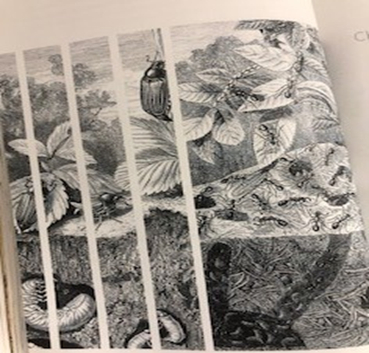
While “Transformation” relies on fluid metaphoric imagery to express how identity dissolves and reforms across bodily and perceptual thresholds, “Little Truth” shifts fluidity to fracture, using segments and diagrammatic visuals to illustrate not the continuity of becoming, but the fragmentation of knowledge itself. The visual rhetoric embedded in “Little Truth” performs a critical function in articulating the novel’s epistemological concerns. The illustration of the segmented forest floor appears early in the section (Fig. 8) and serves as a central metaphor for the narrative’s proposition that “truth” is never total but inherently fractured. Its partitioned structure resembles film strips, evoking Arthur’s work as a documentary filmmaker whose footage repeatedly glitches, stutters, and fails to present a coherent account of the world (Fig. 8). By rendering the forest not as a continuous ecosphere but as a set of dissected visual units, the illustration mirrors the logic of cinematic editing jump cuts, broken reels, apertures and thus makes visible the instability that permeates Arthur’s attempts at documentation. For Jane, the entomologist, the segmented diagram resonates differently: it echoes the scientific sampling practices central to her ecological work, in which the forest is encountered through discrete observational slice soil cores, transects, and magnified specimens (Fig. 8). Yet, this segmentation also marks her growing anxiety that ecological signs are becoming unreadable, distorted by environmental disruption and urban encroachment:
Now that the forest was supposed to be protected, someone in government had gotten the idea to turn it into an eco-tourism destination, but construction of its resort had been abandoned. Still, she could see that there was government money involved, so maybe. It would happen, yet the forest and waterfall linked by air spin over roulette wheel (Tomasula 100).
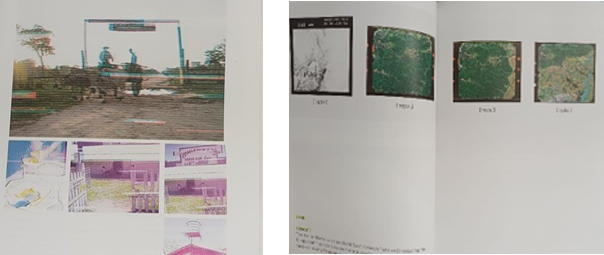
The image’s subtle visual glitches, with irregular color bands (Fig. 9), reinforce this sense of ecological disarray. Furthermore, the diagram’s resemblance to urban mapping systems (Fig. 10) with its branching lines and zoned partitions, underscores the text’s commentary on urban fragmentation, suggesting that natural landscapes are increasingly overwritten by infrastructural grids. Thus, the segmented forest floor stands not simply as an illustration but as a visual argument: in “Little Truth,” truth emerges only through partial, unstable, and fractured representations, and the world itself appears as a composite of broken frames rather than a continuous field.
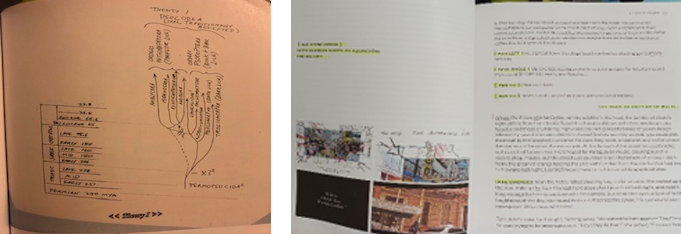
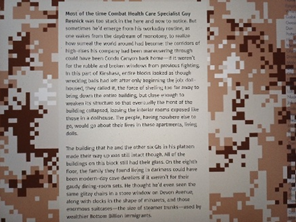
Lastly, the chapter tracing Jane’s meditations on performance and selfhood merges fragmented prose with schematic drawings of feathered dinosaurs (Fig. 11) visual timelines purporting to map evolutionary truth (Fig. 12) and numbers scattered across the page like traces of scientific notation (Fig. 13). These elements do not illustrate the prose so much as interrogate it, revealing how claims to truth, whether scientific, historical, or autobiographical, are always constructed through framing devices. The reader must literally move their eyes across competing semiotic systems, making interpretive decisions that echo Jane’s own struggle to locate meaning within shifting surfaces. Moreover, the novel extends this visual destabilization through the perspective of Guy Resnick (Fig. 14), whose descriptions of urban destruction: buildings “doll-housed” by shelling, interiors sliced open like cross-sections, transform the city into a fractured diagram of vulnerability “One awake from the daydream of monotony to realize how surreal the world around had become […] In this part of Kinshasa, entire blocks looked as though wrecking balls had left after only beginning the job: doll-housed” (Tomasula). His vision aligns directly with the novel’s material form: the exposed, cutaway structures he observes echo the text’s own fragmented pages, collaged images, and interrupted layouts. In this sense, Resnick’s perception becomes a model for the readers, both navigating surfaces that refuse wholeness or transparency.
Reading as Labor: Interpretation, Recursion, and Meaning-Making
Intertextuality as a Structure, not an Ornament
Intertextuality in Ascension operates not as ornament but as a structuring principle that actively shapes the reader’s interpretive labor. Rather than passively decoding references, the reader must actively navigate a cognitive and spatial architecture in which meaning is dispersed across literary, visual, scientific, and conceptual registers. References to Melville, Dante, Bosch, biblical cosmology, and evolutionary treatises do not function as simple allusions; they operate as visual analogues embedded in the page as well as conceptual frameworks that organize how meaning is produced and apprehended.
For instance, in “Transformation,” the intertextual dialogue with Moby-Dick illustrates this demand for interpretive work. The figure of Ahab is not only invoked but reactivated as a critical framework through which Western epistemologies of mastery and domination are interrogated. The reader must recognize that Ahab’s obsessive drive to conquer the whale is not merely a narrative reference but a conceptual lens that structures the novel’s critique and philosophical systems of control. As Tomasula writes, “We are in Nature, not apart from Nature, and so live within an all-powerful unity of life” (Tomasula 53). This tension becomes embodied in the figure of Ahab, whose obsessive drive to dominate the whale exposes the violence inherent in attempts to control Nature. This contraction mirrors Ahab’s inability to perceive the whale as anything other than an enemy or a symbol to be subdued. The connection is explicitly foregrounded when the narrator asks, “What animal […], if we were to use ‘who’ for it?” (Tomasula 54) reframing human mastery as a delusion inherited from Ahab’s legacy. In Tomasula’s hands, Ahab becomes a shorthand for the ideological trap the Professor cannot escape. Ahab stands for a worldview that insists on hierarchy: man, above animal, culture above nature, reason above instinct. The Professor arrives in the forest carrying this inheritance. His scientific authority, his belief in ideal conceptions, and his attempt to classify the rainforest reproduce the same impulse that made Ahab pursue the whale. However, the Professor cannot survive the forest because, like Ahab, he cannot relinquish the fantasies of mastery that structure his identity. Yet, Tomasula’s rewriting of Ahab does more than criticize the Professor’s epistemology, it also sets up a structural comparison with Raul. If the Professor mirrors Ahab, Raul stands outside of this lineage. His “mestizo” (Tomasula 11) identity places him in a different cosmology, one in which humans and nature are not adversaries but interwoven. Where the Professor inherits Ahab’s fixation with naming, ordering, and dominating, Raul embodies a relational mode of being that does not require mastery to understand the world. The intertextual reference to Moby-Dick thus accentuates their divergence: the Professor is destroyed by the Ahab-like insistence on conquering the unknown, while Raul dissolves into the forest precisely because he does not oppose it.
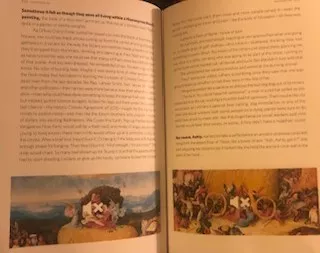
Tomasula also constructs a profoundly intertextual environment in which cultural memory is continually reframed. The invocation of Ahab in Jane’s declaration “Call me Ahab” establishes not simply a literary parallel but a critique of the masculine heroics embedded in Western epistemology. Her allusion to Melville is matched by the novel’s quieter references to Tennyson’s “Flower in the Crannied Wall” (Tomasula 137), which together offer a meditation on endurance. On the one hand, these literary references situate Jane within a literary lineage that has historically dominated by male voices. On the other hand, her reappropriation of these narratives undermines their authority by reworking them from a fragmented perspective shaped by scientific and her position as a woman. Her relationship to language is neither submissive nor purely resistant; rather, it situates identity within a network of patriarchal stories she both inherits and transforms. Furthermore, the novel’s visual intertexts expand this cultural network beyond literature into the history of art. The Bosch imagery reproduced in the last chapter (Fig. 15), that depicts grotesque hybrid beings amid a chaos of torment and metamorphosis, functions as a visual analogue to the novel’s concerns with evolution, fragmentation, and human—nonhuman entanglement. These creatures echo the monstrous hybridity of contemporary identity itself, neither wholly organic nor wholly artificial. Their placement at the bottom of the page positions them as a subterranean layer of meaning, a visual unconscious underpinning the more legible narrative above. Thus, the reader must negotiate multiple semiotic registers simultaneously: textual narrative, visual art history, scientific diagrams, and digital cartographies. Identity becomes not a stable category but, as Mary K. Holland observes of contemporary post-postmodern fiction, a recursive process in which subjectivity is continually rewritten by its media environments.
In addition, the novel’s use of visual documents such as maps, metadata diagrams, screens, film stills, and pseudo-scientific infographics invites the reader to question the authority of documentary forms (Fig. 11); featuring the cellphone metadata map alongside the mass-shootings heatmap operates as a pivotal moment in this regard. Their juxtaposition creates not only a visual shock but also an interpretive crisis as the two images demand to be read together even though they originate from different contexts and scale different orders of catastrophe “Your Privacy Is Our Business. (It really is!) Just as her Fitbit used patterns of rest of wrist movement to determine whether she was on an elevator, sleeping, eating or driving over the speed limit” (Tomasula 170). This pairing reveals the extent to which modern systems reduce human lives to patterns, clusters, and datapoints. At the same time, the reader is compelled to oscillate between the cold abstraction of the images and the emotional weight of the narratives surrounding them, thereby experiencing firsthand the tension between statistical representation and human suffering.
Furthermore, Tomasula extends this destabilizing effect by integrating the reader’s physical manipulation of the book into narrative logic. The unusual layouts require turning the book, scanning pages diagonally, or flipping back and forth to reconstruct fragmented sequences. This destabilizing effect extends beyond the printed page through Ascension’s incorporation of digital media. The novel’s third section and its digital version integrate QR codes that direct readers to YouTube videos thereby dissolving the boundary between the codex and networked culture. On the one hand, these links expand the narrative field, situating the text within real-time media ecologies; on the other, they expose the instability of authority in an age of algorithmic circulation. Ascension prompts readers to transcend the codex to pursue reading, thus implicating them in the same systems of mediation that shape the characters’ realities.
Ascension ultimately situates meaning not solely within its characters or its media apparatus but within the labor of reading itself. The novel’s experimental typography, visual disruptions, and multimodal layering actively resist linear consumption, compelling the reader to return to the text repeatedly to decipher its signs. As Johanna Drucker notes, “the presence of experimental typography within modern art practice is not incidental, but symptomatic of the tenor of the bulk of experiments of the period,” (Drucker 247) a claim that resonates directly with Tomasula’s formal strategy. Typography in Ascension does not merely decorate meaning; it conditions perception, directing attention, interrupting narrative flow, and forcing interpretive recalibration. Accordingly, reading becomes a recursive process rather than strictly cumulative process, in which meaning is not simply accumulated linearly but continually reconfigured through return, cross-referencing, and re-reading. I found myself reading and rereading the book, not because meaning was obscure, but because it was distributed—across pages, images, data visualizations, and media references that only cohere retrospectively. This repeated engagement foregrounds the instability of interpretation itself, as understanding emerges through temporal return rather than immediate comprehension. The act of rereading thus mirrors the novel’s broader meditation on identity as a process continually rewritten by technological, ecological, and cultural forces. Moreover, the digital extension of Ascension intensifies this readerly responsibility. QR codes linking to songs, documentaries, and news footage fracture narrative authority across platforms, transforming reading into a transmedial experience that resists closure. Meaning unfolds through juxtaposition rather than synthesis, requiring the reader to negotiate between textual, visual, and auditory registers. In this sense, Ascension positions the reader not as a passive recipient but as a co-producer of meaning, whose perceptual effort completes the work’s polyphonic design.
Ultimately, through its entangled exploration of evolution, form, and perception, Ascension redefines identity and reality as unstable, negotiated processes. Tomasula demonstrates that neither scientific discourse, narrative authority, nor technological mediation can fully stabilize meaning. Instead, identity emerges through competing epistemologies, reality through multimodal assemblage, and meaning through readerly labor. By implicating the reader within its polyphonic design, Ascension ultimately transforms the act of reading into an ethical and epistemological practice, one that mirrors the fragile, contingent world the novel seeks to understand.
Works Cited
Banash, David, ed. Steve Tomasula. The Art and Science of New Media Fiction. Bloomsbury, 2015.
Barthes, Roland. S/Z: An Essay. Éditions du Seuil, 1970. Translated by Richard Miller, Hill and Wang, 1975.
—. Le Plaisir du texte. Éditions du Seuil, 1973. Translated by Richard Miller, Hilland Wang, 1975.
Bhabha, Homi k., The Location of Culture. Routledge, 1994.
Drucker, Johanna, The Visible Word Experimental Typography and Modern Art, 1909-1923. University of Chicago Press, 1994.
Holland, Mary K. Succeeding Postmodernism: Language and humanism in Contemporary American Literature, Bloomsbury, 2013.
Melville, Herman. Moby-Dick. Edited by Harrison Hayford and Hershel Parker, A Norton Critical Edition, W.W. Norton & Company, 2002, ch. 104, p. 349.
Tomasula, Steve. Ascension. University of Alabama Press, 2022.
—. TOC: A New Media Novel, Tuscaloosa-Alabama, University of Alabama Press, 2009.
Websites
Drucker, Johanna. https://www.stevetomasula.com/ascension
Pactor, Marcus. “The Posthuman and Realist: An Interview with Steve Tomasula.” Heavy Feather Review, Oct. 14, 2022, Heavyfeatherreview.org. Accessed 15 May 2025.
NOTES
I- In 1965, the English novelist, J.G Ballard, was asked to explain his guiding principles for selecting new work. He replied that he was looking for work that would somehow engage the unprecedented changes in human perceptions and experiences of everyday life that science was inevitably producing.
Cite this article
Saidi, Salma. "Beyond the Page: Exploring Identity and Reality in the world of Steve Tomasula's Ascension" electronic book review, 30 June 2026, https://doi.org/10.64773/ac3d-g6r9